

Tuesday June 09, 2026
The Outdoor Action Climbing Program at Princeton University
Since 1974 Outdoor Action—the University’s outdoor education program—has become a unique resource at Princeton for thousands of students. For many students, Outdoor Action is their first experience living in the outdoors, and many come away from a trip with a new respect not only for the wilderness but also for the environment as a whole. Students learn confidence and self-reliance by completing challenging activities with the support of the group. We accomplish this special personal growth experience through small-group wilderness trips where students become a community—self-reliant yet interdependent. We stress values of communication, respect for others, and service. This learning process is facilitated by other students—OA leaders who have been trained in outdoor skills, first aid and safety, and group dynamics. These leaders find that leading and teaching one’s peers is one of the most important parts of their experience at Princeton.
The OA Climbing Program
- OA Climbing Page
- Hanging Out - Princeton Alumni Weekly, November 8, 2000
- History of the OA Climbing Wall
- The Joe Palmer '84 Memorial - help support OA's Clmbing Program.
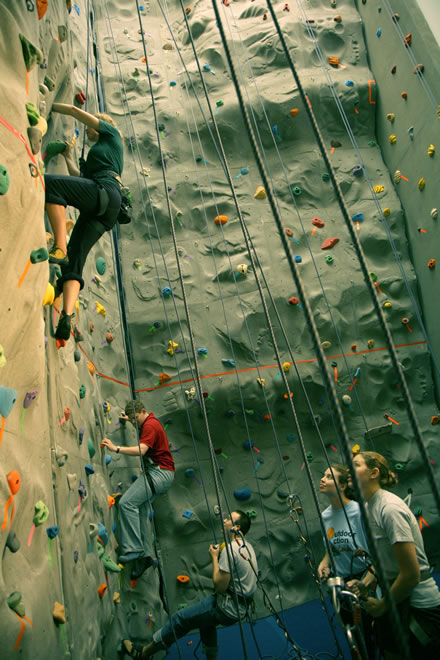
The Climbing Wall has been integral part of Outdoor Action’s on-campus programming for more than twenty-five years. Each year hundreds of students climb at the OA Climbing Wall and climbing becomes an important part of the Princeton experience for many of these students. OA climbers regularly climb at the Gunks and have gone on to climb in such places as Red Rocks, Yosemite, Smith Rocks, as well as mountaineering expeditions to Denali, the Andes, and the Himalayas.
In 1982 Outdoor Action recognized the need for permanent climbing wall as a gathering space for climbers and as site for teaching rock climbing skills. In the spring of 1983 over forty students, graduate students and staff built the first climbing wall out of wood in an empty corner of the Armory near the stadium. Outdoor Action was one of the first universities to build an indoor climbing wall. The Wall, as it is affectionately known, has seen three renovations since 1983. In 1989 well-known Gunks climber Mike Freeman, who was working in the Engineering School, designed and built an overhanging arête that significantly expanded the Wall. In 1997 a group of seniors redesigned one of the original sections. Then in the spring of 2000 two graduate students built a bouldering cave.
The success of the climbing program at Princeton is largely due to the Climbing Wall. It serves as the gathering place for climbers of all ability levels and for many students has been their introduction to a life-long love of the sport of climbing. Outdoor Action teaches both a Beginner’s Rock Climbing course and a Top Rope Climbing Systems Course at the Wall as well as offering weekend trips to local climbing areas.
By far the most important aspect of the climbing program is open hours at the Wall. The Wall is open five days a week and is the magnet that brings together men and women, new climbers and old, undergraduates, graduate students, and professors. Part of what makes the Climbing Wall such a wonderful place is the sense of community. Whether it is teaching a new climber to belay or encouraging someone working out a challenging route, the Wall is the physical symbol of a supportive community.
Anyone who has been a climber knows that it is more than simply a recreational sport. Climbing is an activity that develops focus, concentration, self-esteem, and the understanding of accomplishing a difficult feat. The Climbing Wall has also become an important part of our Community Service program where urban youth discover how to overcome challenging situations with climbing as the educational metaphor. Here is one story from that illustrates just how powerful the climbing experience can be.
Ayla was a ten-year old girl from downtown Trenton participating in an OA community service program that came to climb at the Wall one Saturday. She started up and was able to get only a foot off the ground. She couldn’t find any footholds. Her arms started to shake and she was terrified that she was going to fall. She said that she had to be lowered down. She tried again, got a foot off the ground, and froze again. She tried one more time, then almost sobbing, asked to be lowered down. Ayla sat down on the bench and watched her younger sister climb all the way to the top. After her sister Kali climbed the first few feet Ayla started cheering her sister on. A little later she came back up, and in a quiet voice asked if she could try again. I said of course and got her into her harness. This time I set up a reachable goal for her at the beginning, not to get to the top, but to try to do three moves. She got to three and froze. I lowered her down and encouraged her to go for four moves. She made it. Then she made six moves. All the while people cheered her on. She stopped at six moves (five feet off the ground) and said that was as high as she wanted to go. Afterwards I asked her what it was like. She said, "I was really scared." I asked her if there was anytime she felt that way at school. She said, "Yes, in math class." I asked her, "How is climbing the wall like math class?" She said, "Well, I learned that when I am really scared of something, I should just try really hard and I can do it." |
A New Wall for Princeton
After more than twenty-five years it is impossible to imagine Princeton without a Climbing Wall. It has been our goal for a number of years to improve the quality and the size of our facility to accommodate the increasing number of climbers, to expand our ability to teach climbing, and to expand our community service and outreach programs. With the demolition of the Armory in the summer of 2007, the home of the OA Climbing Wall since 1983, Princeton built a new Climbing Wall in the Princeton Stadium which opened October 11, 2007. You can see photos of the new Wall at the OA Climbing Web page.
Fund Raising Goals
The initial plan for building the new Climbing Wall included a separate Bouldering Area. Our goal is to raise an additional $100,000 to complete this second stage of construction. Ts. The total funds required are outlined below.
Stage 1 – Develop an Endowment for the Climbing Program |
Annual Funding |
Endowment |
| Funds Needed | $30,000 | $500,000 |
Here is what a few Princeton climbers have to say about the OA Climbing Wall.
Even though I began climbing before I arrived at Princeton, it wasn´t until I became part of the Princeton OA climbing community that my true climbing career began. I grew up in Dutchess County, New York, a rock´s throw away from the ´Gunks, and in high school, I spent every Sunday in New Paltz—but only to play my trombone in an orchestra that rehearsed in the SUNY New Paltz auditorium. A few years later, I moved into New York City with my mom and began working as a counselor at the Chelsea Piers summer camp. I would spend my free hours at the huge 50-foot high overhanging climbing wall—but only to top rope the shorter, juggy routes on the periphery while I watched the pros dangling upside-down from the roof above me. Despite the trepidation I felt surrounded by so many strong courageous climbers, I grew to love climbing the summer before my freshman year of college. But by the end of that summer, I became apprehensive about heading off to Princeton because I convinced myself that no one there climbed. Within the first month of my arrival at Princeton, I made a special trip home to buy new shoes, a harness and a chalk bag. I had found the Princeton OA climbing wall and happy students crawling all over it. By my sophomore year, I think I was leading the race in who filled their OA sign-in card the most. I met so many great people at the climbing wall who became my mentors as well as my close friends. Thanks to them, I learned to lead climb, and with them, I began to explore new climbing areas beyond New Jersey and New York. I have taken the skills that I learned at the OA climbing wall cross-country and across the world. I am currently studying in Santiago, Chile, and thanks to climbing, I have been able to make Chilean friends with whom I visit the beautiful mountains and canyons that surround the city. The climbers that I met at Princeton have helped me develop the skills, enthusiasm and motivation to climb, travel and meet new people everywhere in the world. The OA climbing wall made this possible for me; it provided a place where people could meet to climb together, to learn, to teach, to share stories and to have fun. A new climbing gym will be an attraction to many more people who, I hope, will not only be able to partake, but also to contribute to all that the OA climbing community has to offer. In turn, the new climbing gym will give more people the opportunity and ability to explore beyond its walls, and these same people will return again, with their stories and photos, to enrich and inspire further the OA climbing community. - Naomi Haverlick ’01 My first day at the wall I met Professor John Gager, a graduate student, Rob Townley, and an undergrad, Gillian Ashenfelter. They were ‘regulars’ at the wall and all three, Senior Professor of Religion, third year graduate student, and Junior, joked with one another paying no attention to the fact that they were one of the more unlikely of groupings. Were these three here to climb, I wondered, or was this some strange sort of post-work happy hour? I’ve discovered over the past three years that the climbing wall is a place for both. It’s a place for serious training—many hard moves outside on the cliffs are mastered first inside on the plastic holds. But it’s also a place where anyone, beginners or advanced, undergraduates, grad students, professors and staff, is welcome to come, unwind and meet people from the Princeton community they otherwise would not have a chance to meet. It is perhaps the most diverse—and relaxed—community at the University. And it is a community that has made my life at Princeton incredibly rewarding. The Princeton Armory will soon be torn down, and with it so will go our old and dusty, but much loved climbing wall. Though the old wall will be much missed, the chance to build a new, accessible and safer wall is a tremendous opportunity for the Princeton community and for Outdoor Action. Every year the climbing community grows—RA groups, athletic teams, and student volunteer organizations use the wall and its Outdoor Action facilitators to learn and improve group skills. Beyond Nassau, inner city youth from Trenton and New York climb at the wall as a component of Princeton-based experiential learning programs. And the Monday through Friday crowd steadily grows. In the past we have met this increasing demand by adding – both to the structure of the original wall and to the hours of operation. These have been stopgap measures. Today, however, with the Armory coming down, we would like to attempt something bolder—to build a first-class climbing facility capable of meeting the Princeton community’s demands for many years to come. - Eric M. McGlinchey *03 Politics |