KEY IDEAS AND TECHNICAL CHALLENGES
ARCHITECTURAL ISSUES IN BROADBAND ACCESS
Traditionally, DSL broadband access networks have been
analyzed by viewing each twisted pair as a separate communication
channel, independent of other twisted pairs in the same
binder cable, with a fixed pipesize supporting circuit-switched
voice traffic. The key to realizing the vision of ubiquitous,
readily deployable, and truly broadband access networks is
to dynamically optimize the resources in the dimensions of
Frequency, Amplitude, Space, and Time, in the multiple-inputmultiple-
output communication environment of DSL across
multiple layers in the protocol stack.
Therefore, there are two shifts of mentality that underlines
the wide range of activities in FAST Copper:
The first key idea is that, instead of holding the traditional
view that each twisted pair is an independent channel, we
model a bundled cable of twisted pairs as one aggregate
multi-user communication system. Multiple users compete
against and cooperate with each other in this system.
We can explicitly take into account the crosstalk effects
(both near-end and far-end) that currently form the data
rate bottleneck, and to exploit potential cooperation in
sharing limited resources
The second key idea is that today’s traffic over broadband
access, including voice, data, and video, are predominately
supported by packet switched IP. We can exploit
the burstiness of the application traffic through aggressive
statistical multiplexing, with admission control, traffic
shaping, scheduling, and priority queuing mechanisms
to ensure the desired tradeoff between the number of
application flows supported and the Quality of Service
(QoS) attainable.
There are two major bottlenecks to DSL broadband access
today: attenuation and crosstalk. We will see solutions from
the “Space” dimension of the project to tackle the problem of
attenuation, and solutions from the “Frequency”, “Amplitude”,
and “Time” dimensions to tackle the problem of crosstalk.
Note that we have not even brought in factors such as wider
bandwidth and multiple twisted-pairs.
A. Functionality Allocation
Increasing data rate by 10 times (or more) over twistedpair
already presents tremendous technical challenges. We
need to significantly improve both the digital signal processing algorithms in the physical layer and the architecture/protocol
design methodologies in the “upper” layers. Even more challenging
is the need to carefully investigate the coupling effects
across multiple modules and across network elements, so
that end-user experience over broadband access networks
is enhanced. Indeed, one of the most important aspect of
FAST Copper, or any broadband access network design, is
on the access network architecture. Following the notion of
“architecture first”, we open the technical discussion on architectural choices.
Architecture here refers to functionality allocation: which
functional module and network element does what, and how to
connect them. Functionality allocation is often more influential,
harder to change, and less quantitatively understood than
any specific resource allocation scheme. Metrics of measuring
the pros and cons of designs of functionality allocation often
remain fuzzy today, and are drawn from a combination of performance
metrics, cost and complexity metrics, and Network
X-ities (e.g., evolvability, scalability, manageability, diagnosability,
optimizability) metrics. Recent results in “Layering
as Optimization Decomposition” have offered a useful
framework for layered network architecture.
There are unique challenges in architectural issues in broadband
access networks, as elaborated below.
B. Horizontal and Vertical Decompositions
There are two types of functionality allocations:
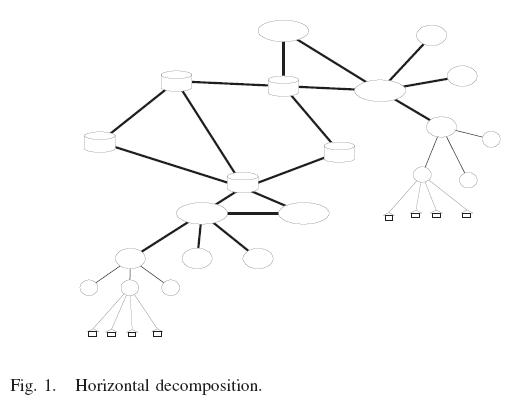
First, we use the term “horizontal decomposition” to
refer to the geographic distribution of control into various
network elements, e.g., in Figure 1, from households to
remote terminals and central offices (represented by circles),
to larger central offices (represented by ovals), and
to backbone acquisition, distribution, and video servers
(represented by cylinders).
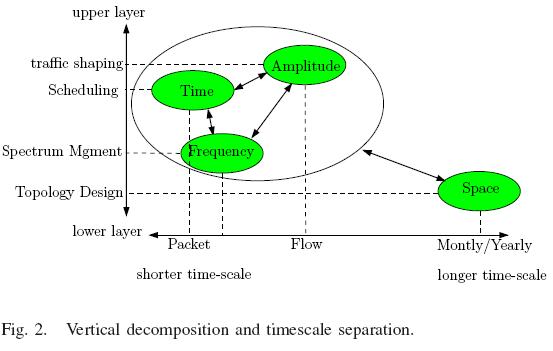
Second, we use the term “vertical decomposition” to refer
to the modularized design into a protocol stack. Ideally
for performance optimization, a fully integrated and joint
design would be best. However, for many reasons such
as evolvability and manageability, modularized design is
necessary.
Horizontally and vertically decomposable modules has a
variety of coupling relationships, depending on their timescales
and target service models. As an example of such couplings,
consider the functionality of error control and recovery.
We can choose from the following: hop-by-hop forward
error correction or feedback based Automatic Repeat reQuest,
or end-to-end connectionless resilient-UDP or connectionoriented
TCP, or coding over packets at the application level.
Which combination to choose from involves both vertical
decomposition (e.g., physical layer or application layer) and
horizontal decomposition (e.g., hop-by-hop or end-to-end).
In the horizontal decomposition, the problem of where to
place video servers involves the tradeoff between response
time and scalability, closer to the customers, faster the response
but lower the scalability. Similarly, the problem of
where to place distribution servers defines the boundaries of
multicast groups. An even larger issue is on “how big should
the access networks be”. The answer depends on the tradeoff
among a variety of factors, from reliability of access tree and
feasibility of big switches to complexity of backbone network
and ease of network management.
In the vertical decomposition, the four dimensions of F, A,
S, and T are all coupled, sometimes in unexpected ways. As
a thought experiment in the extreme, we can think of each
of these dimensions as capable of tackling crosstalk: through
spatial division multiplexing, time division multiplexing, frequency
division multiplexing, and rejection of all flows that
would transmit at the same time. Obviously, these are extreme
measures, and tradeoffs are necessary in any design. But
they do highlight the fact that these four dimensions are not
uncorrelated degrees of freedom.