Multimedia: Featured
Video: Behind the Candela exhibit
Posted February 12, 2009; 11:52 a.m.
To view the multimedia features on this page, you will need to download the latest version of Flash Player and/or enable JavaScript.
Engineering assistant professor Maria Garlock describes how Princeton students helped research and build models for an exhibition on architect Félix Candela. Read more.
Video Closed Captions
(music)
Maria Garlock:
"Beautiful engineering" is not an oxymoron,
Maria Garlock:
and what we are trying to teach is along the lines of what David Billington has been teaching for decades.
Maria Garlock:
And that is the idea that there are these best examples of structural
Maria Garlock:
engineering, which are... the best examples are works of art themselves. Bridges, for example,
Maria Garlock:
are pure engineering forms. And these vaulted structures of
Maria Garlock:
Felix Candela's are also pure engineering forms.
Maria Garlock:
And so, what we are trying to illustrate or what we are trying to
Maria Garlock:
teach is this idea of engineering ...
Maria Garlock:
that the best examples of engineering are actually works of art. Felix Candela's structures are pure
Maria Garlock:
structures in the sense that the roof and the walls are all
Maria Garlock:
integrated into one, and it is a pure structural form
Maria Garlock:
based on a very rational engineering basis.
Maria Garlock:
Although Felix Candela was trained as an architect and had an
Maria Garlock:
architecture degree, we say that he was a self-taught
Maria Garlock:
engineer because he had a strong interest and talent in engineering
Maria Garlock:
analysis and in mathematics. When you see the exhibit or you
Maria Garlock:
study his works, you see all of his structures are
Maria Garlock:
all very different in terms of the forms.
Maria Garlock:
[But] they are all based on the hyperbolic
Maria Garlock:
paraboloid geometric form, and they are all only one and a half inches
Maria Garlock:
thick. Candela liked to express that thinness. So when you take a look at his
Maria Garlock:
structures, you visit them or you see them in photographs,
Maria Garlock:
it's very clear how thin these structures are.
Maria Garlock:
It's actually quite striking. If you go to visit them,
Maria Garlock:
and I've seen this, you can go right up to the edge of
Maria Garlock:
that structure and take a ruler and you can measure how thin that these structures
Maria Garlock:
really are. He was able to arrive at this
Maria Garlock:
economy of construction through the geometric shape of the hyperbolic
Maria Garlock:
paraboloid, because a hyperbolic paraboloid --
Maria Garlock:
although curved in two directions like a saddle -- can be formed with
Maria Garlock:
straight lines. And that leads to economy of
Maria Garlock:
construction through straight-line boards instead of curved forms,
Maria Garlock:
which are very expensive in construction.
David Billington:
These things were built economically,
David Billington:
and that is why we are at great pains to show the scaffolding on
David Billington:
which they were built because that is an important part of the exhibition. He was a builder,
David Billington:
and he always considered himself a builder, but he was also a designer.
David Billington:
And because he had a strong aesthetic motivation, he was a structural artist.
Maria Garlock:
The criteria for structural art --
Maria Garlock:
this phrase coined by David Billington -- is that it has to be
Maria Garlock:
efficient in the sense that it minimizes materials but is still
Maria Garlock:
able to carry the forces that it is intended to carry but still being
Maria Garlock:
very safe. It has to be economical by
Maria Garlock:
minimizing the cost -- the cost associated not only with the
Maria Garlock:
building and the construction but also we're talking about long-term
Maria Garlock:
durability. So, when you combine efficiency and
Maria Garlock:
economy, we're talking about a sustainable structure.
Maria Garlock:
And it also has to be elegant. So, what we are showing through
Maria Garlock:
these works of Candela is that he meets these three criteria.
Maria Garlock:
In 1950, Candela did not have the computers or software that would be
Maria Garlock:
available for us today to analyze these structures.
Maria Garlock:
How did the forces on these structures flow to the foundations?
Maria Garlock:
Candela made some assumptions in his analyses,
Maria Garlock:
and what we did was we used the most sophisticated computers and the
Maria Garlock:
most sophisticated software to make these analyses to essentially
Maria Garlock:
confirm what he had assumed in the 1950s.
Maria Garlock:
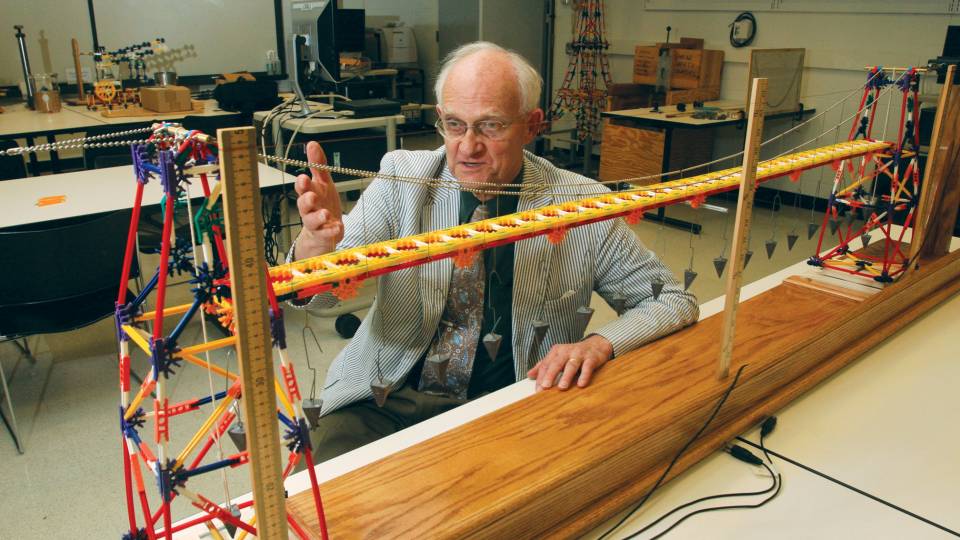
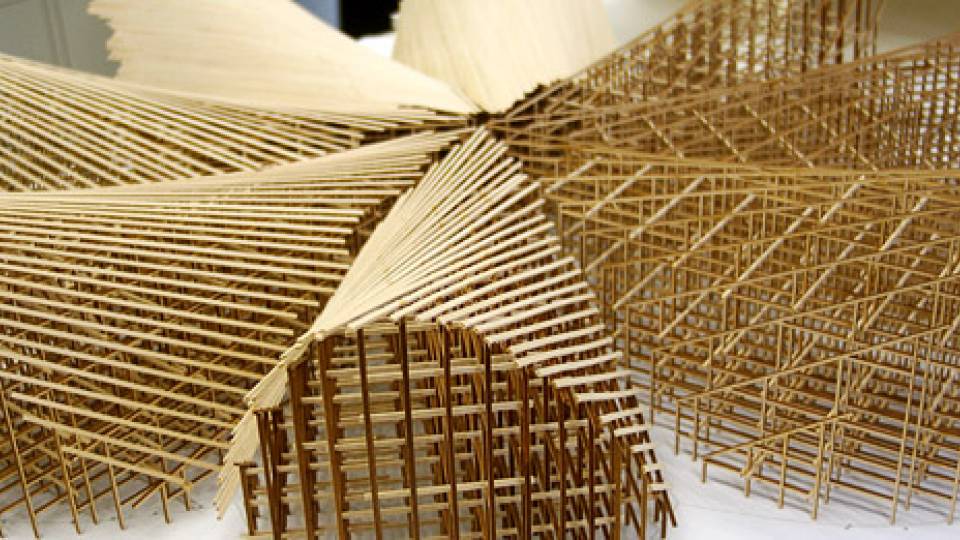
The exhibit consists of structural models, so smaller-scale,
Maria Garlock:
obviously, models of his works. And we had 19 students involved in
Maria Garlock:
the building of these models. And actually the students were very
Maria Garlock:
much an integral part of the entire project,
Maria Garlock:
not only in the model building, but also the research that went into
Maria Garlock:
this. Because the time that this project began, in 2005, there was still a lot of research
Maria Garlock:
that needed to be done on Candela himself.
Maria Garlock:
We needed to write a book, and we needed to do the research.
Maria Garlock:
So we had students write master's theses, a Ph.D. theses, student projects,
Maria Garlock:
conference papers, and if you look at the book it will
Maria Garlock:
say: "This chapter was written by Edward Segal and the co-authors," for example.
Maria Garlock:
So, we had the students help us to put together the book,
Maria Garlock:
even, and write some of these chapters with us.
Maria Garlock:
So, it was very much an educational project from the very beginning.
Maria Garlock:
So, the education aspect of this exhibition isn't just the exhibition.
Maria Garlock:
The process, the whole development of the project, was an educational process as well.