Multimedia: Featured
Video: Princeton's green roofs
Posted August 12, 2009; 03:49 p.m.
To view the multimedia features on this page, you will need to download the latest version of Flash Player and/or enable JavaScript.
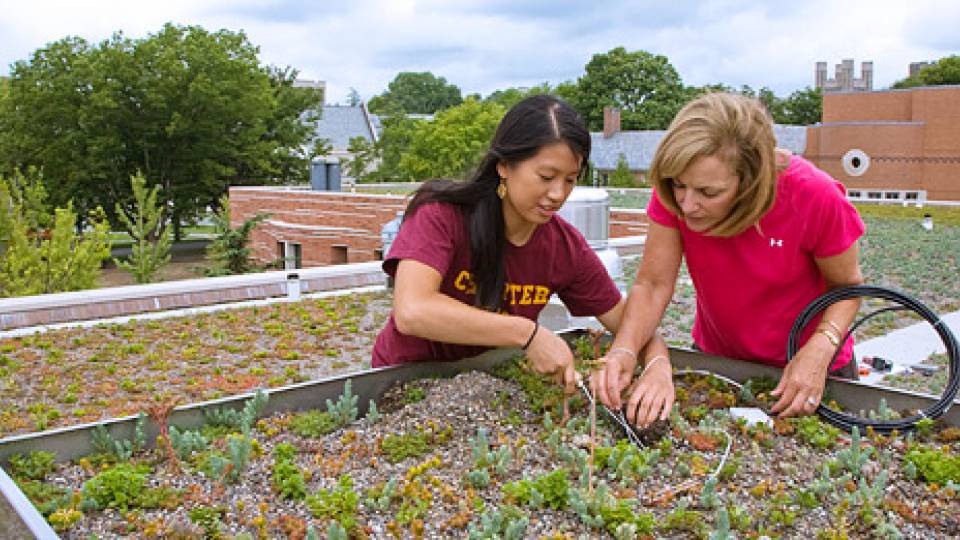
Faculty, students and staff involved in a monitoring project are measuring the effectiveness of sustainability efforts on the newly installed Butler College green roof. Read more.
Video Closed Captions
(music)
Shana Weber:
Whenever you change anything in a system, it's really important
Shana Weber:
to get information about the condition of the system before
Shana Weber:
you changed it.
Shana Weber:
Dr. Eileen Zerba in the Princeton Environmental Institute has been
Shana Weber:
initiating a green roof study on one of our renovated residential
Shana Weber:
colleges. And, um, what's really neat
Shana Weber:
about that is that it took collaboration between academic
Shana Weber:
programs, curriculum, staff in the
Shana Weber:
facilities department and students to make this happen.
Shana Weber:
What we're going to get out of it is live information about the
Shana Weber:
performance of this green roof.
Shana Weber:
And it's set up so that some of the rooftops are green roofs,
Shana Weber:
some are not, and we'll compare between the two.
Eileen Zerba:
So, Butler College, one thing to put this in
Eileen Zerba:
perspective, is uphill from Carnegie Lake,
Eileen Zerba:
and a part of the sustainability initiative is to decrease the
Eileen Zerba:
flow into Carnegie Lake with sustainable practices like green
Eileen Zerba:
roofs or stream water restorations.
Eileen Zerba:
What I have in front of me now are two mock-ups of the green
Eileen Zerba:
roof. So what we want to know in the
Eileen Zerba:
mock-up model is to look at -- a five-by-five square is what
Eileen Zerba:
this is -- and the proportion of water
Eileen Zerba:
that is retained within the roof layers, the soil medium, in
Eileen Zerba:
comparison to a conventional roof.
Eileen Zerba:
So, the thermal advantage of a green roof has to do with the
Eileen Zerba:
surface itself. So, you have evaporation and
Eileen Zerba:
you have transpiration from the plants.
Eileen Zerba:
Plants have small holes in their leaves.
Eileen Zerba:
That's how they take on CO2.
Eileen Zerba:
They're called "stomata."
Eileen Zerba:
When those open, they evaporate water,
Eileen Zerba:
and that serves to cool the surface of the roof.
Eileen Zerba:
A conventional roof -- you can see the smaller layers -- these
Eileen Zerba:
temperatures can get 20 to 40 percent higher than the green
Eileen Zerba:
roof temperatures.
Eileen Zerba:
We've already got the data monitoring online, and we've seen
Eileen Zerba:
that just this summer.
Eileen Zerba:
The advantages of having this is not only to get empirical
Eileen Zerba:
values, we can mathematically model
Eileen Zerba:
this roof, and I think that will have a
Eileen Zerba:
lot of utility in terms of feeding the information back to
Eileen Zerba:
the University and retrofitting other buildings on campus.
Shana Weber:
We've all renewed our commitment to achieving results
Shana Weber:
that can be repeated elsewhere.
(music)