Web Stories
Video: Creative writing professor Chang-rae Lee
Posted April 26, 2010; 11:55 a.m.
To view the multimedia features on this page, you will need to download the latest version of Flash Player and/or enable JavaScript.
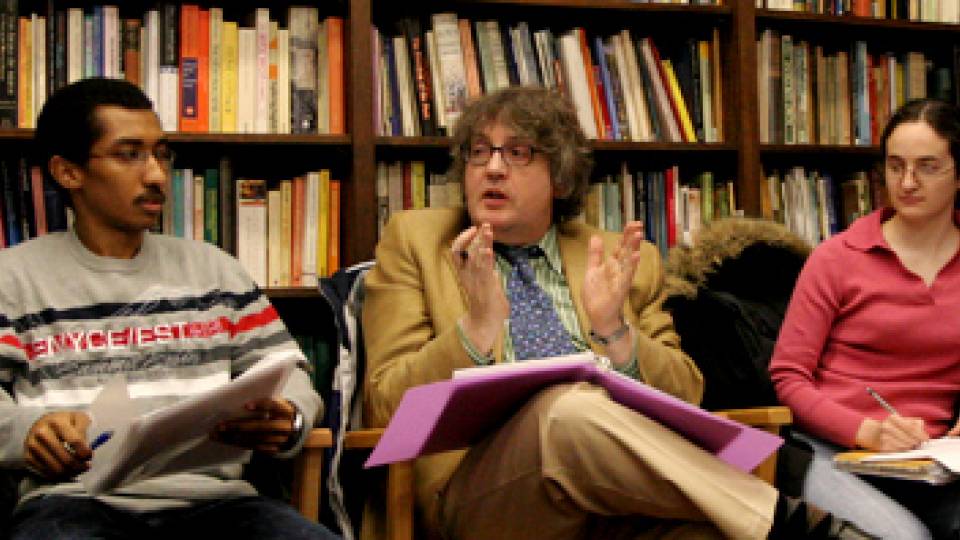
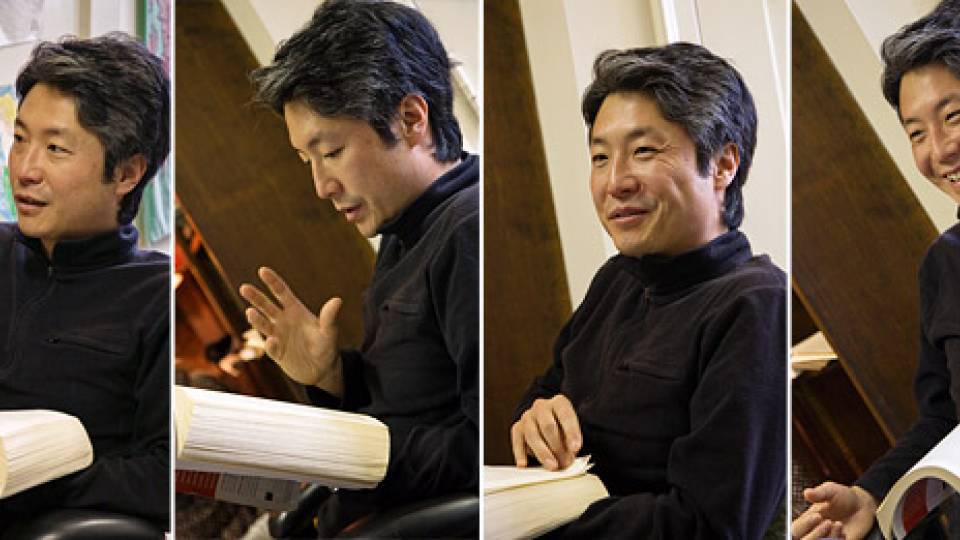
Novelist Chang-rae Lee, director of Princeton's Program in Creative Writing, brings the meticulous nature of his writing style into the classroom. Read more.
Video Closed Captions
(music)
Student:
So what I found interesting was his
Student:
interaction with Lexie.
(music)
Chang-rae Lee:
Yeah, I like Janet's idea that that could be a way
Chang-rae Lee:
to get right into the moment.
Chang-rae Lee:
Because that's what story really is:
Chang-rae Lee:
character in the moment.
(music)
Chang-rae Lee:
The journey was nearly over.
Chang-rae Lee:
The night was unusually chilly, the wind sharpened by the
Chang-rae Lee:
speed of the train as it rolled southward through
Chang-rae Lee:
the darkened valley.
Chang-rae Lee:
The cotton blanket June had stolen was large enough to
Chang-rae Lee:
spread as a tarp and at the same time wrap around her
Chang-rae Lee:
younger brother and sister and herself, but it was threadbare,
Chang-rae Lee:
and for brief stretches the train would accelerate and the
Chang-rae Lee:
wind would cut right through to them.
Chang-rae Lee:
It had not been a problem the night before, but now they were
Chang-rae Lee:
riding on top of the boxcar, as there was no more room within
Chang-rae Lee:
any of them, even as the train was more than
Chang-rae Lee:
a dozen cars long.
(music)
Chang-rae Lee:
The opening chapter has a basis in a family story.
Chang-rae Lee:
My father lost two siblings during the Korean War.
Chang-rae Lee:
His sister died of pneumonia and his brother was
Chang-rae Lee:
run over by a train. There wasn't any room
Chang-rae Lee:
inside the train. That's why they were on top.
Chang-rae Lee:
In the middle of night the train lurched, his brother fell
Chang-rae Lee:
off, and his leg got caught under the wheels of the
Chang-rae Lee:
train as it moved forward.
Chang-rae Lee:
He tried to carry his brother and catch up to the train
Chang-rae Lee:
as it was rolling away.
Chang-rae Lee:
I didn't have any intention of writing that story as part of
Chang-rae Lee:
this book, but once I did, and once I wrote it, I realized
Chang-rae Lee:
this is a wonderful and perfect overture to
Chang-rae Lee:
the rest of the novel.
(music)
Chang-rae Lee:
All literature is a record and celebration of trouble.
Chang-rae Lee:
Stories naturally want to explore what didn't go
Chang-rae Lee:
right: poor choices, wrong ideas, wrong emotions.
Chang-rae Lee:
We're fascinated by those things.
Chang-rae Lee:
What I try to tell my students is that they often want to
Chang-rae Lee:
celebrate life and in that mode of celebration, I think, forget
Chang-rae Lee:
that it's very hard to celebrate life, as in a party, in
Chang-rae Lee:
literature. And the true celebration of life is when -- in
Chang-rae Lee:
fiction, which is not like life at all -- is about
Chang-rae Lee:
identifying those moments at which everything has gone
Chang-rae Lee:
wrong, where the characters are challenged to their core.
Chang-rae Lee:
So that's what I'm constantly asking my students: to put
Chang-rae Lee:
their characters in situations in which the exact wrong
Chang-rae Lee:
thing will happen to them. And what I try to do in
Chang-rae Lee:
class, I try to unpack all those writerly choices.
(music)
Chang-rae Lee:
What I thought was one of the real interests of the
Chang-rae Lee:
story was to try to, of course, capture the sense of this
Chang-rae Lee:
micro-culture of the orchestra, right?
Chang-rae Lee:
And so that's why I thought Jim was actually a good choice as
Chang-rae Lee:
someone to tell this story, because he's an outsider.
Chang-rae Lee:
He's looking at this in the position that we
Chang-rae Lee:
might look at it.
Chang-rae Lee:
I don't think an "I" narrator should just be a video camera.
Chang-rae Lee:
You know it's just -- if that's the case, then it
Chang-rae Lee:
should be third-person. And then third-person in this
Chang-rae Lee:
story would be advantageous in another ways.
(music)
Chang-rae Lee:
Yeah, I'm often asked how one teaches writing, and I always
Chang-rae Lee:
say that I don't teach writing.
Chang-rae Lee:
I don't think you can. I really believe that
Chang-rae Lee:
writers are essentially wonderful readers.
Chang-rae Lee:
They understand how literature happens -- not because they've
Chang-rae Lee:
written it -- it's because they've read it.
(music)