Web Stories
Video: Commencement 2010
Posted June 1, 2010; 06:45 p.m.
To view the multimedia features on this page, you will need to download the latest version of Flash Player and/or enable JavaScript.
Princeton hosted a series of events and ceremonies highlighting the achievements of the Class of 2010, concluding with the University's 263rd Commencement. Read more
Video Closed Captions
Hip, hip! Rah, rah, rah!
Tiger, tiger, tiger! Siss, siss, siss! Boom, boom, boom! Ah!
Princeton! Princeton! Princeton! (cheers)
[drums]
Mickheila Jasmin:
Can we please start with a round
Mickheila Jasmin:
of applause for the illustrious class of 2010?
[cheers]
Eric Plummer Jr.:
We've been there through football bonfires,
Eric Plummer Jr.:
through Presidential inaugurations, through independent work,
Eric Plummer Jr.:
we've been there for each other every step of the way.
Eric Plummer Jr.:
And the fact of the matter is that the bond that we share as classmates,
Eric Plummer Jr.:
and as friends, is strong and unique.
Diana Hill:
I think what I've learned most here, is that it's
Diana Hill:
important to surround yourself with good people.
Imani Perry:
As you exist in the world, you will be actively
Imani Perry:
creating Princeton, defining what it is to the world, long
Imani Perry:
after you leave, and it will continue to be a part of who
Imani Perry:
you are perceived to be for years into the future.
Imani Perry:
Claim power in that relationship: the power to name and to define it and you.
[drums]
Debra Bazarsky:
Welcome to our ninth annual Lavender graduation ceremony.
Mariam Rahmani:
I just want to thank the community for
Mariam Rahmani:
accepting me and letting me voice my own opinions, rather than
Mariam Rahmani:
holding assumptions about what I believe.
Lianne Sullivan-Crowley:
The premise that you will be better
Lianne Sullivan-Crowley:
at anything that you do if you approach life and others with
Lianne Sullivan-Crowley:
dignity and respect is an unwaivering truth.
[music]
Patricia Fernandez-Kelly:
Let me advise you to allow your identity to fly,
Patricia Fernandez-Kelly:
your notion of who you are expand.
Patricia Fernandez-Kelly:
Let your self-definition embrace unexpected possibilities.
[music, cheers]
[singing]
Karambir Khangoora:
Contemplate and reflect upon knowledge,
Karambir Khangoora:
so you will become a benefactor to others.
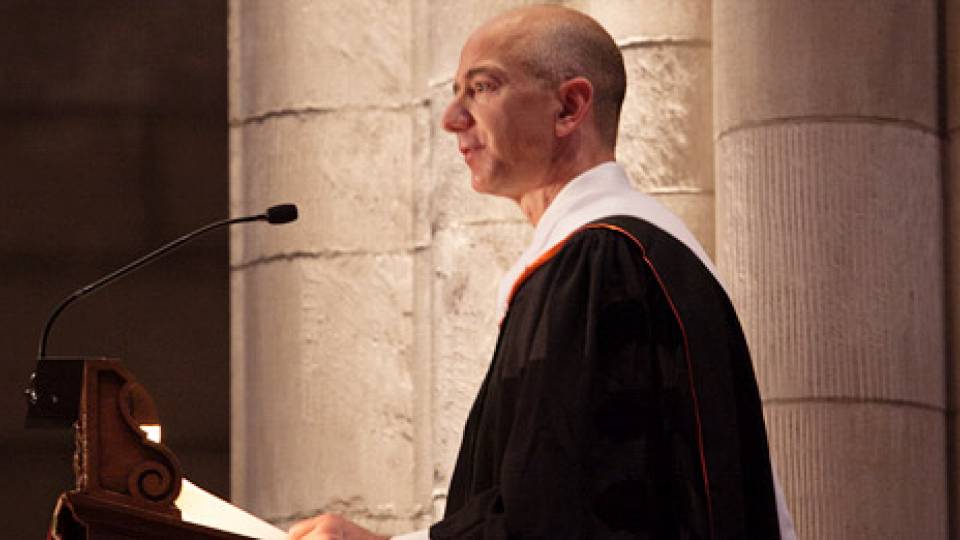
Jeff Bezos:
Will you be a cynic?
Jeff Bezos:
Or will you be a builder?
Jeff Bezos:
Will you be clever at the expense of others?
Jeff Bezos:
Or will you be kind?
Jeff Bezos:
I will hazard a prediction.
Jeff Bezos:
When you are 80 years old and in a quiet moment of
Jeff Bezos:
reflection, narrating, for only yourself, the most personal
Jeff Bezos:
version of your life story, the telling that will be most
Jeff Bezos:
compact and meaningful will be the series of choices
Jeff Bezos:
you have made.
Jeff Bezos:
In the end, we are our choices.
Jeff Bezos:
Build yourself a great story.
[singing, bell ringing]
Aditya Panda:
There are a lot of institutions in America that
Aditya Panda:
can teach you how solve an equation or critically read a
Aditya Panda:
piece of literature, but I truly believe that Princeton
Aditya Panda:
shines in its ability to teach us about something much more
Aditya Panda:
important, the value of community and of friendship.
Charles Gibson:
Above all, I want for all of you to matter.
Charles Gibson:
That doesn't mean people have to know who you are.
Charles Gibson:
We live in the world that is obsessed by fame, and I've
Charles Gibson:
had a little bit of that
Charles Gibson:
-- not according to the New York Times -- but I've
Charles Gibson:
had a little bit of it.
Charles Gibson:
And I can tell you that, in the long run, is not what matters.
Charles Gibson:
It's being a force in your community.
Charles Gibson:
It's being a great teacher or coach.
Charles Gibson:
It's ministering to patients or to a congregation.
Charles Gibson:
It's being a great parent.
Charles Gibson:
It's having a positive effect on others, and it's
Charles Gibson:
standing for something.
[music]
William Russel:
Today, we add to the gown that you already wear, a hood
William Russel:
appropriate to your degree and academic discipline.
William Russel:
At Princeton, these disciplines span the fundamental arts and
William Russel:
sciences, as well as their application to fundamental and
William Russel:
contemporary problems in architecture, finance,
William Russel:
engineering and public policy.
Shirley M. Tilghman:
Whether you've been laying the
Shirley M. Tilghman:
groundwork for a life in academia, preparing for a
Shirley M. Tilghman:
career in government, industry or the nonprofit sector, or
Shirley M. Tilghman:
enhancing your professional credentials, you have the
Shirley M. Tilghman:
potential to have a decisive impact on the lives of others.
Shirley M. Tilghman:
One important characteristic of a well-educated mind is the
Shirley M. Tilghman:
ability to explain what you do and why it matters to others.
[bell ringing, music]
Marguerite Colson:
[Translated from Latin] Eo Ipso, Princetonians, as you go forth, see, conquer and imbibe,
Marguerite Colson:
may you be always faithful to the traditions your success is built upon.
Marguerite Colson:
Remember, though, to make them new and to make them you.
[applause]
David Karp:
And, now that we have all successfully run the
David Karp:
great intellectual gauntlet that is the Princeton undergrad
David Karp:
experience, I hope that all of you will continue to seek out
David Karp:
things that challenge you, not just as a lawyer, or a teacher,
David Karp:
or a hockey player, but as a person.
Charles Gibson:
President Tilghman, I have the honor to
Charles Gibson:
present to you for the degree of Doctor of Laws,
Charles Gibson:
honoris causa, Ruth Bader Ginsburg.
Charles Gibson:
She has dedicated her life to vindicating the Constitution's
Charles Gibson:
promise of equality under law, as a distinguished law
Charles Gibson:
professor, a respected Supreme Court litigator and a trail-
Charles Gibson:
blazing advocate for women's rights.
Shirley M. Tilghman:
It takes real self-confidence to confront the
Shirley M. Tilghman:
other point of view rather than retreat into the safety and the
Shirley M. Tilghman:
comfort of what is familiar.
Shirley M. Tilghman:
To critically explore a different way of thinking, and
Shirley M. Tilghman:
to be open to the possibility that one might actually
Shirley M. Tilghman:
change one's mind.
Shirley M. Tilghman:
Those inclinations define the well-educated individual.
Shirley M. Tilghman:
Now, that's not say that our goal is to graduate a class
Shirley M. Tilghman:
of like-minded thinkers.
Shirley M. Tilghman:
Just the opposite is true, in fact.
Shirley M. Tilghman:
We want you to hold strong and well-considered views on a wide
Shirley M. Tilghman:
variety of issues and to be prepared to articulate those
Shirley M. Tilghman:
views in debate and to defend them to critics.
[singing]