Web Stories
Video: 'Conversation With... Edward Felten'
Posted January 25, 2011; 07:07 p.m.
To view the multimedia features on this page, you will need to download the latest version of Flash Player and/or enable JavaScript.
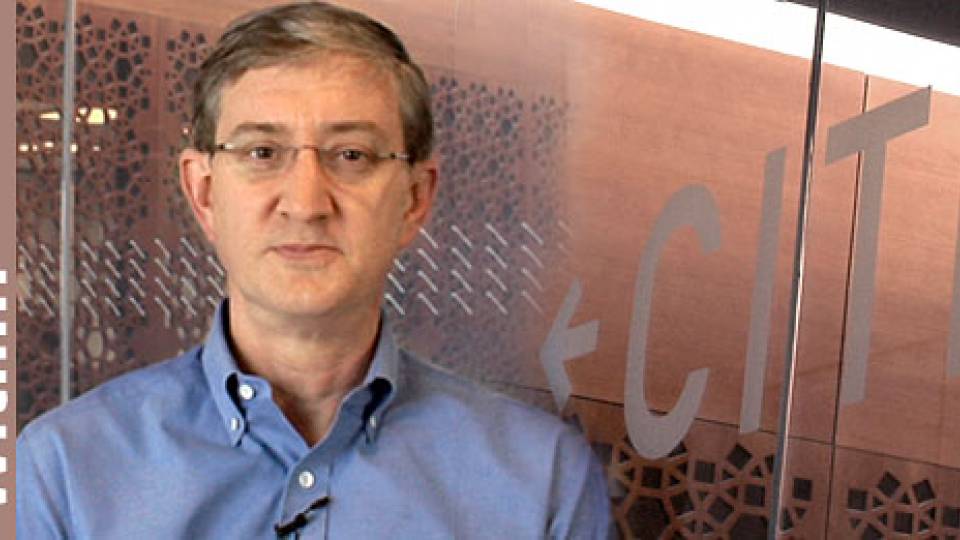
Princeton Professor Edward Felten discusses the many ways technology and society intersect, as well as how students can combine academic interests. Read more.
Video Closed Captions
[music]
Edward Felten:
Hi, I'm Ed Felten. I'm a professor of computer science
and public affairs here at Princeton and the
Edward Felten:
director of the Center for Information Technology Policy.
Edward Felten:
Welcome to the "Conversation With..." series.
Many of you would like to know whether you
Edward Felten:
can study more than one thing... more than
one topic at Princeton, and in my experience,
Edward Felten:
this is something that is easy for students
to do. Many students come with an interest
Edward Felten:
in something else besides the one topic that
they want to major in, and one of the ways
Edward Felten:
that we recognize that on students'
diplomas is through certificate programs which
Edward Felten:
are sort of the equivalent of minoring in
a particular topic.
Edward Felten:
Princeton really encourages people to follow
their intellectual interests. I came here
Edward Felten:
17 years ago as a pure technology professor,
but I got interested over time in public policy
Edward Felten:
and how technology interacted with the decisions
the government and society makes, and the
Edward Felten:
people across the University were excited
to see a faculty member taking off in a new
Edward Felten:
direction and combining different areas of
study, just as we encourage students to do
Edward Felten:
the same thing. A big part of what Princeton
is about is drawing these connections across
Edward Felten:
traditional disciplines. Students are often
interested in whether they can focus on computer
Edward Felten:
science or information technology and issues
of public policy or sociology or economics
Edward Felten:
at the same time, and we have a growing number
of students who do that. That's one of the
Edward Felten:
reasons we set up the Program in Information
Technology and Society. An example would be
Edward Felten:
a student who wants to understand how technology
can enable economic development and a better
Edward Felten:
life for people in the developing world in
Africa or elsewhere. So that student has
Edward Felten:
the opportunity to take technology classes,
they have the opportunity to take classes
Edward Felten:
in economics and sociology and public policy
all around these issues and then to do independent
Edward Felten:
work in a senior thesis that really draws
it all together.
Edward Felten:
I think the intersection between computer
science and society is a fascinating area
Edward Felten:
to work in and touches all kinds of it important
things that go on in our lives. We study electronic
Edward Felten:
voting in elections. We study intellectual
property, which accounts for a bigger and
Edward Felten:
bigger fraction of the economy and a lot of
the devices and products that we deal with
Edward Felten:
everyday. We deal with things like the safety
of cars and the stability of technologies
Edward Felten:
that underlie the banking system. We deal
with issues of national security and the balance
Edward Felten:
of power around the world. We deal with economic
development in the developing world. All of
Edward Felten:
this is connected to information technology these days.
Edward Felten:
One of the early studies we did on electronic
voting was to really take apart an electronic
Edward Felten:
voting machine that was, at the time, used
by about 10 percent of U.S. voters, and we
Edward Felten:
found that it was in fact possible to steal an election
Edward Felten:
in a way that wouldn't be discovered, and
we demonstrated it in many places. I demonstrated
Edward Felten:
it for Congress. We demonstrated on CNN and
Fox News. And this has led to some changes
Edward Felten:
in the way elections are held in a bunch of
states including California, Ohio and Florida.
Edward Felten:
One of the problems with electronic voting
machines is the worry that someone is going to
Edward Felten:
program them to do something other than count
the votes correctly. This is a Sequoia AVC-Edge
Edward Felten:
voting machine, which would normally
be used in election in the United States,
Edward Felten:
but some of our students built a version of
Pac-Man to run on this voting machine
Edward Felten:
I've been teaching about computer technology
and public policy here at Princeton
Edward Felten:
for quite awhile, but now I have the opportunity
to put this into
Edward Felten:
practice. I've been appointed as the chief
technologist at the Federal Trade Commission
Edward Felten:
in Washington, and so I'm going to go off
and do that for awhile. When I come back afterward,
Edward Felten:
I'll be able to teach this material in, I
think, a different way -- I can see that already
Edward Felten:
-- and with real world examples in the kind
of insight that you only get from doing something.
Edward Felten:
Thanks for joining me in this installment
of "Conversation With...." I hope you join
Edward Felten:
me next time when I answered questions submitted
on Facebook.