Web Stories
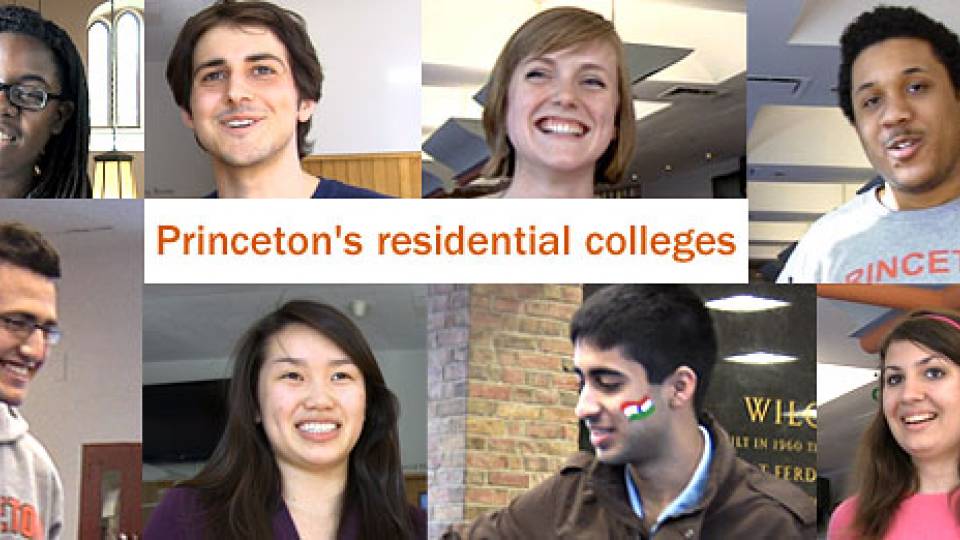
Welcome to Princeton's residential colleges
Posted April 8, 2011; 02:11 p.m.
To view the multimedia features on this page, you will need to download the latest version of Flash Player and/or enable JavaScript.
Students, college masters and staff members describe the importance of life in Princeton's residential colleges. Read more.
Video Closed Captions
[music]
Adoley Ammah-Tagoe:
Welcome to the Princeton residential colleges.
[music]
Jeff Nunokawa:
This is your first home here at Princeton
Jeff Nunokawa:
and we do a great deal, we all of
us do, each of us in our own
Jeff Nunokawa:
way, to make it feel like home.
Jeff Nunokawa:
To make you feel like there's
a place for you here, no
Jeff Nunokawa:
matter where you're from,
and no matter
Jeff Nunokawa:
where you want to go.
Sanjeev Kulkarni:
Each of the colleges is having
Sanjeev Kulkarni:
a Master Chef night.
Sarah Paige:
Well, Butler always has wonderful events
Sarah Paige:
going on, but the master's dinner
Sarah Paige:
is definitely wonderful.
Jeff Nunokawa:
It kind of touches on what we think of as
Jeff Nunokawa:
the mission of the college, and
that's to make people feel
Jeff Nunokawa:
lively and at home.
Eduardo Cadava:
What the way the college is envisioned as is a
Eduardo Cadava:
place to bring together undergraduates, graduate
Eduardo Cadava:
students, and faculty in a place
where students live, in
Eduardo Cadava:
order to enhance the life that you have here.
Sanjeev Kulkarni:
Each of the colleges has
Sanjeev Kulkarni:
roughly about 500 students.
Eduardo Cadava:
Part of my charge is just to make sure
Eduardo Cadava:
that where the students live
continues to be a place where they learn.
Sarah Paige:
Well, I think that the residential colleges are a
Sarah Paige:
really special part of the Princeton experience that
Sarah Paige:
allow you to really get to know an extremely diverse
Sarah Paige:
community, but in a much more manageable way.
Adoley Ammah-Tagoe:
I think what I love most about the
Adoley Ammah-Tagoe:
residential college system is the sense of community that
Adoley Ammah-Tagoe:
you have. It's when you walk
into the dining hall and you
Adoley Ammah-Tagoe:
can sit down with anyone you know.
Adoley Ammah-Tagoe:
It's when you're walking along
the paths of your college, and
Adoley Ammah-Tagoe:
you find yourself saying,
"Hi," to so many people.
Adoley Ammah-Tagoe:
It's when you're studying in the
study rooms, and everyone
Adoley Ammah-Tagoe:
has the same sense of community
in the same environment.
Katelyn Scanlan:
For me, coming from a small town, it
Katelyn Scanlan:
seemed like such a big place.
Katelyn Scanlan:
But once I got here and got into
the residential college
Katelyn Scanlan:
system, into the residential
campus life, it really becomes
Katelyn Scanlan:
a small community and I was
really surprised by how
Katelyn Scanlan:
tight-knit our groups can be.
Katelyn Scanlan:
And I've made of my best friends in
Katelyn Scanlan:
the residential colleges.
Katelyn Scanlan:
So it's something really
unexpected and really, really
Katelyn Scanlan:
nice to have here at Princeton.
[music]
Simon Krauss:
We have six residential colleges.
Simon Krauss:
You're assigned, and you stay
there for at least your
Simon Krauss:
freshman and sophomore year.
Katelyn Scanlan:
How you're sorted into residential
Katelyn Scanlan:
colleges, it's not like you can
put a sorting hat on your
Katelyn Scanlan:
head, like in Harry Potter.
Katelyn Scanlan:
It's done completely randomly.
Jessica Johnson:
Well I like that, in a sense, that it's
Jessica Johnson:
not just one demographic.
Jessica Johnson:
Because part of the reason why
you want to come to college is
Jessica Johnson:
so that you meet people that
aren't in your typical group
Jessica Johnson:
of friends.
Katelyn Scanlan:
Three residential colleges have just
Katelyn Scanlan:
freshmen and sophomores.
Katelyn Scanlan:
And then other residential colleges
Katelyn Scanlan:
are four-year colleges.
Katelyn Scanlan:
For instance, Mathey is the sister college of Rocky.
Katelyn Scanlan:
Rocky has freshmen and sophomores and
Katelyn Scanlan:
Mathey has all classes.
[music]
Victoria Hoss:
A lot ofupperclassmen are also
Victoria Hoss:
choosing to stay in Butler
because it's so nice.
Victoria Hoss:
So that I think, as a different
dynamic-- because
Victoria Hoss:
you don't just have sophomores
and freshmen-- you get to
Victoria Hoss:
interact with upperclassmen who
can help you out with Org-O (organic chemistry)
Victoria Hoss:
and stuff like that, which
is really helpful.
Jennifer Yeh:
Living in Butler
is wonderful, which is
Jennifer Yeh:
actually the reason that I'm
still in Butler as an upperclassman.
Jennifer Yeh:
And so you have a social and
academic network that's there
Jennifer Yeh:
backing you up the entire time.
[music]
Katelyn Scanlan:
Each residential college has some
Katelyn Scanlan:
kind of character.
Katelyn Scanlan:
And it's usually a reflection
of the Master of the College
Katelyn Scanlan:
and the kind of character of
the students that happen to
Katelyn Scanlan:
make up a certain class.
Yien Hao ("Mark") Lock:
What I really like about Whitman is the dining hall.
Yien Hao ("Mark") Lock:
I've been here for four years
and every time I come here,
Yien Hao ("Mark") Lock:
there's always people I know.
Malavika Balachandran:
You can walk into a study room, and
Malavika Balachandran:
it's always filled with people
and you know that you're never
Malavika Balachandran:
really alone.
Lauren Schwartz:
Forbes used to be a hotel, and it's really
Lauren Schwartz:
neat because some rooms even
have their own bathroom.
Lauren Schwartz:
So it's kind of like being
Eloise at the Plaza, only it's
Lauren Schwartz:
not so much pink.
Charquia Wright: It has beautiful views.
Maxim Botstein:
It's really interesting, architecturally,
Maxim Botstein:
so it's really fun to
walk down the halls.
Maxim Botstein:
And you can see how it
changes from a new
Maxim Botstein:
wing to the main Inn.
Owen Knights:
Well, I think Wilson College is special
Owen Knights:
because we have some tremendous academic resources.
Daniel Yeboah-Kordieh:
I'm from Ghana, Accra,
Daniel Yeboah-Kordieh:
and I'm an international
student living in Wilson College.
Eduardo Cadava:
Well, it was the first college.
Eduardo Cadava:
In the late '50s, some students got together and
went to the then-president,
Eduardo Cadava:
President Goheen, and made a case for
an alternative to the eating clubs.
Eduardo Cadava:
It was a place where students
could gather
Eduardo Cadava:
together with faculty. They would invite faculty and it
was a kind of template for
Eduardo Cadava:
the residential college systems.
Alesia Dechkoskaia:
It's next to Frist Campus Center where
you can get late meal and do homework.
Alesia Dechkoskaia:
It's close to some of the libraries.
Daniel Yeboah-Kordieh:
Trust me. If you're in Wilson, you're in the best place.
Akshata Shirahatti:
Rocky's just, in my opinion, the most
beautiful part of campus.
Akshata Shirahatti:
The Gothic architecture really makes for a
great place to live.
Sean Drohan:
The best thing about living in Rocky is that
you live in a castle.
Akshata Shirahatti:
Jeff Nunokawa, our
college Master is great.
Akshata Shirahatti:
I've had a lot of meals with
him and he's a great person to talk to.
Chad Horner, Jonathan Lack and Abraham Chaibi:
Go Rocky!
Sascha Brown:
My favorite part about being in Mathey is the
Sascha Brown:
activities that they put on for us.
Sascha Brown:
My personal favorites were the
two Broadway trips, one to
Sascha Brown:
Wicked, and one to The Lion King.
Peter Giovione:
There's a girl from Kenya.
Peter Giovione:
We're from all over the world.
Peter Giovione:
It's really a great experience
to meet them all.
Student:
I got placed in Mathey.
Student:
I feel like Mathey's full of artsy people.
Sanjeev Kulkarni:
I like to think of Butler as a
Sanjeev Kulkarni:
particularly friendly, collegial,
Sanjeev Kulkarni:
and welcoming place.
Mireille ("Mimi") Pichette:
I like the study break.
Kyle Schenthal:
The location's good for science majors.
Daisy Zhou:
Yeah.
Victoria Hoss:
We're all usually
Victoria Hoss:
outside playing or studying.
Victoria Hoss:
We're a pretty active group.
Kellie Lynch:
I would say so, yeah.
[music]
Charquia Wright:
What's happening tonight is
Charquia Wright:
vegetarian night at Forbes and
it's really popular on campus.
Julie Badessa:
We have a pretty loyal following.
Julie Badessa:
We usually feed about 500 people
for these dinners.
Alex Trimble:
Our entire staff becomes involved with it.
Lauren Schwartz:
The whole campus gravitates towards
Lauren Schwartz:
these special meals.
Alex Trimble:
We have, here at Forbes, absolutely the best culinary team.
[music]
Jessica Johnson:
Most people who graduated will tell you
Jessica Johnson:
that they were greatly impacted
by their time in the
Jessica Johnson:
residential college, whether
they choose to live there as
Jessica Johnson:
upperclassmen or not.
Yien Hao ("Mark") Lock:
And that tends to happen with a lot of people.
Yien Hao ("Mark") Lock:
They stay really attached to
their residential college
Yien Hao ("Mark") Lock:
because of the really close
nature of their friendships,
Yien Hao ("Mark") Lock:
starting in their freshman
and sophomore years.
Peter Giovone: It's really
It's really like a family for me.
Anna Kornfeld Simpson:
It's just a another great way that
Anna Kornfeld Simpson:
Princeton tries to make us all
into a community and form
Anna Kornfeld Simpson:
friendships that are going to
be meaningful to us for the
Anna Kornfeld Simpson:
rest of our lives.
[music]