Web Stories
Faces of Princeton
Posted June 9, 2011; 12:00 p.m.
To view the multimedia features on this page, you will need to download the latest version of Flash Player and/or enable JavaScript.
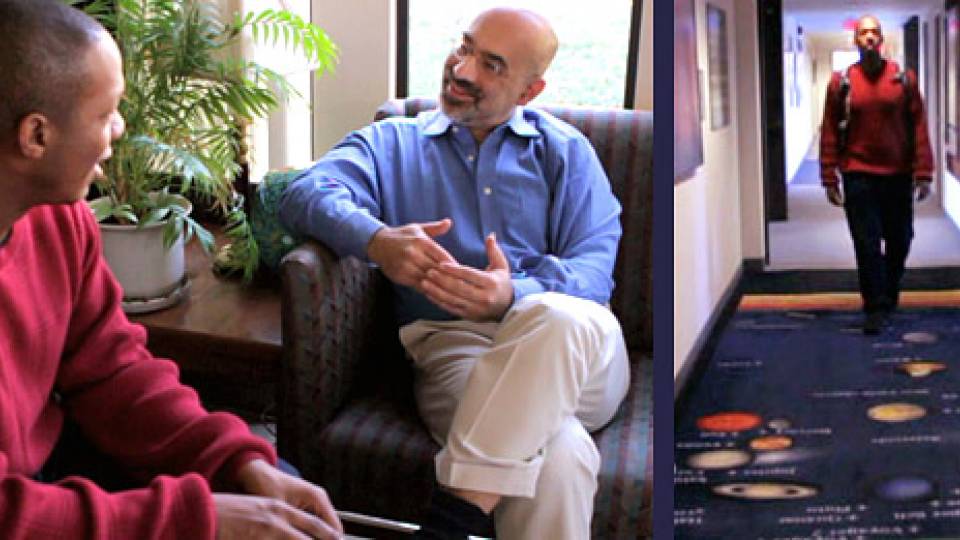
Professor David Spergel and Jared Crooks '11 discuss astrophysics and collaborating, as part of a video for "Aspire: A Plan for Princeton," a $1.75 billion fundraising campaign. Read more.
Video Closed Captions
I grew up in Fort Worth,
Texas where it's
pretty dark at night.
And so it was an exceptionally
clear night one day, and I was
getting out of my car.
I just looked up, and I was
like, oh my goodness look at
all these stars.
I'd seen the same stars
before, but now I had
questions about it.
What does it mean that I'm
seeing this starlight, or this
light from a planet that's
reflected from the sun, and
what does that mean that it's so
far away that I can't even
reach it by a spaceship.
After that I went to go read The
Universe in a Nutshell by
Stephen Hawking, and that's what
really got me interested
in astrophysics.
When I first came to Princeton,
I struggled a
little bit my freshman year,
and I was looking for help.
And luckily I'm at Princeton,
and Princeton's academic
resources are phenomenal.
Princeton has been a leading
center for theoretical
astrophysics for nearly
a century.
I was actually a member of the
class of 1982, and I'm a
professor and department chair
in the department of
astrophysics.
When I was a senior here, I
worked with Jill Knapp, who is
still a professor in
the department.
And Jill was my senior
thesis adviser.
And to kind of go full circle,
I think Jill was the first
person that Jared worked with
when he came to Princeton.
Professor Jill Knapp and
Professor James Gunn really
took me in, and it was kind of
that encouraging, motivational
support that really helped
to shape and define
my Princeton career.
Research is hard.
You're trying to solve
a problem no
one has solved before.
You're going into the
wilderness, finding a new
path, and it's scary.
And one of the things you've got
to do as a mentor is give
the students the confidence and
the strength to go take on
challenges.
Working with David is just
like being a partner.
Now, I don't know as much
as David, I don't
think anyone does.
But what he does as kind of an
academic adviser is just say,
hey look, here's a problem.
I'm going to be hands off on it,
I can help you out, but I
want you to get it done.
One day when I was going into
office hours with David, I sat
down right by the bookcase.
I looked over to the right,
because he was busy on his
computer for a while, so I had
a little time to kind of look
at what kind of books he had.
All the books are either
astrophysics or science policy.
I asked myself, what is David
doing with these books?
I thought, here he is, a hard
core theoretical physicist,
cosmologist. What does he
have any interest in
science policy for?
Then he began to engage me on
what science policy was, and
why it was important to
both astrophysics, but
science as a whole.
And from there, I kind of walked
away from his office
realizing, oh interesting,
there's not just one career
for a scientist, there
are several.
When Jared decided he was
interested in policy, I
thought this was a good
opportunity for him.
Through science policy, you
are able to help write and
effect legislation that will
then be turned into a
guideline for agencies,
corporations, schools to
follow that will help
better our society.
It's something that
really excites me.
We really want good people who
understand what science is
about doing science policy.
SINSI, or Scholars In the
Nation's Service Initiative,
is a fellowship program
here at Princeton.
After I graduate from Princeton
undergraduate, I
will come back as a graduate
student in the
Woodrow Wilson School.
Then I will spend two years in
the government, working for an
agency to help out with science
policy, and then
finish up my graduate degree
here at Princeton, and go off
into my career.
And now that he's going to be
graduating soon, the next task
is passing the baton, and making
sure that you train the
next generation to continue.
I think one of the empowering
and demanding things about
Princeton is a sense that you
should do great things.
It's like a glue that
binds all the
Princeton community together.