Web Stories
Video: Global lessons from Princeton's microclimate
Posted July 28, 2011; 12:00 p.m.
To view the multimedia features on this page, you will need to download the latest version of Flash Player and/or enable JavaScript.
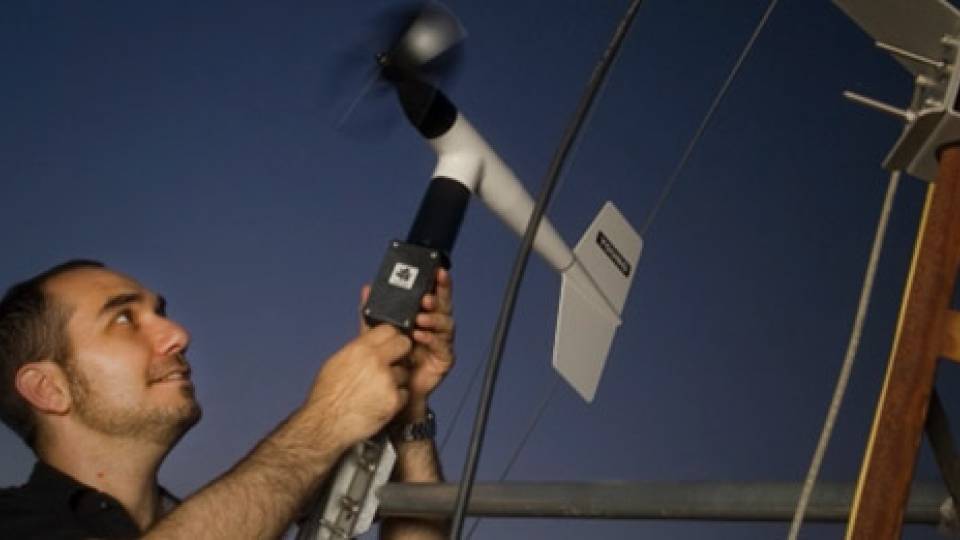
Professor Bou-Zeid is mapping the microclimate of the campus to better understand how local environments affect the global climate. Read more.
Video Closed Captions
ELIE BOU-ZEID: When I was
doing my undergraduate
education in mechanical
engineering, I was very
fascinated by fluid mechanics.
Air and water are fluids and
they flow with a very complex
pattern in the environment.
And I was drawn to apply this
knowledge of fluid mechanics
to environmental problems. The
aim of this project is to
study three aspects: energy,
water and carbon in the
environment of Princeton.
Locally, we would like our
sensing technologies in our
models to be combined to make
our buildings smarter and more
energy efficient.
The idea of these meteorological
stations is
that you want to build
them as cheaply
and simply as possible.
Currently, we have about 12
stations around the Princeton
campus, and we are looking
to increase
this to 20 or 30 stations.
These are computer model
outputs of the surface
temperature over Princeton.
What we see is first, Lake
Carnegie, which is hotter than
the Earth's surface during
the night, and
cooler during the day.
And if you look at the Earth's
surface, you will see that the
vegetative parts always
cooler than the built
terrain or the buildings.
If we keep zooming down, we can
get to the level of one
individual building.
We can then simulate the air
flow around this building and
observe how the presence of this
building will create a
lot of turbulence around it,
which means a lot of mixing of
pollutants and heat and other
things in built terrain.
Global climate models will tell
you what's happening at
the very large scale.
What we try to do is downscale
these climate predictions to
the local level.
So we want to see how a small
city will respond to a climate
change given by these global
climate models.
The wonderful thing about
academia is that you wake up
in the morning, and you go to
work knowing that today, you
will learn something new, or
you might even discover
something completely fascinating
every day.