Web Stories
Video: 'Conversation With... Professor Jeff Nunokawa'
Posted August 11, 2011; 06:42 p.m.
To view the multimedia features on this page, you will need to download the latest version of Flash Player and/or enable JavaScript.
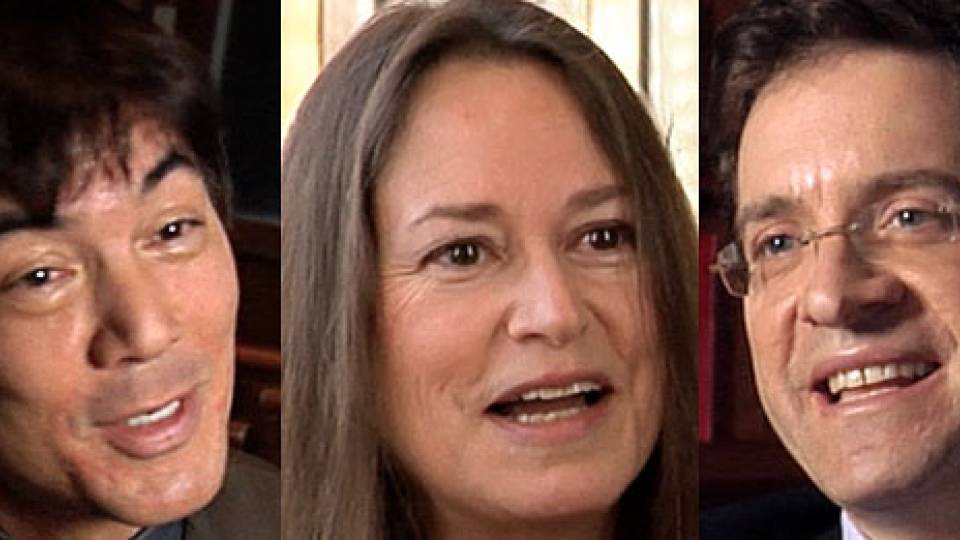
Princeton Professor Jeff Nunokawa answers questions sent via Facebook and Twitter about how social media affect teaching and literature, and much more. Learn more.
Video Closed Captions
JEFF NUNOKAWA: Hi.
I'm Jeff Nunokawa.
I'm a professor in the
department of English here at
Princeton University, and
I'm also the Master
of Rockefeller College.
In this episode, we're going
to answer some of the
questions that you've
sent to me by way of
Facebook and Twitter.
Our first question
is from Twitter.
What are you trying to
accomplish through your essays
on Facebook?
Excellent question.
Excellent question.
I got very interested.
I devised a course in the
history of the essay form, and
got very interested in the
theory and practice of a
genre, of a way of expressing,
which was, as it were,
intellectual and sociable
at once.
So I got very interested in
the possibility of writing
brief essays-- and they
are very brief--
essays whose network would not
be strictly scholarly,
although I hope they are
scholarly interest. But really
primarily, or at least
organically, for social media.
Our next question came
from many users.
Why write on Facebook
and not a blog?
Facebook is where you are.
I know that.
I live amongst college
students.
It's where my students spend
a great deal of their time.
I'm not interested in the
brand per se, obviously.
What I'm interested in
is where you are.
A Facebook user posted
this question.
How does where you came from
and your family background
affect your writing?
It affects it in every way.
But increasingly obliquely.
Let's put it this way.
Let me just cut to
the chase here.
A lot of these essays are, in
one way or another, directed
to or are about my mother and
my family, where I grew up,
which was Hawaii.
These are essays written--
I am very close to my
mother, on one hand.
On the other hand, she'll never
read anything I write on
the other hand, because
I won't let her.
For people who are actually
interested in them, they'll
see that my mother functions in
these essays as the person
whom I'm responding to, who
these essays are written for,
but who can never actually
read them.
First of all, they're
not her cup of tea.
But she instilled in me certain
kinds of values that I
think are most vivid in what I
think of as the great era of
the essay form, which is the era
from mid-18th to the early
19th century.
But, specifically, Dr. Johnson,
who was a profound
and profoundly intense moralist,
as is my mother.
One Twitter user asked how
writing on Facebook changes
how I teach.
It makes me much more aware of
how much I can get students to
think of their writing
as an extension of
their speaking voice.
The writing that I do on
Facebook, it's very written.
I revise it constantly.
But it is really an extension
of the way that I speak.
And one of the things that I
aim to do, and indeed most
professors of literature and of
writing aim to do, when it
comes to teaching writing, is
to get our students to think
of what they write, of how they
write, as an extension of
their real voices.
Multiple Twitter users asked
if I think Twitter and
Facebook have a negative
effect on literature.
I think it does not
negatively affect
literature for many reasons.
Or to put it differently, what
I'm actually much more
interested in it is the way
that it, I think, helps
literature.
And by that I mean
the following.
I find that actually, the very
thing that bothers people
about these modalities, if
you'll forgive a fancy word,
these forms, is it reduces
face to face contact.
It's a simple way
of putting it.
And that's not a good thing.
We're all against that.
We want more face
to face contact.
But one thing that it does which
I think is good is to
recall something which was,
say, extraordinarily--
well I'll ubiquitous nearly in
the period that interests me
the most. And that is the
Victorian period, and that is
the epistolary, writing
letters.
Now, those texts that my that
my nephews and nieces are
constantly sending to their
friends and whatnot--
I'm not suggesting that those
are the same thing as the
letters that the Brownings
wrote one another.
But I've been struck by how much
more poised the diction
of the students on email,
but particularly on
Facebook, and on IMing.
Twitter I don't know so well.
But I'm just saying on those
things, their diction and
their sense of immediacy and
intimacy, and their sense
that, again, that the written
word here is an extension of
their voice--
I just think that is a happy
effect for literature.
So, for our final question, a
Twitter user asked, simply,
what do you think makes
a great writer?
There's this great line John
Updike says somewhere.
And he was accepting
some prize.
Updike says why do I write?
Because I have this completely
bizarre belief that what I
have to say is of incredible
importance.
And I think that you
have to have that.
And in order to have that, you
have to be sufficiently
involved in and studious about--
and I mean that kind
of in an etymological sense--
studious about, passionate
about a subject that you say,
yeah, I've got to say this.
Or to put it differently,
this has to be said.
Well thank you so much for
taking part in this.
I really enjoyed it.