Multimedia: Featured
Putting the squeeze on batteries
Posted November 21, 2011; 12:00 p.m.
To view the multimedia features on this page, you will need to download the latest version of Flash Player and/or enable JavaScript.
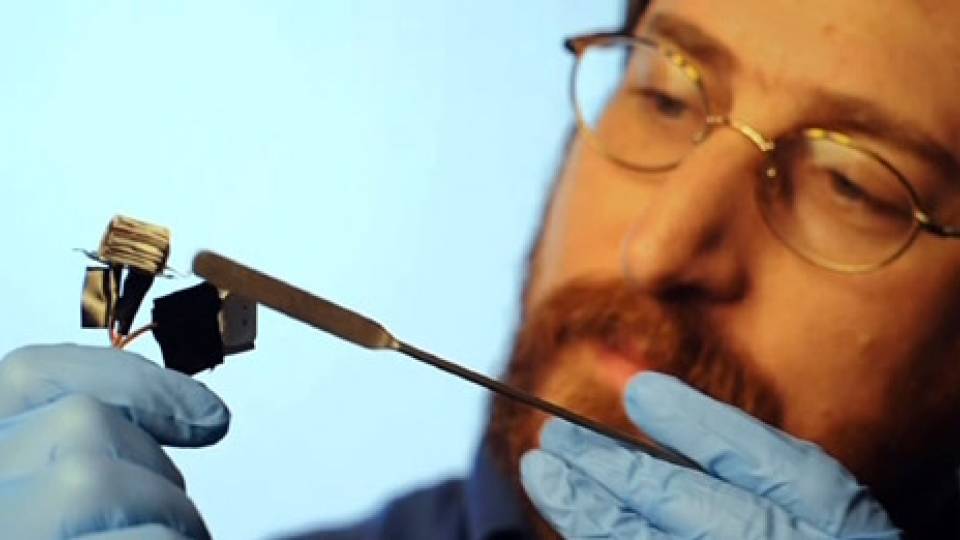
Professor Craig Arnold is working to make lithium-ion batteries last longer and provide more energy. Read more.
Video Closed Captions
[music]
Craig Arnold:
Cars, cell phones, laptops.
Craig Arnold:
We all rely on batteries every day.
Craig Arnold:
My name is Craig Arnold.
Craig Arnold:
And I want to make better batteries.
Craig Arnold:
Lithium-ion batteries are good.
Craig Arnold:
But we all know that they tend
to lose their capacity over
Craig Arnold:
time, and they don't last forever.
Craig Arnold:
Batteries are complex.
Craig Arnold:
They're made up of many layers of different materials.
Craig Arnold:
If we take these layers apart, we could see the dark
Craig Arnold:
electrode material and we could see the
Craig Arnold:
white separator membrane.
Craig Arnold:
This membrane keeps the
electrodes from touching each
Craig Arnold:
other in this tight pack.
Craig Arnold:
In my lab, we try to simulate
what happens to the separator
Craig Arnold:
membrane over its lifetime.
Craig Arnold:
We roll up the material and
expose it to high pressures.
Craig Arnold:
On a microscopic level, this has effects
Craig Arnold:
similar to years of use.
Craig Arnold:
These mechanical stresses can cause
Craig Arnold:
changes to the separator.
Craig Arnold:
But what does that have to do
with your battery failing?
Craig Arnold:
Well, let me explain.
Craig Arnold:
Here's an ordinary sponge.
Craig Arnold:
You'll notice it has a bunch of holes in
it to allow water to pass through.
Craig Arnold:
If I were to press on it, it
would close these holes and
Craig Arnold:
prevent water from passing through the sponge.
Craig Arnold:
This is not unlike the battery separator.
Craig Arnold:
In this material, there is also a lot
Craig Arnold:
of little tiny holes.
Craig Arnold:
If I were to squeeze it, these
holes would also close up,
Craig Arnold:
preventing lithium ions from
passing through the membrane.
[music]
Craig Arnold:
We can see these holes if we
use an electron microscope
Craig Arnold:
with high magnification.
Craig Arnold:
In a new separator, the holes
are all over the membrane,
Craig Arnold:
allowing lithium ions to easily pass.
Craig Arnold:
After simulating long-time use
and storage, we can see the
Craig Arnold:
holes disappearing from the
membrane, making it more
Craig Arnold:
difficult for lithium ions to pass.
Craig Arnold:
So, what can we do about this?
Craig Arnold:
One way to fix this is to prevent
the pores from closing up.
Craig Arnold:
Imagine a battery separator
that's strong enough to resist
Craig Arnold:
mechanical stress.
Craig Arnold:
So in fact, batteries are not
just electrochemical devices.
Craig Arnold:
Their mechanical properties
can also affect their performance.
Craig Arnold:
By better understanding the
science of batteries, we can
Craig Arnold:
begin to engineer ways to keep
the current flowing longer.
Craig Arnold:
Boy, I could really use
that in my smartphone.
Photographer:
Hey, Craig.
That was fun. [laughter]