Web Stories
Video: Student work: Underwater robotics
Posted March 16, 2012; 12:30 p.m.
To view the multimedia features on this page, you will need to download the latest version of Flash Player and/or enable JavaScript.
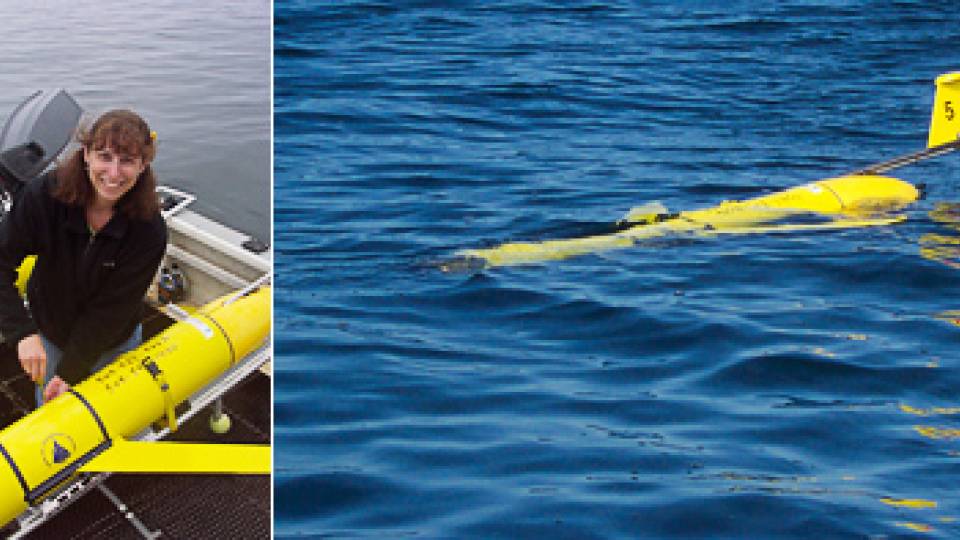
Princeton seniors David Clifton and David Heinz spent a summer testing a robot called the "beluga" in engineering professor Naomi Leonard's laboratory.
Video Closed Captions
[music]
David Heinz:
I'm Dave Heinz.
David Clifton:
I'm David Clifton, and we are both
David Clifton:
undergraduates in Professor Naomi Leonard's lab at
David Clifton:
Princeton University.
David Heinz:
And we're working on controlling underwater
David Heinz:
autonomous vehicles.
David Heinz:
So, our most important task here, what we were hired for,
David Heinz:
was to make a system to control these vehicles
under water.
David Heinz:
And to start that we had to model them, make a good,
David Heinz:
accurate model which we could
use to predict how they were
David Heinz:
going to behave, then control them like that.
David Heinz:
This testbed setup allows us
to test algorithms that have
David Heinz:
been proposed in theory, but
never used in the real world,
David Heinz:
and see how they actually work
before they're implemented in
David Heinz:
somewhere more expensive and more complicated.
David Clifton:
This is the beluga
David Clifton:
that we use for testing.
David Clifton:
The vertical thruster provides
vertical motion, much like a helicopter.
David Clifton:
These bolts hold down the black plastic
David Clifton:
top used for tracking.
David Clifton:
It provides very nice contrast
against the white bottom of
David Clifton:
the tank, for the cameras to pick up.
David Clifton:
This foam top is very buoyant, relative to
David Clifton:
the rest of the beluga.
David Clifton:
This is the metal water-tight compartment.
David Clifton:
It has the computer inside of
it, the pressure sensor on
David Clifton:
this side over here, and then
it's what controls the
David Clifton:
outputs, given via the tether here.
David Clifton:
This is the servo that angles
this back motor, and back
David Clifton:
motor provides thrust, so it can
do, basically, two degrees
David Clifton:
of freedom.
David Clifton:
This keel works oppositely of
the foam top, and provides a
David Clifton:
lot of weight at the bottom,
to help to keep the beluga
David Clifton:
oriented, and that's pretty
much everything.
[music]
David Heinz:
We use four cameras hooked up to image
David Heinz:
processing software in a
computer to give us the
David Heinz:
real-time position of the beluga in the tank.
David Heinz:
And this allows us to close the
loop, which is our goal in
David Heinz:
the control system, so we know
where we are and we know where
David Heinz:
we have to go,
David Heinz:
and that allows us to know how to get there.
[music]
David Clifton:
These four cameras are responsible for
David Clifton:
tracking the beluga in the horizontal plane.
David Clifton:
Each camera corresponds, roughly, with one
David Clifton:
quadrant of the tank.
David Clifton:
And as the beluga makes its
way around the tank, the
David Clifton:
camera responsible for tracking
it switches on automatically.
David Heinz:
On a day-to-day basis, though, we're looking
David Heinz:
at anything from a full day in
the machine shop to sitting
David Heinz:
around, testing MATLAB code,
modifying a full C program of
David Heinz:
tracking, or even just arguing about how
David Heinz:
best to make our model.
David Heinz:
There's a whole lot of stuff
we have to do, and now that
David Heinz:
we've fixed most of the things
that were broken, we spend a
David Heinz:
lot of time tinkering with our
model, adjusting parameters to
David Heinz:
make it represent the real
system better, and comparing
David Heinz:
it to the real results.
David Heinz:
Well, what's been really cool,
I think I can speak for both
David Heinz:
of us on this, is that we've
been able to take things we've
David Heinz:
learned in textbooks, we've seen
on paper, and actually
David Heinz:
implement them in the real world.
David Heinz:
There are no simulations here.
David Heinz:
We actually take our algorithm,
we write it up into
David Heinz:
code, and we run it,
David Heinz:
and we see what happens in the tank.
David Heinz:
We can tell if it works or not.
David Heinz:
And that's an experience we can't really
David Heinz:
have any other way.
[music]