Web Stories
Princeton's Cogeneration Plant
Posted March 22, 2012; 12:00 p.m.
To view the multimedia features on this page, you will need to download the latest version of Flash Player and/or enable JavaScript.
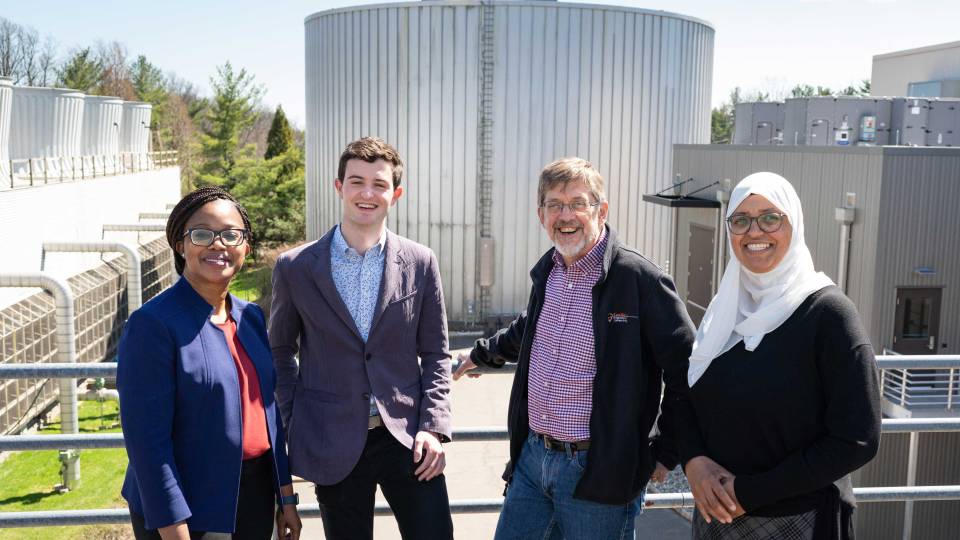
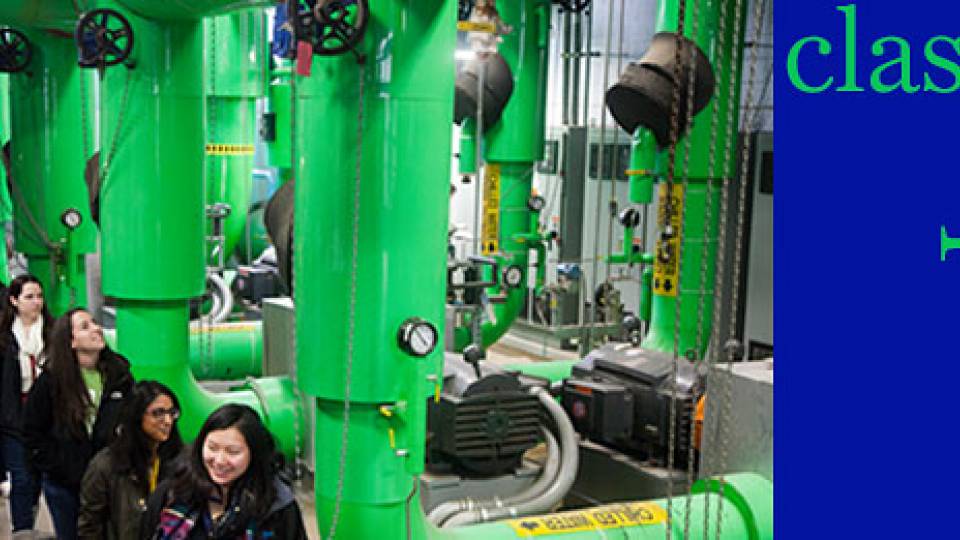
Edward "Ted" Borer, the University's energy plant manager, gives a tour of Princeton's cogeneration plant and talks about energy efficiency on campus. Read more.
Video Closed Captions
[MUSIC]
The cogeneration plant is really the
heart of our district energy system
and I think that an important thing
understand is that if we have
a hundred and fifty buildings that we're
serving,
there's maybe twelve thousand people on our
campus as the daytime population.
Normally, without the cogeneration
plant we'd need a
hundred and fifty boilers
and a hundred and fifty air-conditioning
systems.
With the central energy plant and
district energy I'm able to have
three boilers
and eight chillers
instead of one in each building.
There's three major pieces to the energy
complex. The furthest
is the cogen plant. That's where we make all our
steam and electricity.
The middle section is the chilled
water plant that's where we make
chilled water for the immediate
cooling needs of the campus.
And then the glass and stone building
was built as our
thermal storage plant.
The thermal storage plant is really
about
buying electricity when it's
inexpensive
and cooling the water that we use for
cooling the campus
and then delivering that water when the
value of electricity is quite high.
This is the thermal storage plant
that we have a variety of electric
and steam driven equipment
and large equipment and small equipment
and we value that tremendously, because
then we can pick the most optimal
piece of equipment on any given day
for the environmental conditions and the
campus demand.
The hot exhaust from the gas service
leaves this way. It's about 950 degrees Fahrenheit
It goes out through a catalytic converter
to absorb the carbon monoxide,
and then it turns this corner
and will go through this boiler
to capture the heat.
We take all the hot exhaust gas
and use that to turn water into steam
to heat the campus.
A typical central power plant might be
twenty-five to forty-five percent
efficient, but
by doing a cogeneration process we're
able to double that or even more.
If I put one unit of energy into the
gas turbine,
I get about one-third that unit of
energy out as useful electricity.
And about two-thirds comes out as hot
exhaust. So, by capturing that waste heat
or that exhaust heat,
now our overall process is
seventy and
can be as high as eighty-percent efficient.
The whole facilities engineering
department at Princeton
is working very hard on
reducing our environmental footprint.
Our new neuroscience laboratory is being
built to very very high energy
efficiency standards. Similarly, our new
chemistry laboratory, the Frick new
chemistry laboratory
is built with
very very high efficiency fume hoods and
they are used
only as much as they are needed
so in lots of ways we not only
improved the efficiency of our
production, but also reduce our
total use.
Over the twenty-five or thirty or even
hundred-year life
of some of our utility investments,
we save much much more than it costs us to
build the equipment
and our environmental footprint is much
much lower
by using district energy compared
to
distributed individual boilers and chillers.
[MUSIC]