Web Stories
From Sophocles to Shelley
Posted April 27, 2012; 12:00 p.m.
To view the multimedia features on this page, you will need to download the latest version of Flash Player and/or enable JavaScript.
Freshmen share their thoughts on a yearlong humanities course. Read more.
Video Closed Captions
LEKHA KANCHINADAM: The Humanities Sequence is all-encompassing.
We try to get music, philosophy, literature,
history, politics, and we get professors that
are experts in the discipline to come and
lecture.
PAUL FANTO: What is great about this course then is that
you get the scope. You get to see all the
works in relation to each other and you can
see how one flows into the other; how two
texts present the same ideas.
ANDREW FRAZIER: As a freshman it sets you up for so many different
disciplines because it gives you, you know
it builds you a scaffolding of all of Western
thought.
ISABELLE LAURENZI: The course starts with Homer and we read the
Iliad and the Odyssey, and then first semester
goes, so it starts with Homer and goes all
the way up to Dante.
PAUL FANTO: This new semester right now we're reading
Renaissance to modern works, is the most fascinating
I've studied just because I've had that background
from the first semester.
LEKHA KANCHINADAM: We've had a few lectures on the music in the
era and this semester we're lucky enough to
have Professor Scott Burnham whose a professor
in the music department. Professor Burnham
is vivacious and inspired and he gets us going.
He actually got us to sing a four part harmony
for one of the lectures so that was a lot
of fun.
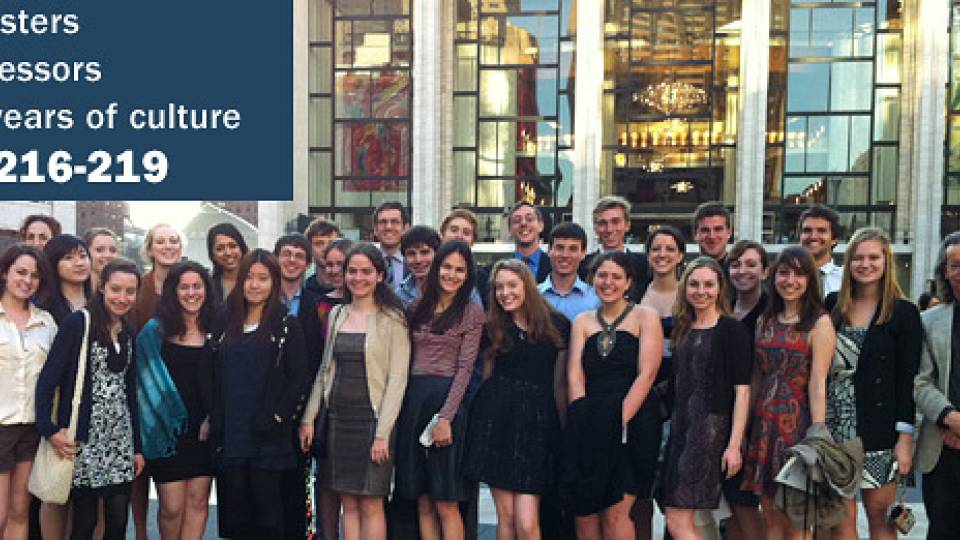
DYLAN LARSON-KONAR: Thanks to some generous donors who gave to
the program that puts together the HUM course
and the outings that we can do, we were able
to go to the Met Opera in New York to see
Don Giovanni, and this is while we were reading
Don Juan which has a lot of different parallels
to it.
MAELI GOREN: You should not let the fact that it's an application
process scare you because first of all you
got into Princeton, so you're qualified to
take this course.
ALAN RYAN: I'm not ashamed to speak with them, and to
ask them the reasons for their actions. Enlightenment
has to be struggled for.
LEKHA KANCHINADAM: My precept this semester is only 10 kids,
and we get‚ Äîeveryone gets a chance to talk
and really delve deeper into the text.
MAELI GOREN: I got to form great personal relationships
with professors in the film department, in
the comparative literature department. I feel
like those people all now know me personally
and take a personal interest in my academic
future.
ISABELLE LAURENZI: They're all really here for you.
ANDREW FRAZIER: What's the courses official title‚ ÄîInterdisciplinary
Approaches to Western Culture? Putting that
on your resume just sounds like you know
everything, and in a sense, you feel like
you do.