Web Stories
Alan Turing at Princeton University
Posted May 3, 2012; 12:00 p.m.
To view the multimedia features on this page, you will need to download the latest version of Flash Player and/or enable JavaScript.
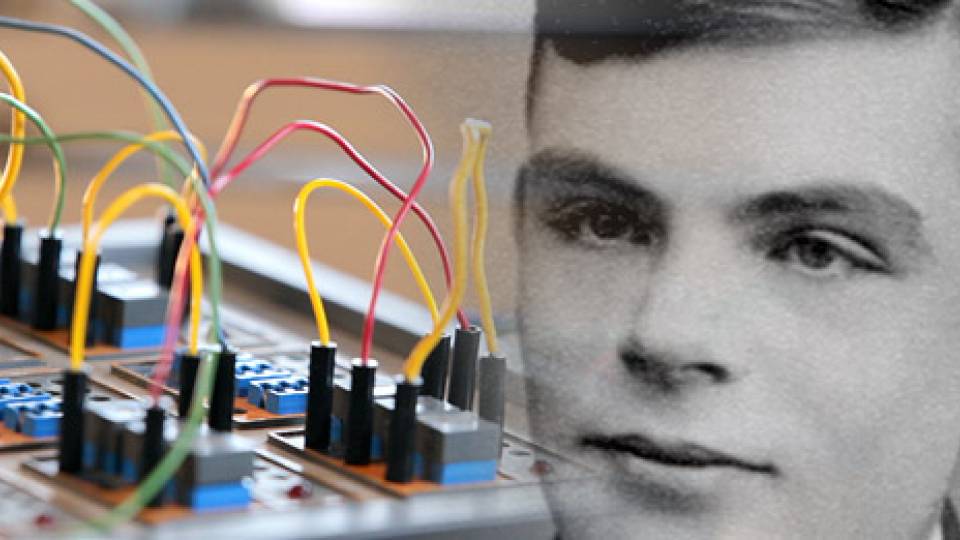
Alan Turing, who earned a Ph.D. from Princeton in 1938, is considered the father of computer science. Read more.
Video Closed Captions
ANDREW APPEL: 2012 is the 100th
anniversary of the birth
of Alan Turing, who in many
ways is the founder of
computer science.
When Alan Turing arrived at
Princeton in 1936, there was
no such thing as a
computer science
department, here or anywhere.
The math department, as it was
at Princeton in the 1930s, had
been built by Oswald Veblen.
He recruited some of the best
mathematicians and logicians
in the world.
The Institute for Advanced Study
was founded in about
1930, in Princeton, and for
the first 10 years of its
existence it shared a building
with the Princeton math
department, here in
the old Fine hall.
And this is where Turing and
Church and von Neumann and
even, Einstein, would have had
their afternoon tea and
discussion.
So when Alan Turing was about
23 years old, in Cambridge,
Alan Turing sent his paper "On
Computable Numbers" off for
publication and then he came
to Princeton, to study with
Alonzo Church.
Turing's paper, in 1936, was so
revolutionary that very few
people understood it.
Alonzo Church understood it, at
Princeton, and Kurt Godel,
but these were geniuses.
One could say, that the greatest
computer science
department in the world in the
1930s was the Princeton math
department because
Church's lambda calculus
became the prototype
of programming languages
that we use.
Turing's machine became the
prototype of the computers
developed by John von Neumann at
the Institute for Advanced
Study in Princeton, in which the
program is just stored as
data in the memory
of the computer.
When we program a computer
today, we don't have to go
change the wiring, we just load
in a program and that
concept goes back through von
Neumann, to Turing, and in
some ways all the way back
to Kurt Godel, in 1931.
Today Princeton, in the 21st
century, has a real computer
science department.
It Is one of the great computer
science departments
of the world.
We study many of the same
things that Alan Turing
himself, was interested in; the
theory of computation, the
construction of real computers,
we study artificial
intelligence, which Turing
became interested in in the
late 1940s, we study the
applications of computation to
biology, which Turing
became interested in
in the early 1950s.
We owe a lot to Alan Turing
and the mathematicians at
Princeton in the mid-20th
century.