Multimedia: Featured
'Sharing the Stage: Science and Art at Princeton'
Posted November 15, 2012; 12:00 p.m.
To view the multimedia features on this page, you will need to download the latest version of Flash Player and/or enable JavaScript.
Princeton seniors Anna Wuttig and Gary Fox talk about how they pursue their passion for creativity as they combine their interests in science and the arts. Read more.
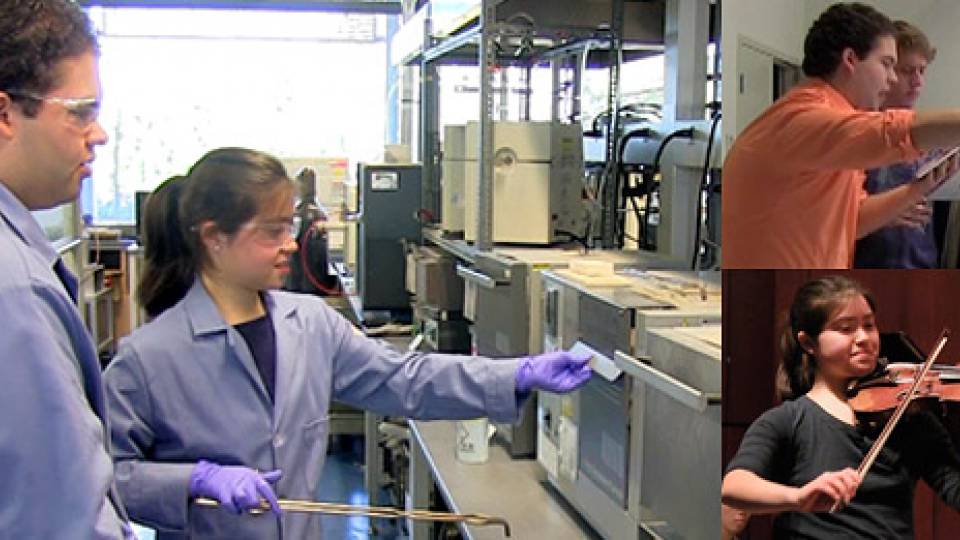
Video Closed Captions
[MUSIC]
GARY FOX: I think it
might have actually
been in the lab here.
ANNA WUTTIG: It was
definitely in lab.
GARY FOX: We were
both working.
ANNA WUTTIG: Yeah.
GARY FOX: And I started...
ANNA WUTTIG: No, no, you
mentioned, somebody mentioned
you in the lead of the play.
And I was like, what play?
TIM VASEN: Gary, our lead,
is a chemistry major.
I think there's a whole
huge range.
As is normal for us since we
don't have majors in the arts
here at Princeton.
We work with people that are
really interested in arts and
also usually really interested
in something else which makes
for a very interesting mix.
GARY FOX: And then you realized
that you were playing...
ANNA WUTTIG: Yeah, that
I was playing.
GARY FOX: ...for the same show.
ANNA WUTTIG: Yeah.
MICHAEL PRATT: Our first
violinist in the orchestra is
Anna Wuttig.
She's a senior.
She's a chemistry major.
Der Bourgeios Bigwig is an
English language version of
this Moliere play, Le Bourgeois
Gentilhomme with the
incidental music that was
written by the great German
composer Richard Strauss.
The arts at Princeton are very
much about collaborations.
And here was a collaboration.
GARY FOX: In Der Bourgeois
Bigwig, I play Mr. Jordan
who's a middle aged man who
with all of this money, he
decides that he wants to
buy himself culture.
ANNA WUTTIG: So the music
department at Princeton is
really great, because it offers
opportunities for
students who are not
even a music major.
I started playing the violin
when I was four years old.
And then, I continued
playing until now.
But I wanted to choose a more
science oriented career path.
Well, science and music, I feel,
are really interwoven,
because they're both creative.
In science, it's important to
study known systems and
reactions and understand them.
But also, it's important to be
innovative and so that we can
make new technologies
for society.
GARY FOX: If we're not creative
in the lab, we're not
going to be able to solve any
of the problems that we're
currently facing here in the
US and around the globe.
And on stage or with music, if
we're not creative, we're not
inspiring people to think
about the world
in a broader context.
And so even though people might
think that chemistry or
science and the arts or theater
and music are totally
separate things, they are
really interconnected.
ANNA WUTTIG: And in music, it's
important to study the
score and to know a little bit
about the composer's life and
to practice and work hard.
But when you're actually
performing, I experience I
forget all of that.
And I'm living in the moment.
And every note that I play is
something new and organic.
And that experience is
motivation for science and
vice versa.
GARY FOX: I like to think of
research and performance as
two entities that are built
out of a toolbox.
And those tools are different
for the discipline.
In science, we have balances,
we have furnaces, we have
mortars and pestles.
We have all of these things that
we need to use and put
them together in a way to
create something new.
Similarly on stage, we have
techniques, we have to
rehearse lines, we have certain
gestures, we can rely
on props that we can use.
And all of those work together
to create something that's
much greater than the
sum of its parts.
ANNA WUTTIG: Exactly.
[ORCHESTRA MUSIC]
[APPLAUSE]
MICHAEL PRATT: Working with all of these students,
I'm just in awe of them: The fact that they
play at such an exceedingly high level
AND do all this other stuff.