


Next: Material Properties Data Records Up: Format of the neutral Previous: Element and Node Set
Next: Material Properties Data Records
Up: Format of the neutral
Previous: Element and Node Set
IKEY,NUMB
Where:
| IKEY | = | -1 for transformation data |
| = | -3 for data set delimiter | |
| NUMB | = | the transformation identification number |
To be written in the format:
FORMAT(1X, I2, I5)
or: FORMAT (1X, I2, I10) for 10 digit transformation number format
Followed by four lines:
IKEY, TRANS1, TRANS2, TRANS3, TRANS4
IKEY, TRANS5, TRANS6, TRANS7, TRANS8
IKEY, TRANS9, TRANS10, TRANS11, TRANS12
IKEY, TRANS13,TRANS14, TRANS15, TRANS16
In the format:
FORMAT(1X,I2,4E12.5)
Where:
IKEY = -2
TRANS1 to TRANS16 define the transformation matrix
Notes:
![\begin{displaymath}
\left[ XT,YT,ZT,1 \right] = \left[ T \right] \left[ A \right] \end{displaymath}](img2.gif)
![\begin{displaymath}
\left[ XT,YT,ZT,1 \right] = \left[ \begin{array}
{cccc}
1& ...
...t] \left[ \begin{array}
{c} X\\ Y\\ Z\\ 1 \end{array} \right] \end{displaymath}](img3.gif)
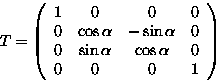
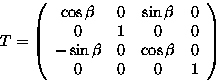
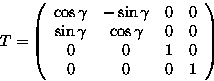
The matrices for some basic transformations are defined below:
A Translation (X,Y,Z ) :
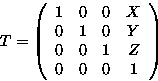
A Rotation about the X axis through angle  :
:
A Rotation about the Y axis through angle  :
:
A Rotation about the Z axis through angle  :
:
Scale Factor S , centre at origin:
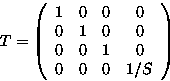
It may be necessary to rotate, translate and scale a model to include it in an assembly. If this is the case, a compound transformation matrix will be needed. The compound matrix may be determined by expressing the compound transformation as a combination of the five simple transformations given above. These matrices must then be multiplied together in the correct order to give the compound transformation matrix.
For example, it is desired to rotate a model about some point in space (mx,my,mz ), scale it by a factor S about this point, and translate the model so that the centre of rotation is moved to a point (tx,ty,tz ). The compound transformation matrix would be determined in the following way:
![\begin{eqnarray*}
\left[ T \right] & = &
{\left[ \begin{array}
{cccc}
1 & 0 & 0 ...
...-m_{y}\\ 0 & 0 & 1 & -m_{z}\\ 0 & 0 & 0 & 1 \end{array} \right]} \end{eqnarray*}](img12.gif)
Once the components of the compound matrix have been found they may then be related to the correct term number (1 to 16) and entered in the format specified above.
Femsys Limited