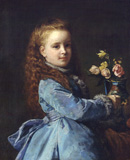
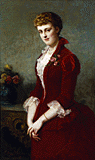
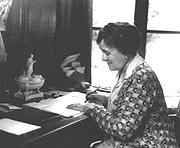
Edith Wharton, The Age
of Innocence (1920)
Edith Wharton's The Age of Innocence became an immediate best
seller on its publication in 1920. It also, like Gone With the
Wind, won the Pulitzer Prize -- Wharton was the first woman to do so
-- and made its author rich and famous. Or in Wharton's case, more
rich and more famous: she was already a wealthy, well-respected novelist
in 1920 (and had published one earlier best seller, 1905's The House
of Mirth), but The Age of Innocence (in addition to rewarding
her very well financially) won Wharton the scholarly accolades she had
long desired. Five film versions of Wharton's novel were made during
her lifetime (she died in 1937). The most recent version is Martin
Scorsese's 1993 adaptation, starring Daniel Day-Lewis as Newland Archer,
Winona Ryder as May Welland, and Michelle Pfeiffer as Ellen Olenska.
A copy of this film is on reserve in the language lab in Jones Hall.
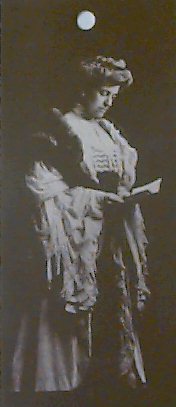
This photograph is captioned on one website as "Edith as she
appeared on a postage stamp." (Click here
for link.) |
Some questions to consider as you're reading
The
Age of Innocence:
• What does the term "innocent" mean in the context of the novel?
Who or what is innocent, and in what ways? Is innocence something
to be praised or shunned?
• Who is the main character of the novel? Is it Newland?
Ellen? May? Who does the narrator seem most to empathize with?
• Critics can't decide whether this is an affectionate and forgiving
look at "Old New York" or a satiric and ultimately critical one.
Which do you think it is?
• Along these same lines, would you say this is a novel best understood
in the context of the 1920s (its decade of publication) or in the context
of the 1870s (the story's time period). What difference might it
make?
• Are you surprised by Newland's decision at the end of the novel?
Why do you suppose Wharton chooses to end the story this way?
• What kinds of readers (then or now) do you think would be most attracted
to the novel? Why? What do you suppose made this book so popular?
|
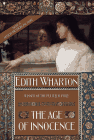
Below are three recent covers to the book. The first
is, perhaps, more traditionally "literary," as culturally befits a Pulitzer-Prize
winning novel by a canonical author. Its iconography invokes "fine art,"
rather than "popular literature." It's the closest of the three to
the edition we're using this year.
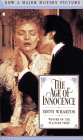
The next cover is a movie "tie-in," produced with
the 1993 film version directed by Martin Scorsese and starring Michelle
Pfeiffer and Daniel Day-Lewis, selling both the movie and the book simultaneously.
Similarly, it might be argued, its iconography keeps a foot in both the
"high" and "low" art camps.
The final cover is a very recent paperback "romance"
cover, designed to look like other romance novels, marketed in the romance
section, and including the description: "A story of love and betrayal among
the rich and sophisticated." The cover also notes, however, that the book
won the Pulitzer Prize.
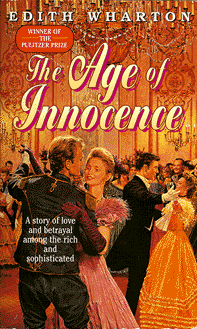
All three of these covers sell the same text.
Here are some links to sites about Edith Wharton, with information on
The
Age of Innocence:
The
Edith Wharton Society Home Page
Edith
Wharton: Domestic Goddess
Edith Wharton:
An Overview with Biocritical Sources
Edith Wharton's
World: Portraits of People and Places
University
of Toronto Edith Wharton page
Edith Wharton Restoration
(a site dedicated to restoring "The Mount," Wharton's former home; also
includes more general Wharton links)
The
Age of Innocence -- e-text
Images of Wharton: