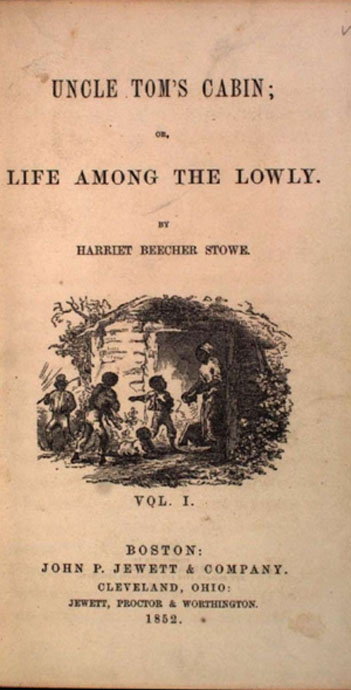
Stowe's novel was quite simply the publishing phenomenon of the 19th century, both in the United States and abroad. First published serially in 1851 in the abolitionist newspaper The National Era, the 1852 book version of Stowe's tale almost immediately became the biggest selling novel of the age. Charlotte Temple had been a tremendous success, to be sure, but Uncle Tom's Cabin's popularity was quite literally unprecedented. It has never gone out of print, and has been translated into (at last count) thirty-seven languages. It has also lived on in countless popular culture incarnations, including dramatic adaptations, children's versions, and various forms of Uncle Tom's Cabin "kitsch" (handkerchiefs, candlesticks, wallpaper, games, and so on.)
Some questions you might keep in mind as you read:
• What does the phrase "Uncle Tom" mean to you? Compare your impressions
with the actual depictions of Uncle Tom in the book.
• How does the book make you feel? Angry? Frustrated?
Sad? Amused? Offended? Sympathetic? Where, and
why?
• Where does the power of this book lie? In its style?
(What is that style like?) In its language? In its characterizations?
In its plot? In its moral outrage? Its irony? Somewhere
else?
• Who do you think Stowe's principal audience was? What kind
of readers do you suppose would have liked the book? Who would have
disliked it? Why?
• Is there any particular character in the book who functions as Stowe's
"mouthpiece"? Who (if anyone) speaks for the author in this text?
• How would you describe the novel's attitude toward religion?
Toward African Americans?
• Is the ending of the novel satisfying? Why, or why not?
Then, as you read Philip Fisher's introduction to Hard Facts in the course packet, you might ask, how does Fisher's definition of "cultural work" differ from Jane Tompkins's (from week 1)? Which do you find more persuasive, and why?