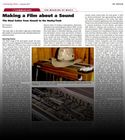
The steel guitar arrived from Hawaii onto the US mainland in the early 20th century and its sound created a craze for Hawaiian music that lured travelers to the islands as the tourist industry formed. As the sonic icon of tropical tranquility from Hawaii, the electric steel guitar was taken into swing and country music on the mainland and then became the signature of country’s “hillbilly” sound. This sample sequence from our film in progress features a number of the “men of steel” who brought the steel guitar into country music; they played with numerous legendary singers from Hank Williams, Merle Haggard, Waylon Jennings, Willie Nelson, Johnny Cash and Patsy Cline, to musicians like Ringo Starr, Paul McCartney, George Harrison, Linda Ronstadt, James Taylor, Sting, and Elton John. In this scene, they recount the moment when the steel guitar redefined the sound of country music when pedals were added. The scene also flips over the steel guitar and follows its sound from its mechanical origins in the machinery of US military and aerospace industries toward a logical yet surprising direction.
In interviews not included in this scene, these pioneer steel players recount how the music industry promoted the steel guitar’s “voice” and used its “hillbilly” sound as an icon to distinguish and promote country music as a commodity. Steel guitar players were prominently featured as soloists by kicking off songs and using the steel’s voice to dialogue with vocalists, as Don Helms describes his playing to accompany Hank Williams. But when the music industry shifted its emphasis from live performances to selling recorded music in the late ‘50s to early 1960s, the industry promoted vocalists more heavily and diminished steel guitar’s prominence. Rather than playing a role as a musical “voice,” the steel was used for fills and blended into the background as “texture.”
In many single records aimed at crossing over into popular markets, producers replaced the steel (and the fiddle) tracks with strings and a chorus in order to “de-hick” country music. By the late 1960s, however, the L.A. rock band The Byrds devoted their 1968 album Sweetheart of the Rodeo to a country sound and featured two top session players in L.A. and Nashville on steel guitar, including Lloyd Green who appears in this scene. By addressing country and rock audiences, Sweetheart sought to diminish cultural and political differences between the US south and north during the Vietnam War. Musically, the record opened country and steel guitar music to pop and rock artists such as the Rolling Stones, and back in Southern California, Buffalo Springfield, the Eagles, Linda Ronstadt, and Jackson Browne. The pedal steel guitar sound was used in many of the rock, pop and country radio hits well into the 1970s. Perhaps the most well-known steel guitar lick to this date is the one that kicks off Crosby, Stills, Nash and Young’s “Teach Your Children,” a song that was inspired by anti-war sentiment and belies its sonic origins in the machinery of the military industrial complex.