
|
The notion of a network may be the best means through which
to appreciate the particular qualities of globalization, Most
literally, networks are arrangements of connections into nets,
or openwork systems linking groups of points and intersecting
lines. Obvious examples are the body’s circulatory network of
veins or a country’s arteries of rivers, canals, railways, and
roads. Networks may also be interconnected chains or systems of
immaterial things, events, or processes. A focus on networks
allows us to examine the integration of economic, social,
political, and cultural regimes as a process in and of itself.
Viewing globalization as a network allows us to combine different
forms of interaction (e.g., trade, migration, conflict) into a
cohesive portrait of international integration.
But network maps can often seem like nothing more than random lines. Using the technology developed by Net Map Analytics, we have produced several representations of the network of contemporary trade. In these images, boxes, color-coded and grouped by continent (according to United Nations designations), each represent a country. The countries are organized in a circle at the center of the image, and then repeated in the smaller surrounding circles. The dark green lines connecting countries in the outer circles represent trade links within that grouping or continent. The lines in the very center of the circle represent inter-group, or inter-continental trade. Example PDFs |
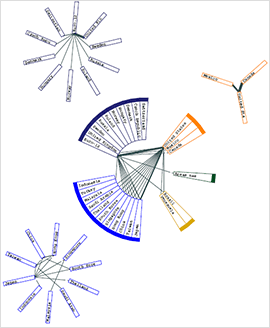 Sample Network Map
The boxes represent countries. The dark green lines represent trade links. |