
|
October 19, 2005: Perspective
After Katrina, three Princetonians reflect
Illustration by Marc Mongeau |
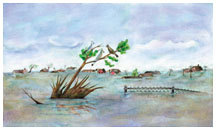
By Michael Pettit ’72
Michael Pettit ’72 has received a National Endowment for the Arts fellowship, the Iowa Poetry Prize, and other awards for his work. His new book, Riding for the Brand, is forthcoming in 2006 from the University of Oklahoma Press. He lives in Santa Fe.
A strong wind whipped the waves against the seawall; even inside you could hear the racket. The movie was about a man who lost his memory in an accident and as a result lost everything: his family, his friends, his money. He found himself a stranger in a strange city.
— Walker Percy, The Moviegoer
Before I left for Princeton in 1968, New Orleans was my home. It is still home — though now unlivable — to my mother, sister, and many friends. I go back often and with great pleasure — I was scheduled to fly in on Aug. 31, to work on my mother’s house, maybe eat at Jacques-Imo’s, take leisurely walks through Old Metairie. But as Hurricane Katrina swirled across the Gulf of Mexico my plans, like the lives of so many Gulf Coast residents, changed.
Now, two weeks after Katrina struck Louisiana and Mississippi early on Aug. 29, New Orleans is largely evacuated, terribly damaged, and constantly in my thoughts. I did not get back and don’t know when I will or what I’ll find. My mother’s home is still flooded.
I grew up in a neighborhood of three somewhat isolated streets on the Orleans-Jefferson Parish line, which is formed by a drainage canal — the 17th Street canal that overflowed and breached its levee near Lake Pontchartrain, flooding the city. Kids in our neighborhood would play along the canal, which normally carried rainwater to pumping station #6, a massive brick structure surrounded by a high chain-link fence, in New Orleans called a “hurricane fence.” The canal and pumping station were part of the extensive system required to keep the city from going under the nearly 70 inches of rain each year. When not running with rainwater, the concrete channel offered the residue of previous storms — a rusting shopping cart, waterlogged boards, a pair of ragged jeans. Just north of the pumping station ran a line of Southern Pacific railroad tracks; Metairie Road formed our border to the south.
On the east side of the neighborhood, where I lived, on an island in the street out front was the Big Oak. Kids climbed out on its enormous branches and dropped acorns on passing cars. It was home base for every game, where we’d meet after school or disperse for home as mosquitoes whined at dusk. Even then, the Big Oak was over a century old, held together by cement to keep it from splitting apart, and I wonder whether it has survived. Beyond our backyard, past the ligustrum hedge and fence, lay Metairie Cemetery. Built on the site of a former racetrack, its rows of white tombs were another playground, its clamshell roads where my father taught my sisters and me how to drive. At the entrance was a soaring monument topped by marble angels and bearing the charges: “Faith.” “Hope.” “Charity.” Metairie Cemetery is where my father is buried, and my older sister. In the immediate aftermath of the hurricane and flooding, my mother, with me here in New Mexico, was inconsolable at the thought of her husband and daughter lost under floodwaters.
She was perhaps remembering the terrible accounts of graveyards on the Mississippi Gulf Coast washed away by Hurricane Camille, which struck near Bay St. Louis in August 1969, nearly destroying Gulfport and Biloxi. Rebuilt, the Mississippi coast has once again been shattered, and who knows what will be its next incarnation. That’s also the question now for New Orleans, which has always resisted fundamental change. Unlike Atlanta or Houston or Dallas — booming New South cities that spin out suburbs like cyclonic winds — New Orleans was an exercise in perpetual restoration of its graceful, funky, sensual soul. It wasn’t going anywhere, in part because there was nowhere to go, with the lake and river and Gulf holding it back, just like its levees held their waters back. So New Orleans was a hothouse under big bruised cumulus clouds: lawns of thick St. Augustine grass; yards rich with azaleas, camellias, gardenias; streets lined with magnolias and live oaks that formed canopies overhead while their massive roots buckled the sidewalks we negotiated on roller skates.
Although over time the city grew, from the original French Quarter and American Garden District — early animosity between those cultures led to establishment of “neutral grounds,” what New Orleanians call the medians of boulevards — it never seemed ambitious. Rather than materialism, its choice was usually hedonism. The real bricks and mortar of New Orleans are food and music, sensual pleasures that drew visitors to the city and will draw its residents back. In the aftermath of Katrina, from shelters or distant homes, we look at newsreel footage and aerial photographs of flooded neighborhoods. Lives are lost, countless homes ruined, a million people displaced before our eyes. We check on old friends and hunt for reliable accounts of damage. We mourn the destruction and wonder about restoration of personal lives and our culture: Would Preservation Hall and Tipitina’s ever reopen? Would Mardi Gras roll and the JazzFest return to the Fairgrounds? What about Galatoire’s, Commander’s, Drago’s with its billows of smoke from charbroiled oysters?
These are not frivolous questions for New Orleans, despite the clear and immediate need to attend to all who have been uprooted and scattered. A family has come to stay with me in New Mexico; others are in shelters in Houston and San Antonio, churches in Shreveport, apartment complexes in Illinois. People around the country and around the world respond with concern and support that brings me close to tears several times a day. The present tense is critical, but the past and future of New Orleans cannot be understated. Jazz, blues, zydeco. Gumbo, crawfish etoufee, po’boys from Parasol’s in the Irish Channel, breakfast at the Camellia Grill. Streetcars rattling down St. Charles Avenue, Canal Street, or Carrollton. A Cajun or Cuban accent here and there, voices of poor black folk, the unique idiom of the city. At Princeton everyone asked why I didn’t have a Southern accent, and I explained that New Orleans was a port city on the rim of the Caribbean, with a history that was French, Spanish, black, white, Irish, Cajun, Italian, Cuban. I explained that its neighborhoods varied block by block: Garden District mansions with broad porches and leaded glass doors on one street, shabby little shotgun houses on the next. Former Mayor Marc Morial, now head of the Urban League in New York, said in the wake of Katrina that New Orleans was the city that invented multiculturalism. I’m not sure of that, but it certainly wasn’t the place to pick up a traditional Southern accent or outlook. “Where y’at, darlin?” you hear — or did — in Fat City or Bucktown or Gentilly, the local “How do you do?” It’s a penetrating question now.
The summer after my freshman year, I worked offshore on oil rigs 50
miles out in the Gulf of Mexico. That hard work paid well, with a week
on and a week off, sometimes two weeks on, two off. Twelve hours a day.
By the time a shift ended, everyone was ready for home, wherever that
was — some guys back to Picayune or Poplarville, Miss., some to
Plaquemines or Chalmette. Climbing off the crew boat in Venice, very near
where Katrina struck Louisiana, all of us were eager after exile for familiar
lives. I remember catching a ride with a couple of Cajuns headed for Lafitte,
which required a drive up the Mississippi River to New Orleans, then back
down the bayou. I could hardly follow the speech in the front seat —
at times the patois French of south Louisiana, at times English so accented
I hardly recognized it. I was physically and emotionally exhausted from
my two weeks away, and drifted off to sleep. When I awoke, we were coming
up the Belle Chasse highway, and there in sunlight soared the Mississippi
River Bridge and beyond it the shining buildings of downtown New Orleans.
There it was, still standing, waiting for me, my city — solid in
a fluid world, full of memory and promise. Now as never before I remember
how I was swept with relief and love, that sense we always have when returning
home. 
Illustration: Linda Helton |

By Margaret Johnson ’05
Margaret Johnson ’05 writes from Brooklyn, N.Y., where she moved in July. She majored in English at Princeton.
I used to say that New Orleans was the city of sin and redemption. It’s a good sound bite, one I started easing into conversations soon after I arrived at Princeton. This is odd, because one of the reasons I wanted to go away to college in the first place was to leave New Orleans, the city where I was raised. Despite its many charms, I felt stifled there. It wasn’t the glutinous humidity or the population of robust, overgrown cockroaches but the utter languor of the place, the absence of any anxiety or ambition, certainly any wanderlust. I have never been able to muster the contentment that so many New Orleanians have always manifested, despite the rampant poverty, low-quality public education, rumbling racial tensions, and bureaucratic ineptitude that have plagued the city for years. The general absence of stress there stressed me out.
When I left New Orleans for Princeton, I looked forward to joining a community where people recognized that the hard things in life are the things worth doing. Soon after I arrived, however, I began to fear that I didn’t have as much to offer as my new classmates. I panicked. Could it be that I was fundamentally uninteresting? Uninteresting wasn’t such a far cry from that most horrifying of adjectives, mediocre. Soon, and not entirely subconsciously, I began mining my New Orleans upbringing for fragments of “local color,” which I used to construct a sort of caricature of myself: the jaded, strayed-Catholic quasi-belle. I donned this persona when that nearly mediocre feeling came over me, plying new acquaintances with Bloody Mary recipes and debutante ball anecdotes. I hoped never to live in New Orleans again, but I milked my association with it for all it was worth.
Only in the last two weeks have I felt a stirring to move back home, and I owe that to Hurricane Katrina. Having grown up listening to the lore of Camille and Betsy, I was initially nonplussed by the storm that became one of the single most devastating disasters in American history. My sister was born amid the all-but-forgotten thrashing New Orleans received from Hurricane Juan in October of 1985. In my memory, every tropical storm that came within a certain distance of New Orleans was forecast to be “the big one,” the tempest that would assault the city at its most vulnerable point and wash Lake Pontchartrain into our homes. During my time at Princeton, any phone call I made home to my parents in the early fall inevitably involved a discussion of the latest tropical depression brewing in the Caribbean. “This could be it,” my mother would sigh. I came to dismiss her worrying as the product of sensationalist meteorology and always declared my confidence that we’d be spared in the end. And this was my attitude on Sunday, Aug. 28, as I watched my father watch CNN’s coverage of Katrina’s approach from our hotel room in Amsterdam, a city I was visiting for the first time. As the searing red fireball on the Doppler radar swirled across the television screen again and again, I pouted. The Katrina hype was delaying our exploration of the Prinsengracht. “It’ll turn and go to Mobile at the last minute,” I said. “It always does.”
As we know now, the biggest blow suffered by New Orleans came in the form of the rising waters and the veneer of stability it dissolved. Before Katrina, my father used to claim that New Orleans possessed interracial tolerance, if not harmony, that doesn’t exist elsewhere in the country. He often reminded me that New Orleans was the only major Southern city not to have a race riot in the ’60s and early ’70s. Besides, he used to say, New Orleans hosts a riot every year in the form of Mardi Gras, when the 1.5 million residents of the metropolitan area engage in collective drunken revelry. Mardi Gras is also a time when wealthy, mostly white citizens ride through the streets hooded and masked, on floats or on horseback, tossing thousands of dollars’ worth of cheap baubles to the masses. With the exception of the handful of murders that occur every year over the weekend before Fat Tuesday, the whole thing goes off without a hitch.
I once asked my father how the police manage to keep the peace during this frenzied pageant of inequalities, which he does not regard that way. His answer, gleaned from his own years riding in the parades of a carnival organization to which he belongs, is that the police don’t hesitate to use force. “From the float you could see when a fight broke out in the crowd,” said my father, “and the next minute there would come a police officer and beat the living hell out of whoever was making trouble, and everyone who saw understood right away what happened to you if you stirred things up.”
Affluent New Orleanians have always known about the extreme poverty in which so many of their fellow citizens, mostly black, live. I was born in 1982, 18 years after the Civil Rights Act of 1964 was passed, but I have never lived in an integrated society. I have been conscious of this fact for as long as I can remember, though I have done little, if anything, to remedy it. My most vivid memories from childhood are of afternoons spent around the swimming pools of Metairie Country Club, whose membership is lily-white. Black waiters wearing jackets in the wet August heat served me grilled cheese sandwiches and French fries and called me “Miss” before turning, wiping the sweat from their foreheads, and hurrying off to get someone else’s grilled cheese.
It’s possible that Katrina will serve as a wake-up call to those willing to return to New Orleans, white and black. The natives of the city whose socioeconomic failure the entire nation has been forced to acknowledge in recent days could finally address that failure honestly and actively. Or they could readopt the passivity that led so many residents confronted with a category-four hurricane to appeal to the mercy of Our Lady of Prompt Succor, pool their liquor supplies, and hunker down to wait out the storm.
I wish I could say with idealistic fervor that I am moving back to New
Orleans to help rebuild it differently. I wish I could convince myself
to take a job teaching English in the Orleans Parish public school system,
where four in 10 10th-graders cannot demonstrate “English approaching
basic” on standardized exams. But because I was born white with
money, I was able to attend an excellent private school and get into the
finest university in the country and get out of New Orleans long before
the storm. I do not have it in me to renounce the opportunities now open
to me. So I find myself in New York still using my birthplace for a story,
hoping redemption comes magically, mercifully, of its own accord, to New
Orleans and to me.
Illustration: Michael Woloschinow |

By Dan Grech ’99
Former PAW student columnist Dan Grech ’99 is the Americas correspondent for Marketplace, the public-radio business news show, and has written for major American newspapers.
I was driving again through Bayou La Batre the other day when I took a turn down a road I hadn’t traveled before. Since Hurricane Katrina hit, I’ve been traveling a lot of unfamiliar roads. I have crisscrossed the Gulf Coast of Mississippi and Alabama, map in hand, surveying storm damage east of the eye — areas outside the eye of mainstream media coverage, which has focused on New Orleans.
Bayou La Batre is a scruffy Alabama shrimp town, a place where the secrets of shrimping are passed from father to son like a secret recipe. Bayou La Batre gave me my first taste of the destructive power of Katrina. Even here, a good 80 miles east of where it made landfall, a wall of water taller than a tree lifted up dozens of trawlers and deposited them onshore like beached whales, masts askew. Within a matter of hours, a longtime seafood town became a ship graveyard. Even so, in the cold calculus of storm damage, this town was lucky. Katrina erased towns in Mississippi that were closer to the eye. In Bay St. Louis, all it left were stately oaks denuded of their leaves and slabs of concrete where homes once stood.
Bayou La Batre was dying even before the storm. With the high price of fuel and the low price of shrimp, its sea captains were starting to disappear. The town was a place where nostalgia and the smell of the sea hung together in the air. That, of course, was before the storm. Today the place smells of sea scum and rotted shrimp and raw sewage. Still, the gruff charm of the village, and its people, remains — and it snared me in its net. Three weeks after the storm hit, I found myself drawn back to Bayou La Batre for a second visit.
As I drove down that unfamiliar street, I passed a small one-story house whose front lawn was covered in debris.
I was curious, so I pulled over. As I walked up the driveway I heard hammering inside the house and the Alabama football game on the radio. I found a group of men tearing out the walls. They used crowbars to wrench off the panels, exposing mold on the wood frame. The bare frames looked like the rib cage of a wildebeest picked cleaned by lions. It was an emptiness once filled with life.
I introduced myself to the owner of the house. His name was Robert. He told me that the storm surge had reached above his counter tops, soaking everything. He had homeowner’s insurance, but because he didn’t have flood insurance, his insurance company told him nothing was covered. A man of the middle class was suddenly dirt-poor. He had to salvage what he could. He laid out his belongings on his lawn to dry them. There was the three-volume set of books on the Vicksburg campaign, a model train set, his underwear. His wife’s wedding dress floated in the breeze like a ghost. Robert picked up a children’s book, The Cajun Night Before Christmas. He started peeling apart the pages. They made a satisfying smacking sound as they separated to reveal drawings of the true Santa Claus, the Cajun Santa Claus, the one whose barge of presents was dragged by a team of alligators.
I have seen the worst that Hurricane Katrina had to offer. I met a woman walking along the beach in Waveland, Miss., whose home was swept to sea. All she recovered were a few photos and her son’s pocketknife. President Bush mentioned Trent Lott’s porch in Pascagoula. Well, I sat on what’s left of it: a pile of bricks.
Still, of all my Katrina images, Robert is first in my mind. What moved me was to see his life laid bare, its most valuable and intimate and private parts spread scattershot on his front lawn for all to see. I walked up Robert’s driveway and knew, for instance, what his wife wore on their wedding day. It was a life eviscerated, entrails spread on the surgeon’s table for inspection.
That moment encapsulated what Hurricane Katrina has come to mean to me. The storm didn’t simply strip bare the shoreline of the Gulf Coast. It bared an entire people. It stripped them of everything — everything they had ever bought, everything they had ever valued. It turned Donna Bennett, a proud mother of three who home-schooled her children in good Christian values, into a beggar. I found her picking through a pile of donated clothing dumped onto the lawn of her church in Bayou La Batre, a mock shopping trip for a dress that might make her feel pretty again. Still, when I asked to take her picture, she took a moment to let down her unwashed hair.
Katrina showed me how fragile and how resilient we can be. I saw Tommy Kidd Jr. thread a thin rubber hose into the gas tank of his flooded truck. He sucked on the hose until he gagged. But before he fell to his knees and threw up, he directed that tube into a red gas can. Gotta do what you gotta do, he told me, the gasoline still burning his mouth. Tommy needed that gas to power a generator that kept the fans running at night. Without fans chasing away the 90-degree heat, he and his wife and neighbors wouldn’t sleep.
When people are driven to raw survival, a clarity emerges. The storm bared the racial and class divides that frame this country. Once the panels were stripped, we all saw the mold. But I found something else in my travels. I found it in the team of firefighters who took a month off work to help people retrieve valuables from their toppled homes. I found it in the bus of Tennessee high schoolers who cleared people’s yards. I found it in Robert’s friends, who helped him strip his home; in Donna, who insisted I take a can of Vienna sausages for the ride home; in Tommy, who got gas for others.
I found that when people are at their lowest and most desperate, when
they value a bottle of water over a wad of cash, when they become their
most basic and essential selves and they reach that inescapable crossroad
where they have to choose whether to steal or to share, they tend to choose
the steeper path. What Katrina showed me, as I traveled in its destructive
wake and listened to the stories it left behind, as I witnessed act upon
act of kindness and charity and selflessness and love, is that human nature
tends toward goodness. It’s a lesson I won’t ever forget.

Features 2 Title
Body copy goes here.
