|
October 19, 2005: President's Page
THE ALUMNI WEEKLY PROVIDES THESE PAGES TO THE PRESIDENT
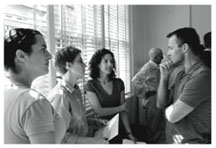
New fellows (left to right) Gayle Salamon (English), Margot Canaday (history), and Jennifer Rubenstein (politics) chat with second-year fellow Martin Scherzinger (music) at the Society of Fellows’ opening seminar. |
The Society of Fellows
This year marks the fifth anniversary of the Society of Fellows in the Liberal Arts—a community of scholars that has broadened and deepened the intellectual conversation on our campus in myriad ways. Currently headed by Leonard Barkan, the Arthur W. Marks ’19 Professor of Comparative Literature, the society has assembled a small but brilliant group of postdoctoral scholars, cultivating new ideas and creating a framework in which these ideas can be exchanged without regard to disciplinary boundaries. Intellectual openness and rigor have been hallmarks of the society since former president Harold Shapiro *64 and former provost Jeremiah Ostriker, along with Alexander Nehamas *71 and Carol Rigolot of the Council of the Humanities, launched this venture in the fall of 2000 supported by a generous gift from Lloyd Cotsen ’50.
Since that time, 28 young scholars have been invited to pursue their research on our campus and share their wisdom and enthusiasm with our faculty and students. Although the majority of fellows are drawn from the humanities—fields that lack a strong tradition of postdoctoral fellowships—the social and natural sciences are also represented, resulting in a fertile mix of views and methodologies. Fellows are chosen who embody this multidisciplinary spirit: fellows like Dominic Johnson, who holds doctoral degrees in both evolutionary biology and political science; Anne-Maria Makhulu, an anthropologist who last spring co-taught a course on nation and race in South African literature with Professor of English Simon Gikandi; and historian Benjamin Kafka, who, like several other fellows, shared his expertise with students in the interdisciplinary introduction to Western culture sponsored by the Program in Humanistic Studies. Fellows must also excel in their primary fields, and we have been fortunate in attracting scholars whose dissertations have broken new ground and whose impact as researchers and teachers already promises to be far-reaching.
Princeton is not the first university to establish a Society of Fellows, but ours is certainly one to which other institutions can look—and have looked—for inspiration. Two of the society’s strongest features, in my view, are the length of its fellowships and its relationship with other sectors of the University. Fellows are invited to spend three years at Princeton, allowing them to establish connections among themselves and with others that could never be forged in a single academic year. They also have time to advance their scholarship beyond the frontiers set forth in their dissertations, as well as to teach a variety of courses. The Society of Fellows is not simply a stimulating stop on the road from graduate school to a junior faculty appointment. It is an intellectual journey in and of itself, with milestones in the form of weekly seminars where work-inprogress is presented, and with continuous mentoring by the society’s seven faculty fellows and a designated mentor in each of the fellows’ host departments.
This brings me to the place of the Society of Fellows at Princeton. Rather than forming a rarified enclave, tucked away in the historic Joseph Henry House, the society has become an integral and highly regarded part of our University community. Each fellow is hosted by—and participates fully in—a department, and is encouraged to affiliate with one or two interdisciplinary programs. Half the fellows’ time is dedicated to teaching, collectively representing some 20 courses a year, and this involvement extends all the way from freshman seminars to graduate-level classes. Undergraduate advising further strengthens the fellows’ contact with students and faculty; last year, for example, Christopher Bush, who holds a doctorate in comparative literature, guided no fewer than three senior theses and one junior paper.
In fact, the fellows seem to be everywhere, despite their modest numbers—from scholarly conferences and seminars, to reading and discussion groups, to student programs and organizations, and this does not include the society’s own events. Yet, even here, the society looks outward, inviting faculty and students with similar interests to attend its weekly seminars, as well as its monthly dinners, where third-year fellows and faculty have an opportunity to present their research at length. One of the society’s most exciting innovations has been a series of workshops in contemporary scholarship—an opportunity for fellows to bring other scholars to campus to explore the issues that concern them most. Topics have ranged from “After Afro-Pessimism: Fashioning African Futures,” to “Islam and the Study of Religion,” to “Neoliberalism: Historical Perspectives and Critical Possibilities.” As Professor Barkan puts it, “Every one of these events . . . has brought something new to Princeton, something that could have been envisaged only by the very brightest individuals of the coming generation.”
With a wealth of talent on which to draw—no fewer than 937 applications
were received last year—and a perfect placement record in faculty
positions, including, for the first time, Princeton, once the fellows’
term is completed, the future of the society looks bright indeed. This
future includes a number of targeted fellowships that will supplement
the Cotsen-supported fellowships that form the core of the society. The
former will focus on LGBT studies, thanks to the support of alumni in
the Fund for Reunion; the history of the book, thanks to a Mellon Foundation
grant provided by Humanities Council chair Anthony Grafton; and the study
of race and/or ethnicity, an initiative of my office and that of the Dean
of the Faculty. We hope that these fellowships will encourage research
in new fields and further widen the society’s perspective, drawing
its fellows and Princeton as a whole into a conversation like no other.