First Person - January 27, 1999
- Activist Scholar
Eric Goldman marshaled history in the cause of social justice
by Daniel J. Kevles '60 *64
Activist Scholar
Eric Goldman marshaled history in the cause of social justice
by Daniel J. Kevles '60 *64
Not long after his arrival at Princeton, in 1942, Eric F. Goldman began
work on an ambitious history of modern American reform. Published 10 years
later to critical acclaim, Rendezvous with Destiny -- the title derived
from Franklin D. Roosevelt's speech, which had thrilled Eric when he heard
it delivered in 1936 at Franklin Field, in Philadelphia -- analyzed the
development of the grand tradition of liberalism in the United States. Yet
Eric also hoped that the book would make a difference in the life of his
country. For he held that what people believe about the past helps shape
their attitudes toward the present and the future. To him, history was a
weapon for social change, and he passionately wanted to help change the
United States.
Eric was eager to change the world because he had learned early in life
that much of the world was not very pleasant. Born in Washington, D.C.,
in 1915, he grew up in Baltimore, amid a grinding poverty that drove his
mother into a mental sanitarium. His earliest memories were of a dilapidated
one-ton Chevrolet truck from which he helped his father, Harry Goldman,
a crusty but caring man, eke out a living selling fruits and vegetables
-- until the Depression wiped out the business and his father turned to
struggling as a taxi driver.
A prodigy, Eric graduated from high school at age 16, entered the Johns
Hopkins University with sophomore standing, and eventually skipped his bachelor's
degree to proceed directly into graduate work in history. During his years
as a student and then an instructor at Hopkins, he came under the influence
of the columnist and social critic H. L. Mencken, who befriended Eric when
he moonlighted as a reporter for the Baltimore Sun, and the economic historian
Charles Beard, who hired him as his assistant. Mencken helped Eric learn
how to write, and Beard impressed on him the possibilities of writing books
that, by exposing the contradictions of the past, might persuade people
to think differently about the present and future.
By the time Rendezvous with Destiny was published Eric had started work
on a new book. The Crucial Decade: America 1945-1955 appeared in 1956, a
year after Eric was promoted to full professor at Princeton, and it immediately
jumped to the New York Times best-seller list. In both these books and in
most of his other writings, Eric practiced analytic narrative history --
history that tells a story while weaving analysis into the tale. Although
he drew on works in social science, including studies in anthropology, psychology,
political science, and economics, he did not think of history as a social
science expressing or testing laws of human behavior. To his mind, historical
writing was fundamentally an art form, and most definitely not a search
for a timeless, absolute Truth.
Eric -- the product of the Depression and the Baltimore streets -- enlisted
history on behalf of the New Deal and the welfare state. While the power
of economic interests shaped his understanding of modern America, he held
that forces were at play in the United States that were not fundamentally
economic. To Eric's mind, the most important non-economic force was status
-- the drive to maintain it or achieve it, or both. The patrician reformer
-- a theme he developed in Rendezvous, notably in his treatment of Franklin
Roosevelt -- was a reformer partly because he had an interest in conserving
social stability but also, in part, because his reforms would defend his
position in society against plutocrats ambitious to replace him.
CHRONICLING AND CRITIQUING THE FIFTIES
Eric relished writing about the American people and their diverse ways.
In The Crucial Decade, he analyzed McCarthyism, the acceptance by Eisenhower
Republicans of the welfare state, and the country's ultimate embrace of
internationalism; but he also recounted the dizzying social changes that
accompanied the prosperity of the postwar years, including television, suburbia,
the baby boom, TV dinners, frozen foods, installment buying, Mickey Spillane,
religion, popular music, organized crime, and the Kinsey Report. He gave
intellectual point to such trends, relating them to elections and public
policies and to the stories of socioeconomic groups who were not white Anglo-Saxon
Protestants, including Catholics, Jews, and blacks. Status aspirations loomed
larger in Eric's interpretive thinking during the Eisenhower years, when
prosperity diminished the economic differences between old-stock Protestants
and ethnic and religious minority groups. His books recounted the demands
of such groups not only for access to the wonder of America but also for
recognition and respect in it, and analyzed how they were, in greater or
lesser degree, increasingly attaining it all through a combination of public
and private action. He made Jackie Robinson's flashing cleats speak for
an era of remarkable social change.
Eric loved the United States for its democratic credo. Yet while he celebrated
the changes that the credo had brought about in the 20th century, he was
unhappy with salient features of postwar America. He deplored the 1950s'
indulgent materialism, as though the point of reform had been only to put
a barbecue in every backyard; its discouragement, even after the repudiation
of McCarthyism, of adventurous thinking; and its slowness to deal with the
longstanding issue of race.
Eric's unblinking eye contributed to the wild popularity of History 307,
his course for undergraduates on the history of modern America. It regularly
enrolled some 300 to 450 students. Time and again seniors voted Eric "best
lecturer." Like his writing, his lectures were textured with colorful
vignettes, resourceful wit, and razor-sharp deflations of pomposity and
cant. But the course also appealed because, in many ways, the undergraduates
of the era increasingly represented the America that Eric was critically
analyzing -- a get-ahead America, where white minority groups were flooding
through the gates of opportunity, joining old-stock whites in the new prosperity.
Eric's teaching also articulated inchoate questions that doubtless troubled
many of his students: How to maintain intellectual independence in an era
of conformity? How to maintain freedom against the power of big government,
big labor, and big corporations? How to hold one's identity as a Catholic
or a Jew while aspiring to acceptance in a predominantly Protestant country?
How to make it in America without losing one's conscience or soul? How to
be a responsible citizen in a world teetering on the edge of Armageddon?
REVISING THE CONSTITUTION
In 1958, he challenged a group of his students to revise the U.S. Constitution
in lieu of a final examination, pointing out that the founding document,
having been written in an agrarian society, might warrant recasting for
an age of urban industrialism and intercontinental missiles. The project
was derided by some in the national press -- the Indianapolis Star declared
that when Professor Goldman's students finished disposing of the Constitution,
he "might try his hand at the Bible, a document turned out by some
ancient Jewish cattle men and farmers." The students in the course
thought better of the project. The revision tended to strengthen federal
power over state power, executive power over legislative power, and civil
liberties and civil rights. History 307, assembled in convention, adopted
the document by a vote of better than two to one.
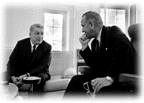 In 1964, the White House announced Eric's appointment
as Special Consultant to President Lyndon B. Johnson. Eric threw himself
into the job (which allowed him to continue teaching at Princeton) in his
passionate eagerness to serve his country. He responded to Johnson's genuine
eagerness to ameliorate the bread-and-butter lives of the American people
and to that Southerner's resolve, now that he was in the White House, to
deal at long last with the issue of race. I remember vividly, when I arrived
in Washington for a brief stint as an assistant to Eric, the glowing excitement
he felt over being in a position where he could roll up his sleeves and
help make America over.
In 1964, the White House announced Eric's appointment
as Special Consultant to President Lyndon B. Johnson. Eric threw himself
into the job (which allowed him to continue teaching at Princeton) in his
passionate eagerness to serve his country. He responded to Johnson's genuine
eagerness to ameliorate the bread-and-butter lives of the American people
and to that Southerner's resolve, now that he was in the White House, to
deal at long last with the issue of race. I remember vividly, when I arrived
in Washington for a brief stint as an assistant to Eric, the glowing excitement
he felt over being in a position where he could roll up his sleeves and
help make America over.
The White House job was Eric's ultimate opportunity to recruit history
to the cause of changing the United States. In the speeches he drafted and
the memoranda he wrote, he often drew on the past to articulate strategies
and directions for the development of Johnson's policies. Eric was exhilarated
and effective during the tonic months in 1964, when Johnson drove to surpass
FDR's record on domestic-reform legislation, and in early 1965, when his
legislative successes achieved torrential proportions. But during the summer
of that year, Eric's influence seemed impaired by the growing protests over
the escalating war in Vietnam. He left the White House in the fall of 1966
because of his own distress about the war and his inability to do anything
about it. Eric provided his own account of his White House years in The
Tragedy of Lyndon Johnson, another best-seller, part memoir and part
history.
"A TOUCH OF JOY IN LIVING"
During the 1970s, Eric spoke with increasing seriousness about retiring
early from Princeton, possibly to a semirural area where he would write
and fish and contemplate the world. He and his wife, Jo, were zeroing in
on a place in North Carolina when, in March 1980, he suffered a serious
stroke. In April, Jo, who had beaten cancer, died suddenly, a victim of
the extraordinary stress of his illness. Eric eventually managed a partial
recovery, but he had lost the ability to read easily and to use his right
arm well enough to write. He might have found ways around those disabilities
to continue as a writer and commentator, but Jo's death had broken him.
After he retired from Princeton, in 1985, he became increasingly preoccupied
with establishing a memorial to her.
Eric died in February 1989, before having hit upon a memorial he considered
appropriate. However, he had willed almost his entire estate for the purpose
and asked me to advise his executor on the fulfillment of his wishes. In
1992, as the principal remembrance of Jo, the estate established the Joanna
Jackson Goldman Memorial Lecture in American Civilization and Government,
to be delivered annually and expanded into a small book. The aim of the
memorial is to invite writers and analysts of distinction to probe and provoke
fresh thought about issues of contemporary importance in American life.
That purpose seemed consistent with Eric's ferocious love of the United
States, his bedrock belief in its credo -- "that ordinary men and women
have a right to peace, material comfort, self-respect, and a touch of joy
in living," as he wrote in the preface to The Tragedy of Lyndon
Johnson -- and his enduring eagerness to harness iconoclasm and intellect
to achieving those ends.
Daniel J. Kevles '60 *64 is the Koepfli Professor of Humanities and
head of the Program in Science, Ethics, and Public Policy at the California
Institute of Technology. This memoir is an abridgment of a much longer essay
that appears in Luminaries: Princeton Faculty Remembered, edited
by Patricia H. Marks *72, published in 1996 by the Princeton Graduate Alumni
Association, and available from the Princeton University Store (1-800-624-4236).
paw@princeton.edu