|
Meet
the Profs Posted January 13th, 2002: Friz
Graf: Master of magic Robert
Kaster: Classicist in the modern age John
Morgan: Web economist Martin
Wikelski: Physiological ecologist
John
Morgan:
Web economist By Rob MacKay ’89
In one facet of his research, Morgan, who earned his doctorate in economics from Pennsylvania State University, used the Internet to price millions of consumer electronics products at various sites. He found that there can be as much as a 40 percent difference from Web site to Web site in pricing for the same item. Consumers no longer have to be dependent on sales people and their pitches when it comes to price, a huge help to shoppers says Morgan. "I noticed that there are two main types of electronics consumers on the Web: the techies and people like my mother who aren’t as savvy," says Morgan, who is 33. "The techies are extremely well versed in the market value of products. Prices have to be low for them. The thing is, the companies are not learning how to make much money off people like my mom, who — but for the competition of price comparison services and the low cost of search on the Internet — would get taken to the cleaners. " Morgan has also done field experiments on price setting at Internet auctions. Using www.ebay.com, he repeatedly auctioned off popular CDs. Morgan quickly discovered that it was 10-15 percent more lucrative to start bidding for his items at $0 and casually mention a $3.50 handling and shipping price than to start the bidding at $3.50 and promise not to add anything later. Said he: "There’s something psychological about it. It reminds me of the television commercials that talk of an album being $19.99, but fail to mention the shipping price they’re soon going to pass on." Microeconomics and connecting its theories with reality have always been passions for Morgan, who earned his undergraduate degree from the Wharton School of Business. "Of all the social sciences, I find economics the most useful way to view the world," he says. "You can really make a difference with it, and you can always step back and ask, ‘What does this mean?’ or ‘Is this model of the world really working?’ It’s hands on." A professor in both the economics department and the Woodrow Wilson School, Morgan is constantly taking a step back and pondering his classes. He created two of the courses he offers — www.auction-course.com and Game Theory Approaches to Bargaining, Conflict, and Negotiation. He also teaches Microeconomic Analysis, an advanced class at the Wilson School. "I think people differ in ways that they learn, so I try to present a variety of learning experiences to make what I think are the most important points in a course," he explains. "For instance, the notion of equilibrium is fundamental in microeconomics. I teach this concept the usual way [lectures with PowerPoint slides], but I also have students participate in economic markets where they play the roles of buyers and sellers. I use their ‘induced’ supply and demand curves to show how economics can predict their trading outcomes. Finally, I’ll have them do problem sets, often working with the data from the markets they participated in to examine how social policies affect outcomes." When teaching public policy, Morgan tries to clarify some of the discrepancies between theory and practice. "Students often believe it’s better to collect a tax from firms, since it means consumers bear less of the tax burden," he explains. "Basic economic analysis shows that price will adjust given supply and demand conditions regardless of the person from whom the tax is collected. I try to emphasize the lesson that supply and demand determine prices so the legal incidence of a tax is not its economic incidence." Creativity and innovation. What can students and faculty expect from Morgan in the future? "I think it would be great to do a general course on the economics of the Internet. In addition to e-commerce, there are a host of interesting public policy issues such as taxation, privacy, copyright protection, and patents," he says. "More grandiosely, I’d like to create an interdisciplinary specialization in Internet studies modeled after the specialization in finance program already in place." Rob MacKay, is an editor at Timesnewsweekly, a weekly newspaper in Queens, New York. He can be reached at robertazo@hotmail.com.
Martin
Wikelski:
Physiological ecologist By Rob MacKay
’89 In ongoing
studies beginning in 1982, Wikelski and colleagues found that the
iguanas on the Ecuadorian archipelago would shrink as much as 2.7
inches — or 20 percent — to survive food shortages caused
by El Niño’s overheating. (It’s estimated that
90 percent of that iguana population was at risk at the time due
to lack of algae in the ocean.) Such is life
for Wikelski, who teaches physiological ecology to juniors, seniors,
and some graduate students when not studying the laws of nature.
Splitting his time between New Jersey, the Galápagos, and
the Smithsonian Tropical Research Institute in Panama, where he
teaches a field course to Princetonians, the 34-year-old German
seeks to find the real reasons behind evolution and the survival
of species. Among other
ecological phenomena, Wikelski wants to know why some animals are
bigger than others, why the pace of life is slower in the tropics,
why birds migrate, and why tropical birds only lay two eggs per
clutch while their Temperate Zone colleagues lay five to 12. When in Panama,
Wikelski focuses on energy expenditure, space use, and migration
in birds. He uses heart rate monitors and injects isotopic water
into migrating birds before catching them later on to measure how
much water was used per mile of travel. He also observes birds flying
in wind tunnels. Wikelski usually travels to the Galápagos twice a year. Beyond flipping over iguanas, stretching them out on their backs, and measuring their snout-to-anus length, he also looks at their body temperatures, their ability to excrete salt and the effect of the overall climate on the reptiles. Another facet of his research involves looking at the energy expenditure of dating. "There’s always an open courtship, but female iguanas usually go for the big and active guys in the end," says Wikelski. "We want to know what it costs them in terms of energy. How much smaller will their offspring be if they spend a lot of energy mating?" When he returns to campus in the spring, he will assist graduate students, juniors, and seniors with their independent work and teach. "In my classes I stay away from simply giving a lot of knowledge. Instead I try to make students interested in the project," he says. "Everybody forgets information, so I want students to think critically and never assume anything or take a textbook for granted." Wikelski has
cowritten articles for such publications as Nature, Ecology,
Behavioral Ecology, and Animal Behavior. He has also
appeared on made-for-TV science documentaries. Born on a farm
in Schlagenhofen, Bavaria, Wikelski credits his love of nature to
a few "really good biology teachers" he had when growing
up. He received a master’s degree from Ludwid-Maximilian University
in Munich and a Ph.D. from the University of Bielefelf in Germany.
He taught at University of Illinois before joining the faculty at
Princeton. Wikelski is proud to point out that — beyond the understanding of evolution — his work can be used for conservation, too. "If there’s an oil spill, we can show how the animals are stressed by it," he says. There’s also a human benefit. "If researchers are able to figure out the mechanisms behind the shrinkage and renewed growth in iguana bones, they may be able to apply the same triggers to humans to treat diseases such as osteoporosis from aging or bone loss during space flight," he says. In the future, Wikelski plans more of the same. He loves the tropical climates of Panama and the Galápagos and finds the animals he‚s studying to be fascinating. Says he: "I’ve sat for seven months at a time just observing iguanas. But they always do something to surprise me."
Rob MacKay, is an editor at Timesnewsweekly, a weekly newspaper in Queens, New York. He can be reached at robertazo@hotmail.com. Robert
Kaster:
Classicist in the modern age By Rob MacKay ’89
Among other issues, Kaster, 53, is very interested in the history of ancient education. He has done exhaustive research of the Roman version of high school teachers, trying to understand the role they played in the Empire's social system. "They were basically tutors, and they had an odd and ambiguous position," he says. "They were counted as members of the elite, but they were on the margins, fairly humble compared to other elites." Kaster likens the Roman educators of yore to their counterparts in 19th-century England in that they did not have a lot of resources, money, or land, but were sought out by those who did. "Having an education in antiquity was a tremendous privilege," he says. "So teachers got respect as being the gatekeepers of the elite." One of Kaster's books, Guardians of Language, reports on this subject. Another book, De Grammaticis et Rhetoribus, deals with a collection of biographies on grammar and rhetoric teachers written in the second century AD. Currently, Kaster has been studying Roman emotions, and how their versions of shame, envy, disgust, and regret related to their ethical system. Though he has just started the undertaking, has already learned one thing. "It was basically expected that those who governed in antiquity would leave office a lot richer than when they came in," he says. "In that respect, it's not much different than today." Kaster, who is proud of his mostly German heritage, professes a great respect for the Romans and Greeks of yore, but doesn't think he would have been able to live back then, nor would he invite them into modern times. Says he: "They wouldn't like the noise and artificial light, but we wouldn't have liked the smell and unsanitary conditions." As Latin and the Old Greek he's involved in are both dead languages, Kaster doesn't claim complete fluency in either tongue. "I can read, write, and teach them, but I don't speak them," he says. A New York City native, Kaster originally wanted to be a psychiatrist when he enrolled in Dartmouth College in 1965. But midway through his freshman year it became obvious that chemistry was really hard and that he had a talent for Latin. He quickly signed up for more classes in the language that at first had only appealed to him as a way to fulfill a requirement. Soon he was taking Greek. This eventually led to earning a Ph.D. from Harvard in classics, with a thesis on 9th-century manuscripts of the Roman poet Virgil. It's basically a toss-up, but when pressed, Kaster admits to feeling "more Roman than Greek." Romans are considered to have been better at getting things done, while Greeks were famous for their ability to talk, he explains without agreeing with the hypothesis. Then there's the question of the Trojan Horse. What does he think about that? "It was a great stunt," he replies immediately. "I wish I had thought of it." Friz
Graf: Master of magic
"Divination was present everywhere in antiquity," says Graf, who taught in Switzerland, France, Italy, and at Cornell before joining the Princeton faculty two years ago. "People used magic for most life crises. In fourth century Athens, for example, there was an abundance of lawsuits, and people hired magicians to make the their opponents unable to appear or speak in court. A lot of the time it worked, adversaries choked instead of testifying." Graf has found that people seeking partners, doctors and politicians looking for a competitive edge, the sick, and those about to perform or compete also used magic. The power of magic was universally respected, and even feared, and usually was considered the cause of natural disasters, such as plagues and famines. "Basically, people shunned it publicly, but they also used it privately when they felt it was necessary," says the 57-year-old, who grew up near Lake Constance in Switzerland. Later Roman law had provisions against practitioners of witchcraft, and Graf has read accounts of witch trials that led to execution or exile. Saint Augustine, Graf points out, once opted not to seek a sorcerer’s help before a performance in Carthage because he considered himself a virtuous man. Meanwhile, Prince Germanicus died at a very young age in Syria in 19 AD, a premature demise which was attributed to bad magic. Whether Greek or Roman, there was always a strong religious influence in the ancient practice of witchcraft. In one funeral ritual common in 4th-century Egypt, for example, Greek mythology-influenced healers would pierce a figurine with 14 needles before the ceremony and lay it in the grave so that the deceased might find a mate in the afterlife. Then the healer would take a sheet of lead, recite a prayer, and put the lead in the newly filled grave at sunset. Soon thereafter, the sorcerer would offer the corpse's spirit to Helios, the sun god. Similarly, the predominant religions were forced to respond to magic's ubiquitous appeal. Christians in the later Roman Empire, for example, demonstrated a strong fear of sorcery and often wore amulets to ward off perceived evil spirits. Graf’s most recent book, "Magic in the Ancient World," was published first in French in 1993 and in English in 1995. Graf describes it as "an introduction to magic" that explains the sortilege phenomenon, its proponents and enemies, and points out references to sorcery in literature. Graf also wrote a complex study on local cults in Asia Minor and is presently working on a book about ritual at Roman festivals. In the fall, Graf, who earned his doctorate at Zurich University in 1971 and did post-doc research in Oxford in 1981, will teach a course on Greek mythology that will include seminars on topics related to religion and another course on problems in Greek history, which is an introduction to religion and inscriptions. In other words, Graf is happy to explore almost every aspect of this enchanting topic. He’s shown that it’s a way to make a living, but what does he really think of magic? "Oh, I don’t believe in it," he says, "but it can divert attention. And it is a beautiful scenario of ritual that doesn’t come forth in traditional, rational Roman and Greek society."
Rob MacKay, is an editor at Timesnewsweekly, a weekly newspaper in Queens, New York. He can be reached at robertazo@hotmail.com.
|

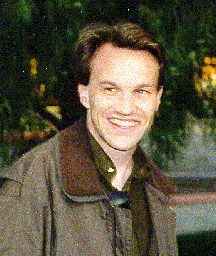 Long-venerated
economic theories have been put to the test by the newfangled, cybernetic
way of doing business, and nobody understands this more than John
Morgan, an assistant professor of economics and public affairs at
Princeton. Among other activities, he’s been studying price
competition on the Internet and looking at how venture capitalists
and initial public offerings have affected costs.
Long-venerated
economic theories have been put to the test by the newfangled, cybernetic
way of doing business, and nobody understands this more than John
Morgan, an assistant professor of economics and public affairs at
Princeton. Among other activities, he’s been studying price
competition on the Internet and looking at how venture capitalists
and initial public offerings have affected costs.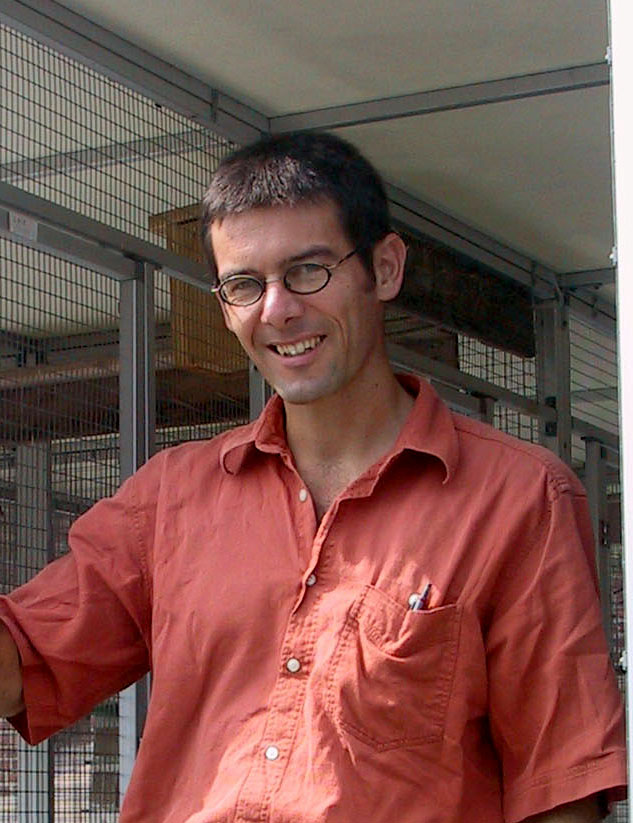 Imagine
Shaquille O’Neal shrinking from his present 7’ 1"
to a decidedly more diminutive 5’ 8" in order to continue
being the best basketball player on the planet. Martin Wikelski,
an assistant professor in Princeton’s ecology and evolutionary
biology department, discovered that exact phenomenon — relatively
speaking — among marine iguanas in the Galápagos Islands.
Imagine
Shaquille O’Neal shrinking from his present 7’ 1"
to a decidedly more diminutive 5’ 8" in order to continue
being the best basketball player on the planet. Martin Wikelski,
an assistant professor in Princeton’s ecology and evolutionary
biology department, discovered that exact phenomenon — relatively
speaking — among marine iguanas in the Galápagos Islands.
 He
hasn't been to modern day Italy or Greece for 28 years, but Robert
Kaster visits the ancient cultures of these Mediterranean countries
every workday. As professor and chair of Princeton's Department
of Classics, he teaches every level of Latin and Greek, administrates,
and studies life back when the world's most famous marble sculptures
were new and still had their extremities.
He
hasn't been to modern day Italy or Greece for 28 years, but Robert
Kaster visits the ancient cultures of these Mediterranean countries
every workday. As professor and chair of Princeton's Department
of Classics, he teaches every level of Latin and Greek, administrates,
and studies life back when the world's most famous marble sculptures
were new and still had their extremities.  He
hasn’t done any card tricks for a long time, and his disappearing-ball
acts are a bit rusty, but Professor Fritz Graf is a wizard at ancient
forms of magic. The Andrew Fleming West professor of classics has
distinguished himself as an expert on ancient Greek and Roman religions
and has a keen interest in rituals, especially those which involved
sorcery.
He
hasn’t done any card tricks for a long time, and his disappearing-ball
acts are a bit rusty, but Professor Fritz Graf is a wizard at ancient
forms of magic. The Andrew Fleming West professor of classics has
distinguished himself as an expert on ancient Greek and Roman religions
and has a keen interest in rituals, especially those which involved
sorcery. 