~ Handbook: Theater ~
In 1599 Shakespeare's acting
company, The Lord Chamberlain's Men, built a splendid
new theatre and called it The Globe. It was on the south
bank of the Thames, beyond the jurisdiction of the city of
London's municipal authorities. (An earlier theatre, called
simply The Theatre, had been located in the northern
suburbs.) Nearby were several other theatres, used by other
acting companies, as well as an arena for the lovely
Elizabethan sport of bear-baiting. Most of Shakespeare's
plays were written with the special opportunities and
limitations of The Globe in mind.
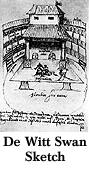
 The Globe was a polygonal
wooden frame building (in Henry V the Chorus calls it
a "wooden O") three stories high, surrounding an open
courtyard, or pit. Into the pit, extending from one wall of
the frame, was an open stage 43 feet wide by 27 feet deep.
(The McCarter Theater stage in Princeton is approximately
the same width.) Over the stage was a canopy supported at
its front by two pillars. The area behind the stage, where
actors made their entrances and exits, was the so-called
tiring house, that is, the dressing room and backstage
areas. (Entrances and exits could also be made through a
trap door in the stage floor and from the canopy above:
these spaces were especially useful for ghosts and gods.)
The gallery space at the rear of the stage could be used as
an upper playing area; for instance, the mayor of Harfleur
might have stood there, on what the audience would
understand was the city wall, while Harry stood on the stage
below telling him to surrender. Most action happened on that
large stage, with entrances and exits quickly succeeding one
another.
The Globe was a polygonal
wooden frame building (in Henry V the Chorus calls it
a "wooden O") three stories high, surrounding an open
courtyard, or pit. Into the pit, extending from one wall of
the frame, was an open stage 43 feet wide by 27 feet deep.
(The McCarter Theater stage in Princeton is approximately
the same width.) Over the stage was a canopy supported at
its front by two pillars. The area behind the stage, where
actors made their entrances and exits, was the so-called
tiring house, that is, the dressing room and backstage
areas. (Entrances and exits could also be made through a
trap door in the stage floor and from the canopy above:
these spaces were especially useful for ghosts and gods.)
The gallery space at the rear of the stage could be used as
an upper playing area; for instance, the mayor of Harfleur
might have stood there, on what the audience would
understand was the city wall, while Harry stood on the stage
below telling him to surrender. Most action happened on that
large stage, with entrances and exits quickly succeeding one
another.
 The Globe could hold as
many as 3000 spectators. (McCarter Theatre holds about
1100.) Some of these, paying extra for the privilege, sat in
the galleries of the building's frame. The majority stood in
the pit. Because the audience virtually surrounded the
stage, and because the Elizabethans had considerable
tolerance for being packed closely together, the most
distant member of the audience would be little more than 70
feet from the stage. So The Globe combined a large capacity
with great intimacy between audience and actors. There was
no curtain. No lighting. No scenery. Nothing, that is, to
distract from the actors' spoken language.
The Globe could hold as
many as 3000 spectators. (McCarter Theatre holds about
1100.) Some of these, paying extra for the privilege, sat in
the galleries of the building's frame. The majority stood in
the pit. Because the audience virtually surrounded the
stage, and because the Elizabethans had considerable
tolerance for being packed closely together, the most
distant member of the audience would be little more than 70
feet from the stage. So The Globe combined a large capacity
with great intimacy between audience and actors. There was
no curtain. No lighting. No scenery. Nothing, that is, to
distract from the actors' spoken language.
 After 1608, the King's
Men also acted in a second theater, the Blackfriars, which
had once been the hall, or large dining room, of a Dominican
friary. Unlike The Globe, it was indoors, had artificial
lighting, was expensive, and held a much smaller audience.
It is possible that in his last plays, like The Winter's
Tale and The Tempest, Shakespeare was writing
with the architectural and social requirements of the
relatively exclusive Blackfriar's in mind, as he had earlier
written with The Globe in mind.
After 1608, the King's
Men also acted in a second theater, the Blackfriars, which
had once been the hall, or large dining room, of a Dominican
friary. Unlike The Globe, it was indoors, had artificial
lighting, was expensive, and held a much smaller audience.
It is possible that in his last plays, like The Winter's
Tale and The Tempest, Shakespeare was writing
with the architectural and social requirements of the
relatively exclusive Blackfriar's in mind, as he had earlier
written with The Globe in mind.
The King's Men also occasionally played at colleges,
aristocratic houses, and before King James at one or another
royal venue.