9.8 Contact
Plane with Coulomb Friction
The
element is defined by four nodes and two spring constants or "penalty
parameters",  and
and  in the tangential and
normal directions, respectively. The
nodes
in the tangential and
normal directions, respectively. The
nodes  ,
,  and
and  define the contact
plane, and node
define the contact
plane, and node  is the contact node
(see Figure 9.8.1).
is the contact node
(see Figure 9.8.1).
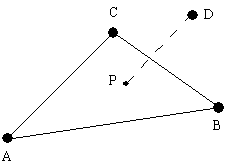
Figure 9.8.1 Contact Plane with Coulomb Friction
The direction of the unit vector  normal to the contact
plane is defined as:
normal to the contact
plane is defined as:

where
" " denotes the cross product of two vectors. The relative normal displacement, or gap, is
computed as:
" denotes the cross product of two vectors. The relative normal displacement, or gap, is
computed as:

where
"." denotes the dot product of two vectors. The contact point  is defined as the
intersection of the line through in the direction of
the motion of , with the contact plane . The relative slip is
computed as:
is defined as the
intersection of the line through in the direction of
the motion of , with the contact plane . The relative slip is
computed as:

where  is the position at
which node first contacted the
plane. The normal and tangential
stresses are computed as:
is the position at
which node first contacted the
plane. The normal and tangential
stresses are computed as:

where Area = area of contact plane , and  is a memory parameter.
The normal stress must be compressive, i.e.,

and the tangential stress must satisfy the Coulomb friction constraint as:

where  = friction angle, and
  = cohesion. A return procedure is used to enforce the
inequality when violated.
= cohesion. A return procedure is used to enforce the
inequality when violated.
CONTACT_PLANE
Element_name = CONTACT_PLANE
m, stiff(1, m), stiff( 2, m), phi(m), c(m) < m = 1, numat >
< connectivity data >
< terminate with a blank record >.
9.8.1 Element Group Control Information
Must follow the element name (same data record), and define the control parameter as follows:
Note Variable Name Type Default Description
(1) Gapping list [on] Gapping code
on / off
Friction_load_time integer [0] Friction angle load time function
number
formulation list [penalty] Formulation
penalty
augmented_lagrangian
Notes /
(1) This allows the contact-release option to be deactivated if needed.
9.8.2 Geometric / Material Properties Data (Numat sets)
Note Variable Default Description
M [0] Geometric/material set number
STIFF(1,M) [0.0] Spring constant
STIFF(2,M) [0.0] Spring constant
PHI(M) [0.0] Friction angle (degrees)
C(M) [0.0] Cohesion
9.8.3 Element Nodal Connectivity Data
Consult Chapter 11 for details; for this element NEN = 4, and the nodes are entered in the following order; node A, node B, node C and node D.
Plots of various element response components may be obtained. Each component required is plotted versus time. Plots of this type are useful in providing quick information concerning the time history behavior of important data. The total number of components to be plotted must equal NOUT, which is defined on the element group control record (see Section 9.8.1).
Note Variable Default Description
(1) N [0] Element
number  1 and
1 and  Numel
Numel
(2) NG [0] Generation
increment 0
(3) NTEMP(1) [0] Component
number 1 and 2
NTEMP(2) [0] Component number 1 and 2
Notes/
(1) Element components history output data
must be input for elements at which the time history of one or more components
is to be plotted. Records need not be
read in order. Terminate with a blank record.
(2) Element components history output data can be generated by employing a two record sequence as follows:
Record 1: L,LG,LTEMP(1),LTEMP(2)
Record 2: N,NG,NTEMP(1),NTEMP(2)
The output time history requests of all elements
L+LG, L+2*LG,...,N-MOD(N-L,LG)
(i.e., less than N) are set equal to those of node L. If LG is blank or zero, no generation takes place between L and N.
(3) Two different component numbers may be plotted as described above. The corresponding component numbers and output labels are:
Component Number Description Output Label
1 Normal contact force 
2 Tangential contact force 
Notes . .
Notes . .
Notes . .