HAROLD U. RIBALOW PRIZE WINNER
The Great
Letter E
By Sandra M. Schor
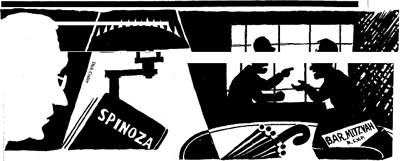
The Harold U. Ribalow Prize, administered by HADASSAH MAGAZINE, was awarded to two books for 1991. Following is an excerpt from The Great Letter E by Sandra Schor, who died shortly after the publication of her novel. The story centers on a New York optometrist, Barry Glassman, who tries to reconcile his family and religious life with his affinity for Spinoza's philosophy.
So help me, I am an hour too late. The episode is over, yet my mind keeps altering its strategies, as if the rabbi were still before me, frowning, gesturing, cautioning. I lean my head against the couch arm and surprise myself: In the fever of reimagining my case, I doze off on the couch.
Marilyn must have been home awhile, since I find her raincoat drying in the bathroom. She has already taken off her wet shoes and slipped into her puffy satin scuffs and is padding about straightening up. Standing at the bathroom sink I hear her banging kitchen chairs and rustling newspapers to let me know she now has things to do when she gets home from work. As if all those years with me were not work. Bob Donahue, that sporting little go?getter, splashing designer eyewear all over the Upper East Side---and installing Marilyn as consultant! Get lost is what she's saying, which means down to the basement study, Glassman. We speak only about financial obligations for the week, Michael and the bar mitzva looming ahead of us. We are theoretical and polite. We theorize that I'll sleep downstairs until after Michael's big day and then split. Will it kill us to give the kid what he wants?--a last memento of family happiness? So we take our meals together as a front, though it's clear Michael is on to us. Out of cowardice or embarrassment or simply the desire not to lose his bar mitzva in the swamp of our marriage, we fake it. Maybe it's his adolescent savvy, maybe it's dumb luck, but for some reason he never backs us into an open discussion. For him it's wolfing down dinner, prolonged silences and a panicky getaway to homework. I descend to the basement. Marilyn washes up. During the first month, Michael appeared every evening like a lighthouse, beaming a loving "Good night" in all directions; but he doesn't do that anymore.
"I've had it up to here, " Marilyn says, standing
over me, her flattened palm jutting out at her neck, as I resettle myself
on the couch for ten minutes before dinner. Out of Michael's earshot, she
whispers fiercely, her s's steaming like radiators, "I met Dolores Gutman
at Gristede's. She said she had just left you. “The rabbi's angina is
acting up,’ she says, as though it were my fault. I tell you, get off
their backs, Barry." With a swift karate chop across her neck she shows
me again up to where she's had it. "Haven't you argued with them enough?
Can't you shut up?"
"Anything in the mail?" I say coolly.
"Uncle Nathan has declined."
"He's all the way out in Sheepshead Bay in a wheelchair
. . . . "
"But is Gertrude in a wheelchair? or Rita Gans? or
Cousin Elliot? They've all declined, along with a dozen others: Whoever heard
of tucking a message about atheism into a bar mitzva invitation?"
I pick up the enclosure that came back with one of the refused
invitations. Marilyn, honey?--I plead with her silently?--my fearful, phobic
Marilyn whom I taught to love little dogs and cats and stroke the brown rumps
of horses under their police blankets on Fordham Road. Novalis called Spinoza
a Gott betrunkener Mann. That means "drunk on God"! Is that so damaging?
And begin to read.
Since the Torah does not represent revelation but the high thought of reasonable people, we are pleased to honor a few of our most reasonable family and friends---men and women---by calling them to the Torah. Please say the following when called upon: Blessed are Thou God or Nature, in whose extended greatness we all dwell. Our ancestors gave us the Torah as a record of high thinking and a testament to the divine intellect of which we partake. Just as we do not envy a lion its courage nor a tree its height, so we foresee a life for Michael commensurate with his own nature. Amen.
I am as temperate when I read it as when I wrote it, but
Marilyn cannot bear to listen. It is one of those moments when her huge chocolate
eyes glaze and her disdain of my position is excessive. We have a history
of great moments between us. Now they are all empties, and I want with all
my heart to cart them away and turn them into cash. Enough retrospection.
Enough nostalgia.
I need a new communion, a fresh start. Grabbing the day's
response cards, Marilyn escapes to the kitchen. From across the street the
drone of a buzzsaw is grinding up the silence where she stood. For eleven
years after his shift at the firehouse, Ed Hoddeson has cut wood. "What
about the Hoddesons?" I yell into Marilyn. "Did they RSVP?"
"All seven of them are coming."
"Michael told me if Deirdre Hoddeson comes to his bar
mitzva, he won't."
Marilyn moans. Another contretemps, another wind about to
knock us into each other on a street corner. I steady myself with a sip of
club soda. Deirdre Hoddeson, menacing my son, Michael, because all of her
secondary sex characteristics (and several of her primary ones) are, at thirteen,
in wondrous operation. Thirteen?year?old Michael of the soprano voice, still
taken for his mother by telephone callers. Barely five foot one, he lifts
weights before breakfast, his interest in bodybuilding traceable to a certain
morning when Marilyn revealed at breakfast that Deirdre's periods had started.
I sensed the ice?cold alarm with which Michael had received this information:
continued to spoon Wheatena into his mouth, expression a blank, cereal and
cheeks the same pale zero color. Said not a word. Left the table.
"Where's your tact?" I demanded.
"When a boy grows up without a sister, too many mysteries
make girls untouchables. Undergrown thirteen?year?old boys are surrounded
by towering thirteen?year?old women. But what do you know?"
So things are not 100 percent in my little family, with
my kid rattling around the house measuring his biceps at 6 A.M., netting his
mother and me one additional waking hour in which to be estranged, and a bar
mitzva ready to take off like a train out of Grand Central Station, all doors
closed, no getting off.
I should have explained that God is not like anybody we
know. Not like Henry Kissinger, or Mother Theresa, or Rabbi Akiba, or Spinoza.
God is unimaginable! Perfect and complete as a carrot. God needs nothing,
no flattery, no songs of praise, no bargains. I should have said, "Listen,
all I want is to get rid of God as king, God as ruler, God as the big negotiator
in the sky. I want Michael to say God is infinite, God is necessary, and only
God is necessary."
Instead, the rabbi walked all over me. At last all the comebacks
come to me: quotations from Spinoza like tiny keys rapidly unlocking my "position,"
pointed man?to?man retaliations to Mordecai Mayberg and a few to Dolores Gutman-?-he,
wretched as a bar mitzva boy, she, presidentka of our synagogue, cool, aloof,
face and body like a Gupta goddess.
"It is God or Nature, rabbi," I should have said,
"not God and Nature, not even God of Nature. "
As civilly as I could, I pointed out to Mordecai that to
know things philosophically is to know them in eternity, and that although
October 17 was the official date of my son’s bar mitzva, nothing on
my calendar was ever more than tentative. Couldn't they cooperate? If they
changed the wording just two or three lines---I would be satisfied. I never
meant it as a threat.
A glass of club soda burbles on the end table. The pleasure
of gas in my stomach unbubbles the whole repressed little ritual: Mayberg
shrinking into a corner, his eyes filling up (I saw real tears). "Don't
threaten us, Barry. You know you're like a yeshiva buddy to me. Who else in
this congregation can I talk to? Pritzker? Steinman?" and, whispering
behind the back of his hand, "el presidentka? You think they're curious
about God? They come to be big shots, to schmooze?--God knows why they come!
You're the one I look forward to seeing. You're the one who's got it! I'm
always telling Dvora, ‘Barry Glassman has got it!’
"
"What, rabbi? What have I got?"
"A gene for God!" He brushed gently at the fatigue
on his eyelids. "But lately . . . "
"Don't hand me that ‘lately’ crap. We've
always had our differences, Mordecai."
"Michael deserves a traditional bar mitzva. He's one
of our sharpest kids. Rational inquisitiveness he gets from you, okay---but
from Marilyn he gets another side, a normative side. You think I don't remember
Marilyn's parents, very heimish, traditional people, they should rest in peace?"
"What the hell kind of doubletalk is normative?"
.
"You're accusing me of doubletalk? You should hear
yourself. Spinoza isn't doubletalk? You could do with a little traditional
doubletalk. It's good for the nerves."
"Mordecai, you're misconstruing my purpose."
"Our most learned cosmologists go beyond reason to
a simple, single force separate from the universe. At MIT they are making
the leap to a mystical beginning. Don't you read the Times on Tuesdays? In
the science section, they're tracking God. They see Something?--God??--easing
a world into being." And I trying to hold onto my footing as I was being
eased out by Dolores, handed my raincoat and umbrella, listening to the rain
behind the rabbi's drapes, and still clutching the edge of the rabbi's desk:
"Of course, rabbi. God is the substance of the universe. I agree. But
it's God's intellect we partake of. That's why reason is everything. It's
the whole story. Through reason we come to know God, and that knowledge, dear
Dolores Gutman, dearest rabbi, is blessed happiness."
I have said this to them three times in the last month,
driving home to Bayside in the long September afternoons immediately after
the shop closes, appearing casually at sundown as the mourners gather for
their nightly Kaddish. I stand around. I joke with the regulars. I get counted
among the ten necessary for prayers. As the mourners pray, they put me in
the mood: I hum along, thinking about what is true and worthwhile in the universe.
Then immediately after the last Kaddish, as the congregants are rushing to
go home for supper, I move in on the rabbi, following him into his office.
"Modern science is mystical, not philosophic."
The rabbi paced feverishly. "Scientists are stargazers like the rest
of us." But finally all he produced was a mild ridicule. "Barry,
you pray like the rest of the infidels: ‘Oh God, there is no God.’
"
"Who said there is no God?"
"Glassman," he reached both hands toward me; his
voice grew sweet as a mother's, "you are denying that God is King of
the universe."
"Oh, rabbi! All I am saying is that God is the universe."
I was trying my best for a balanced argument. We had always
enjoyed our discussions languorously. I spoke softly. "Just think about
the difference." I tried to smile. "Put your mind on it." Instinctively,
I turned to Dolores Gutman, silhouetted like a Balinese puppet in the rabbi's
illuminated study, her dark eyes lustrous under the fluorescent lights that
also caught the long swoop of nose and the curve of heavy breast under her
white silk shirt. Maybe the rabbi would understand my position, but Dolores?
I couldn't afford to sound like a crank. Papers and books lay everywhere,
in heaps on the desk, in chairs, trailing down from the draped window ledges,
and spilling onto the floor. This was a pleasant room, disordered with my
kind of bookish chaos. All those seductive Hebrew volumes, lovelier to behold
than a meal or a good?looking Middle Eastern woman. And on the wall, like
an eye chart, a magnificently framed diploma in English and in Hebrew, vividly
hand lettered in waves of black ink, with a huge, coal black alef. I envied
my friend Mayberg this sublime cave, even his pacing back and forth, his luminous
alef. I valued his confusion. He knew I had spoken up for him at the last
board meeting when Steinman swaggered in late and smugly proposed we support
the rabbi's anti-intellectual fervor by dispensing with his sermons. But many
in the congregation were confused by Dr. Steinman's proposal. A rabbi with
no sermons? Who needs him? A new fissure of doubt spread among the congregants.
Hadn't Professor Winning always said it, half?consoling,
half?mocking our flustered attempts to follow the Spinoza geometry? "Our
confusion is part of our perfection." How he misled me into believing
I could be a philosopher, praising me after class for my methodical readings
of the Ethics, for espousing the system with less confusion than anyone else--?or
so I thought. Then the B+ in "Spinoza," and a glowing recommendation
went to Yale in behalf of Lorenzo Levi, the Orthodox son of an Italian Jewish
mathematician from Sunnyside. Who could forget those ice?cream silk shirts,
those blazing eyes, and the tiny scars on his wrists? But he wrote like an
angel! I swore then to out?Spinoza Spinoza and out?Levi Levi. Levi and his
rubber bands went to Yale and I to the New York School of Optometry. Eventually,
they dropped his fellowship: A suicidal Orthodox Jew was the wrong risk for
a philosophy department. I finished with honors. Why then do I still see pudgy
Lorenzo Levi riveted to my dream of boola?boola and all that crap, while all
I have is a drafty optometry shop, lit with a capital E, among the crazies
on Eighth Avenue?
* * *
"You are a marginal Jew, Barry Glassman, only marginal," the rabbi said balefully, the rainy wind rattling the windows of his study. Thus my moment with the rabbi belonged to eternity, or would have had I not noticed that his glasses were ill?fitting, marking time by sliding down his nose and causing him to swat them back up. "For your own sake, I will not take you seriously." Dolores Gutman's expression darkened. "Barry," she said malignantly, "think of what you're doing to Marilyn and Michael. Let's get out of here now," she said, opening my umbrella and leading me out to our cars, parked side by side in the rainswept Temple lot. "I have to get to Gristede’s before it closes." The rain drummed overhead on the umbrella as we huddled beneath it and walked. "Come to your senses," she whispered, as I pulled the umbrella closed and climbed into my car with it. The rain poured off the hood of her raincoat and ran off the tip of her nose. But she stood until I pulled away. "For God's sake, Barry," she yelled through the downpour, "It's only a bar mitzvah."
Copyright 1990 by Sandra M. Schor. From The
Great Letter E published originally by North Point Press. Reprinted by permission
of Joseph M. Schor. For copies contact Daedalus Books at 800?395?2665 or Anne
Borchardt, Georges Borchardt, Inc., 136 East 57 Street, New York, NY 10022.