The tensile behavior
of composites is also different from that of metals in the 'plastic deformation'
region of the stress/strain curve. The diagram shows the curve for a uniaxial
sample tested along the fiber direction. For this material the strain
at fracture is less for the fibers than for the matrix, and Young's modulus is
larger for the fibers than for the matrix.
In Stage I both the
fibers and the matrix are in their elastic range. The sharp break as Stage
II is reached is due to the matrix becoming plastic.
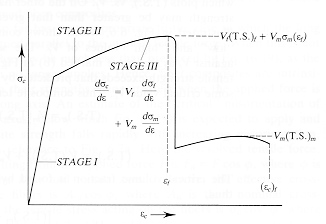
From: Courtney, "Mechanical
Behavior of Materials,"
McGraw Hill (1990)
The effective elastic modulus of the matrix then drops to the local slope of the matrix stress/strain curve, (dsM / de). At the peak of Stage II the fiber fractures and the full load is transferred to the matrix. For the material illustrated, the matrix volume fraction is large enough that it can take the increased load without failing, and the composite continues along the matrix stress/strain curve until matrix fracture occurs causing composite failure.
| Materials |
| Menu |
| Prev |
| Next |