Although materials are used in their elastic range, in order to form them into the required shape they must be taken into their plastic range or machined from a larger section. The diagram below shows three methods for forming thin section material. In the case of spokes, wire drawing is the method of choice.
In the drawing process the material is forced through a die that has an exit hole of the correct diameter. The thin section after the die is placed in tension, and the die walls exert a
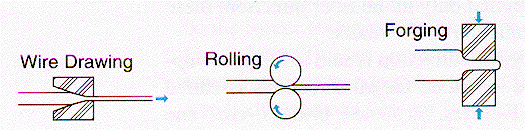
From: McMahon & Graham,
"The Bicycle & the Walkman,"
Merion (1992)
compressive force on the material to be reduced by this pulling process. The force acting on the wire must produce a stress greater than the yield stress of the material so that plastic deformation can occur. In the elastic range, both stress and strain may be obtained from the initial dimensions of the sample (nominal stress and strain). In the plastic range it is necessary to use the actual sample dimension during deformation (true stress and strain).
| Structure |
| Menu |
| Prev |
| Next |