|
Web Exclusives: From the Cheap Seats a PAW web exclusive column by Matt Golden '94 (email: golden2@erols.com) November 22, 2000 Size does matter for Princeton's offense
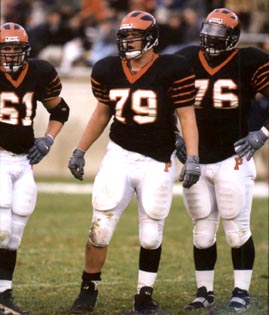
During the 2000 football season, injuries forced the Princeton Tigers to start four different QBs. Caption: Dennis Norman '01 (#76) and his line mates, including Jeff Micsky '04 (#61) and Matt Peluse '02 (79), have been a consistent force for the offense this year. First there was Tommy Crenshaw '02. He was the incumbent, the blond-haired, blue-eyed, gun-slinging quarterback with the shotgun arm that would revive the Princeton offense. Crenshaw led late-game touchdown drives against Lafayette and Lehigh, but suffered a broken wrist against Columbia on September 30 and was lost for the season. In stepped Jon Blevins '01, the cagey veteran. Short on arm strength but long on composure, Blevins used guile and grit to lead a dramatic comeback against Columbia that won the day. But a week later, the Colgate defense and an ankle sprain brought Blevins back to reality and, in turn, the bench. David Splithoff '04 to the rescue. The young understudy with the explosive gate and the confident swagger was supposed to wait patiently for Crenshaw to ride off into the sunset after next season. But pressed into action, Splithoff was great. He baffled opposing defenses and brought a long-missing cockiness back to the Princeton huddle before breaking his jaw on the final play of the Harvard game on October 21. Next up, Brian Danielewicz '02. In relief of a still-hobbled and again injured Blevins, Danielewicz threw a touchdown pass against Cornell on October 28 that would have tied the score in the game's final seconds. But a botched point-after try robbed him of hero status. The quarterback position was a revolving door all season for the Tigers. The face behind center changed almost weekly, but the offense remained productive. The reason? The Tigers had consistency where it matters most - in the trenches. While head football coach Roger Hughes conducted an almost-weekly manhunt for an able body to trigger his offense, the big boys were, without fail, front and center for the Tigers. Seniors Dennis Norman, Ross Tucker, John Ravache, and Brian Wilson anchored the Ivy League's best offensive line throughout the 2000 campaign. Big and athletic - with an average weight of nearly 285 pounds per man - this group played physical and precise football. While everyone in the stands worried about the QB-de-jour, the men up front methodically and anonymously pounded on opposing defenses. Their physical and relentless play wore down opponents and enabled the Princeton offense to produce some memorable second-half rallies. Any football coach will tell you that games are won and lost at the line of scrimmage. And while the Tigers didn't win many in 2000, the ability to dominate the offensive line of scrimmage kept them in their share - and made Saturday afternoons exciting for Princeton fans. The Tigers will have
several explosive offensive players back in 2001, including Crenshaw
and Splithoff. And the program seems to be on the upswing. But replacing
the group up front will be no easy task.
By Matt Golden '94
|

 The
quarterback gets the glory when a football team does well, and he
is blamed when it falters. He is the centerpiece, the star. But
without a strong supporting cast, the show will ultimately be a
flop.
The
quarterback gets the glory when a football team does well, and he
is blamed when it falters. He is the centerpiece, the star. But
without a strong supporting cast, the show will ultimately be a
flop.