Building schools through people
Temp Keller ‘98’s CharterTeach organization tries to keep
good teachers in the classroom
Urban
school districts across the country get new teachers who are eager
to share their passion for learning with students in classrooms
every year.
Keeping those teachers in those underserved communities is not easy.
About 50 percent of all new teachers leave urban classrooms within
three years, often to teach in the suburbs or to enter a new field,
according to the National Association of State Boards of Education.
But John "Temp" Keller ’98 thinks there is a way
to keep those talented teachers in education and he founded the
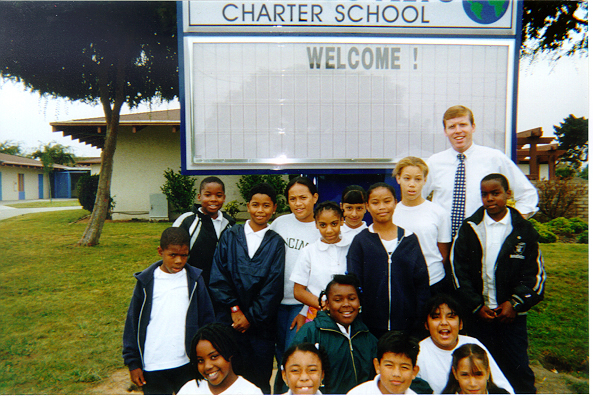
CharterTeach Organization in California to prove it. Keller taught
fifth grade in East Palo Alto, California, before starting the teacher
recruitment organization in the San Francisco Bay Area in 2000.
He believes good teachers need support in a school environment where
their knowledge and passion is appreciated and they are enabled
to lead on a school-wide level.
"Every other industry, every other field has worked tirelessly
to keep the best and brightest either working for their firm or
in their field in general," says Keller. "No model in
and of itself is a silver bullet. But it’s high time in public
education that we start thinking the same way and really come to
grips with the fact that public schools will ultimately only be
as good as the people who are in them."
CharterTeach connects high quality teachers early in their careers
with schools where they can make an impact and also provides teachers
in the program with career development seminars and $5,000 over
two years that can go toward graduate studies, teaching credentials,
or innovative classroom programs.
After receiving nearly 120 applications for its pilot fellowship
program last year, CharterTeach has eight fellows currently working
in six charter schools. All fellows have had at least one year of
teaching experience and have been screened to makes sure they are
good instructors with leadership potential.
The schools in the program are also prescreened to make sure they
provide the right environment for the fellows. Keller has focused
the program in urban public charter schools because he believes
they offer principals, teachers, and parents autonomy when it comes
to staffing, budgets, and programming. According to CharterTeach,
there were nearly 2,400 charter schools operating in 34 states and
the District of Columbia as of September 2001.
The program is also branching out into some traditional inner-city
public schools, where districts have extended some "charter-esque"
autonomy, as Keller puts it.
Keller says he often has to remind people that charter schools are
public schools since they are funded through public school districts
and the students do not pay to attend. The difference for his program
is the onsite control and the opportunities for young teachers to
really make a difference in students’ education, he says.
"When bright young people go into classrooms they develop as
teachers very quickly. They then have very strong opinions as to
why their school works well and why their school doesn’t work
well," he says. "If you have ideas on how you can make
a school better, then lets get you to a school where those ideas
can be heard."
Keller hopes to eventually expand the program, a la Wendy Kopp ’89’s
Teach For America, which he used as a model for CharterTeach’s
early planning stages. He sees CharterTeach as the next step after
Teach for America for quality young teachers who finish the two-year
program and are looking to continue developing as educators.
Other Princetonians in education have also inspired Keller, including
his father Dennis Keller ’63, who cofounded the Keller School
of Management. The school changed its name to DeVry Inc. in 1987
and is now one of the largest private higher education systems in
North America.
"I always saw how happy my dad was when he was in the classroom
teaching while I was growing up," remembers Keller. To learn
more about CharterTeach, visit http://www.charterteach.org.

 Urban
school districts across the country get new teachers who are eager
to share their passion for learning with students in classrooms
every year.
Urban
school districts across the country get new teachers who are eager
to share their passion for learning with students in classrooms
every year.
