|

Meet the Profs
Princeton
Faculty and what they're working on
July 10, 2002
Nonprofits in the city
A major economic force for New York
By Argelio Dumenigo
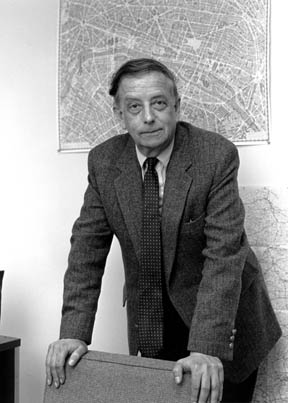 |
| Professor Julian Wolpert found that nonprofits
are critical to New York City's economic health. |
New York City’s nonprofit sector, did not carry the luster
the city’s financial and technological industries radiated
in the 1990s, when Wall Street and Silicon Alley ruled Gotham.
But longtime Princeton professor Julian Wolpert discovered that
during the last decade the nonprofit sector was a major cog in New
York City’s economic engine with employment levels growing
at 25 percent, compared to 4 percent for the city as a whole. That
growth made the sector, which includes hospitals, universities,
cultural institutions, and social service organizations, the fastest
growing source of jobs in the city, according to a new study by
Wolpert and others.
"We were very surprised. The study was motivated by the notion
that the nonprofit sector is not widely known and not widely appreciated.
The findings go well beyond what we expected," says Wolpert,
who arrived at Princeton in 1973 and now serves as the Henry G.
Bryant Professor of Geography, Public Affairs, and Urban Planning
at the Woodrow Wilson School. He also chairs the urban and regional
planning program.
Wolpert's two-year study also revealed that nonprofit organizations
accounted for 1 in 7 city jobs, or 14 percent of the labor force,
and pumped more than $43 billion into New York City’s economy
in 2000.
For nearly 20 years Wolpert has focused his research on the nonprofit
sector and philanthropy and has written on such topics as location
theory, the provision and delivery of public and nonprofit services,
urban development, and environmental policy. In 2000, the Non
Profit Times, a business publication for nonprofit management,
named Wolpert to its Power and Influence Top 50 list, saying "his
research remains timely and accessible, which most often is not
the case in this sector. Other researchers look to his work as a
springboard to what they are examining."
Wolpert hopes the New York City research will serve as a springboard
to action for the mayor’s office and economic development officials,
who he believes need to show more appreciation for nonprofits and
help them deal with such problems as the high cost of real estate
in the city.
Wolpert taught a course entitled The American City last spring at
the Woodrow Wilson School and is set to teach an undergraduate course
on geography and public affairs and a graduate level class on planning
theory and process the upcoming year. 
Argelio Dumenigo is an associate editor at
PAW. You can reach him at dumenigo@princeton.edu
|
