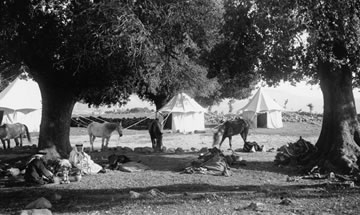
In 1895, 1897, and 1898, Rudolf-Ernst Brünnow, professor of Semitic philology and languages at the University of Heidelberg, and his friend and colleague Alfred von Domaszewski explored the former Roman provinces in the area that today comprises parts of Syria, Jordan, and Lebanon. Brünnow took photographs of Amman, Bosra, Petra, and other sites in the region. One of the most interesting sites explored by this expedition was the palace of Mshatta (“the winter camp” in Arabic) in Jordan, a key monument of early Islamic art in the Levant. Despite the damage inflicted on the building by time and man, and despite the fact that it was never finished, the remains
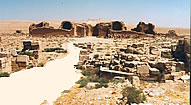 of corner towers and buttresses still convey the impression of a powerful building.
The outstanding feature of the Mshatta palace is the intricately carved decoration on its facade. Sitting on elaborately articulated moldings and framed by a rectangular field 13 feet high, the facade is dominated by a monumental zigzag band enclosing rosettes carved in high relief. During the campaign of 1898 Brünnow visited Mshatta, where he carefully documented and systematically photographed this carved stone facade.
 When the Mshatta palace
was threatened by building activities connected with the nearby railway, German
archaeologists petitioned the imperial court at Berlin to secure the facade
for the newly built Kaiser Friedrich Museum in Berlin. Emperor Wilhelm II intervened,
and the Ottoman sultan Abd l-Hamid II donated the facade to the museum. Today
those facade and wall sections can be seen in the Museum
of Islamic Art in Berlin. When the sections of the facade and walls were
removed in 1903, the base moldings and five of the decorative triangular panels
were left behind. The facade’s last standing remains can still be seen
at Mshatta, but those parts of the carved walls that were not sent to Berlin
have disappeared and must be considered lost. The complete facade, as it was
in the mid-eighth century A.D., exists only in the photographs that were taken
as part of Brünnow’s extensive documentation of the site.
When the Mshatta palace
was threatened by building activities connected with the nearby railway, German
archaeologists petitioned the imperial court at Berlin to secure the facade
for the newly built Kaiser Friedrich Museum in Berlin. Emperor Wilhelm II intervened,
and the Ottoman sultan Abd l-Hamid II donated the facade to the museum. Today
those facade and wall sections can be seen in the Museum
of Islamic Art in Berlin. When the sections of the facade and walls were
removed in 1903, the base moldings and five of the decorative triangular panels
were left behind. The facade’s last standing remains can still be seen
at Mshatta, but those parts of the carved walls that were not sent to Berlin
have disappeared and must be considered lost. The complete facade, as it was
in the mid-eighth century A.D., exists only in the photographs that were taken
as part of Brünnow’s extensive documentation of the site.