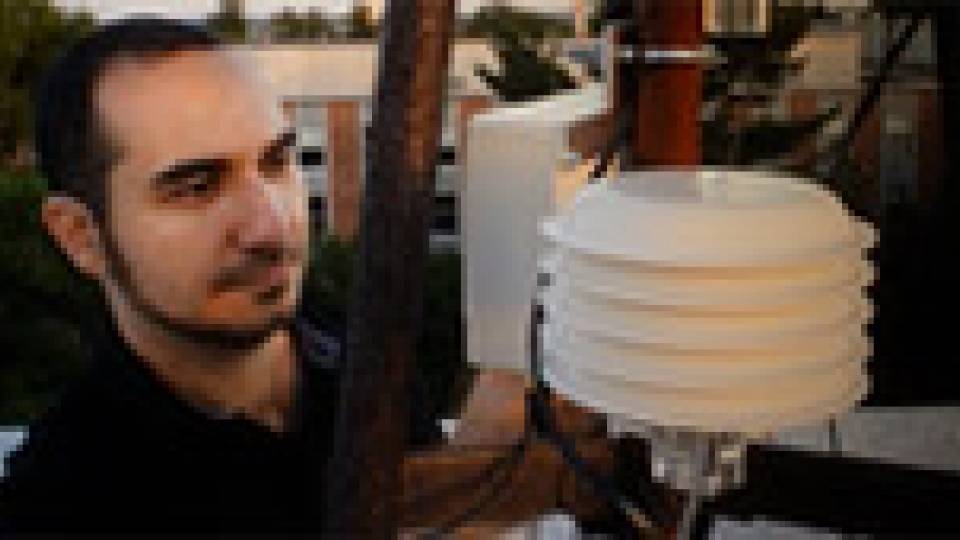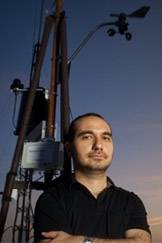
In this short video, Professor Elie Bou-Zeid shows how he is using the Princeton campus as a base to study how local environments affect and are affected by the global climate. Seen here, Bou-Zeid stands in front of a meteorological station that is part of the wireless sensor network deployed across campus to monitor the microclimate of Princeton.
Video stills courtesy of Volker Steger
In mapping the microclimate of Princeton's campus, Elie Bou-Zeid, an assistant professor of civil and environmental engineering, hopes to better understand how local environments affect the global climate -- and vice versa.
In this video excerpt of a full-length video produced by the School of Engineering and Applied Science Bou-Zeid describes his research and his method for collecting data. So far he has placed a dozen sensing nodes across campus to gather data on energy, water and carbon that ultimately will lead to a more complete understanding of how different building materials and vegetation interact with the local climate.
Play the video "Princeton's Microclimate: Global lessons from local buildings".
"Global climate models will tell you what's happening at the very large scale," Bou-Zeid said. "What we try to do is downscale these climate predictions to the local level. So we want to see how a small city will respond to a climate change given by these global climate models."
View real-time data from the sensor network.