


Next: Examples Up: Evaluating Mesh Quality Previous: The Quality Tests
Next: Examples
Up: Evaluating Mesh Quality
Previous: The Quality Tests
The total quality value for an element (`TOTAL') is calculated
by averaging
the contributions from all of the tests that are both applicable
and currently switched on for that element type.
These contributions are normalised between 0 and 1, so that for
each test an ideal element will receive a score of 1, a very bad
element will receive 0 (for example a degenerate element will score 0
for ASPECT),
an element with a value at the criterion (set by the user or default)
will receive a score of 0.5 and elements whose value is twice or more
as far from the ideal, as the criterion is from the ideal,
will receive a score of 0. Values in between these will be interpolated.
These contributions are then averaged using the weights currently
applicable.
The relative importance of a test is dependant on many
factors, like element type, loading, boundary conditions and
the user's personal preferance. Because of this the `average'
may be weighted, in favour of (or against) various test types,
using the UTILITY SETUP QUALITY command.
The overall quality value for an element (TOTAL) is then:
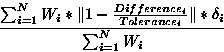
where
| N | is the number of Quality Tests applied | ||
| Differencei | = 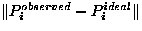 | ||
| Tolerancei | =  | ||
 | = 1 if  and 0 otherwise and 0 otherwise | ||
| Piobserved | is the distortion value calculated for the ith test | ||
| Piideal | is the ideal value for the ith test for that element type | ||
| Wi | is the weight of that test. | ||
If Wi is not explicitly set with the UTILITY SETUP QUALITY command a default value of 1/N will be used, where N is the number of tests applicable to that element type.
The first test to fail is indicated when tabulating or displaying failed elements. The `weight' value is also used to order the application of the tests and so control the layout of information.
Femsys Limited