Princeton summer programs help high school, community college, veteran, transfer and other students to thrive in college and beyond
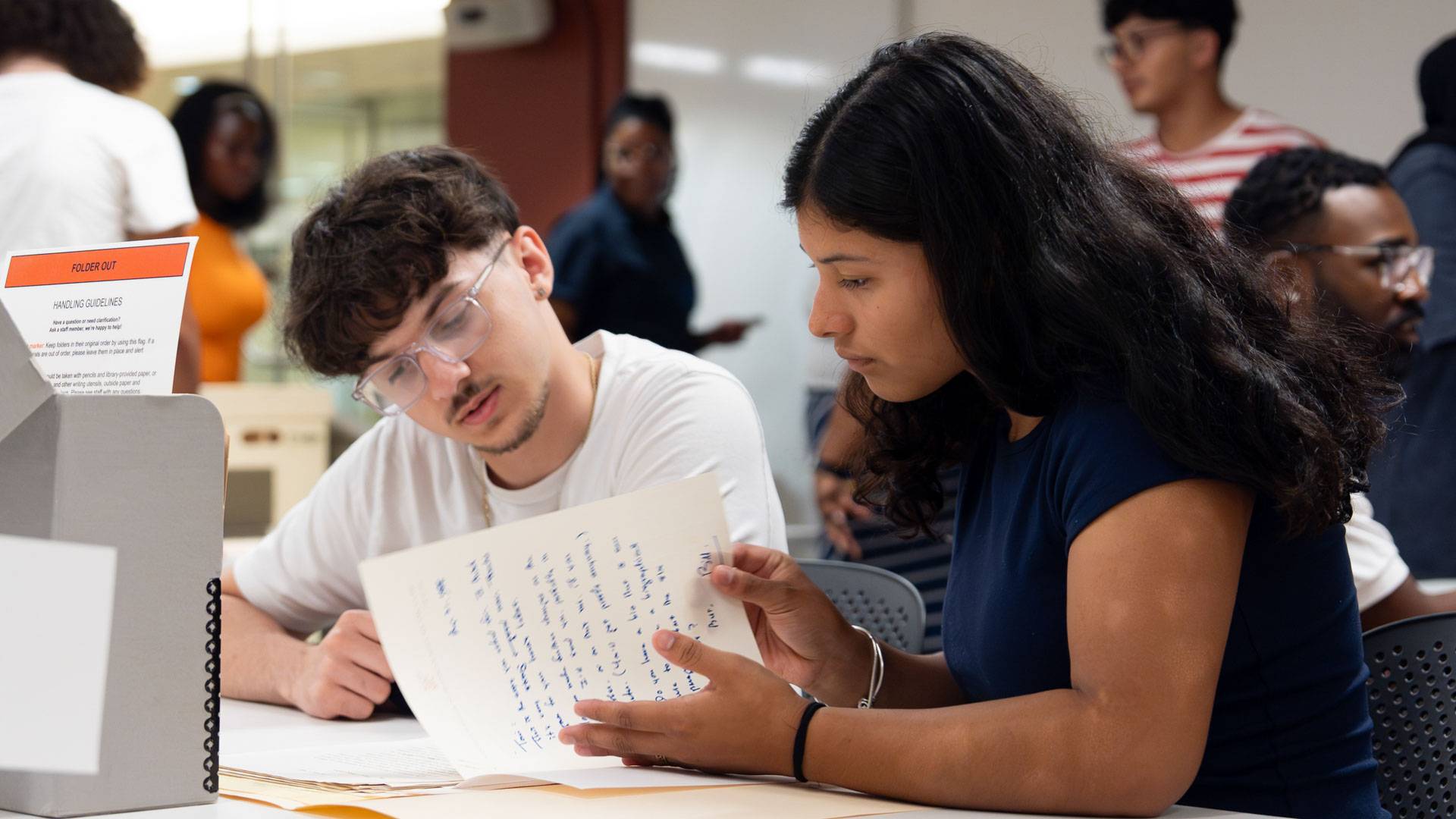
The Emma Bloomberg Center for Access and Opportunity welcomes over 400 students to campus every summer and offers year-round support for students at the University and other schools, including those from first-generation college, lower-income, transfer, veteran and military backgrounds. Lydia’s Scholars Program students like Michael Haws (left) and Anna Molina (right) come from nearby high schools for a snapshot of academic life and coursework taught by Princeton graduate students.
Vincent Zeferino, a first-generation college student from Elizabeth, New Jersey, attended his first college-access summer program on Princeton’s campus last year as a community college student. This summer he returned for a second program at Princeton’s Emma Bloomberg Center for Access and Opportunity (EBCAO) — this time as he transfers from community college to a four-year liberal arts college.
“If you had told me a few years ago when I was in high school that I would spend not one but two summers at Princeton University, I could have never imagined that,” said Zeferino, who graduated from Union College of Union County this spring.
His first Princeton summer was with EBCAO’s Transfer Scholars Initiative, which prepares New Jersey community college students to transfer to selective four-year colleges and universities. This summer, he interned at Princeton University through the center’s Aspiring Scholars and Professionals program before beginning his studies at Williams College in Massachusetts in the fall.
Every summer, EBCAO welcomes over 400 students to campus, from high school sophomores considering their college options to community college and veteran students looking to transfer to a four-year environment and incoming Princeton students eager to begin their journey at the University, according to Khristina Gonzalez, senior associate dean of the college and the Bob Peck ’88 Director of EBCAO.
“Through the support of faculty, staff and near peers, these students gain confidence and skills to apply to and succeed in college,” Gonzalez said.
The Emma Bloomberg Center also offers year-round support for students at the University and other schools, including those from first-generation college, lower-income, transfer, veteran and military backgrounds. Highlights from EBCAO's 2026 summer programs, which welcome talented students from all backgrounds, are below.
Transfer Scholars Initiative
This summer, TSI prepared 48 students from 11 New Jersey community colleges to transfer to selective four-year colleges and universities. Many TSI participants come from first-generation, lower-income, veteran or non-traditional student backgrounds.
“Community college built up my confidence and TSI helped me discover who I can become and where I want to go next,” said Jayed Sourov, a first-generation college student at Atlantic Cape Community College.
During the six-week session, students took a Princeton-accredited writing seminar, attended transfer success workshops on topics ranging from essay writing to applying for financial aid, heard from college admission representatives from across the country and learned about Princeton faculty research at weekly colloquia for EBCAO summer programs. Their first assignment this summer was to write an essay closely examining an artifact on display at the Princeton University Library exhibit, “‘Nursery of Rebellion’: Princeton and the American Revolution.”
“Beyond the pedagogical value, the experience showed community college students how they could take advantage of the resources available on a four-year college campus,” said EBCAO’s Deputy Director Keith Shaw, who leads TSI with Jordan Reed, director of transfer and veteran initiatives, Queenie Reda, associate director of wellbeing and Lane Marsh, alumni associate for transfer and college outreach.
Since 2023, TSI has helped more than 150 community college students from New Jersey successfully transfer to public and private institutions including Cornell, Johns Hopkins, Rutgers, Princeton, Swarthmore, the University of British Columbia, the University of Michigan, the University of Virginia and Williams College.
Jo Aggarwal is one of those alumni, attending TSI last summer and serving as a Writing 100 course fellow this year.
“One of the most helpful realizations TSI brought me was a prioritization of ‘fit’ in the colleges I was interested in,” said Aggarwal, who graduated from Mercer County Community College and starts Duke University this fall. “Beyond looking at what classes and financial aid schools offered, I started to look into cultural and intellectual spaces on campuses that I would enjoy and searched for communities that valued the kinds of life experiences I would bring, especially as a community college student.”
TSI also prepared her for the academic rigor of a highly selective university like Duke.
“It transformed how I think about academia: I stopped seeing myself merely as a passive receiver of knowledge and began to step into the role of a budding thinker and researcher — one with the capacity to contribute new knowledge to scholarly conversations,” Aggarwal said.
Leandro Batista from Union College of Union County had a similar transformation this summer. “Finishing community college and getting into a top four-year school wasn't something many of us thought was possible before,” Batista said.
Following the summer intensive, TSI will continue to support students through the academic year, including a Transfer Application Bootcamp on campus this fall.
“Some of the schools I once believed were out of reach, might actually be attainable,” Batista said.
FSI Residential and Online
The Freshman Scholars Institute introduces incoming students to Princeton’s academic, social and co-curricular life. This summer, 207 incoming first-year students — 78 in FSI Residential and 129 in FSI Online — earned one or two class credits and familiarized themselves with Princeton more broadly before starting the fall semester.
“Through this program, they can determine the best path for achieving their goals and taking their place as leaders here and in the larger world,” said Gonzalez.
At weekly colloquia for FSI students and participants in other EBCAO summer programs, Princeton professors shared insights from their scholarship and their own academic journeys. Speakers included Dean of the College Michael D. Gordin, an expert in the history of science, and Shamus Khan, the Willard Thorp Professor of Sociology and American Studies.
One panel discussion explored what it means to be a scholar in the humanities and social sciences during America’s 250th anniversary, featuring professors Beatrice Adams in history, Agustín Fuentes in anthropology, and Rachael DeLue, Princeton's Christopher Binyon Sarofim ’86 Professor in American Art.
Adams stressed that history is not solely memorization but "about using the past as a lens to think about the present, the future and interpretation.”
“Undergraduate research is an incredible opportunity to actually be part of the discovery,” Fuentes added.
At another colloquium, Andrew Houck, Princeton’s dean of engineering and the Anthony H.P. Lee ’79 P11 P14 Professor of Electrical and Computer Engineering, explained how quantum computers can solve problems that are “impossible” for existing technology in areas like drug discovery, catalysis and more.
Houck, who graduated from Princeton in 2000, said his decision to specialize in quantum computing was shaped by a colloquium much like FSI’s, where he heard a proposal for building a quantum computer.
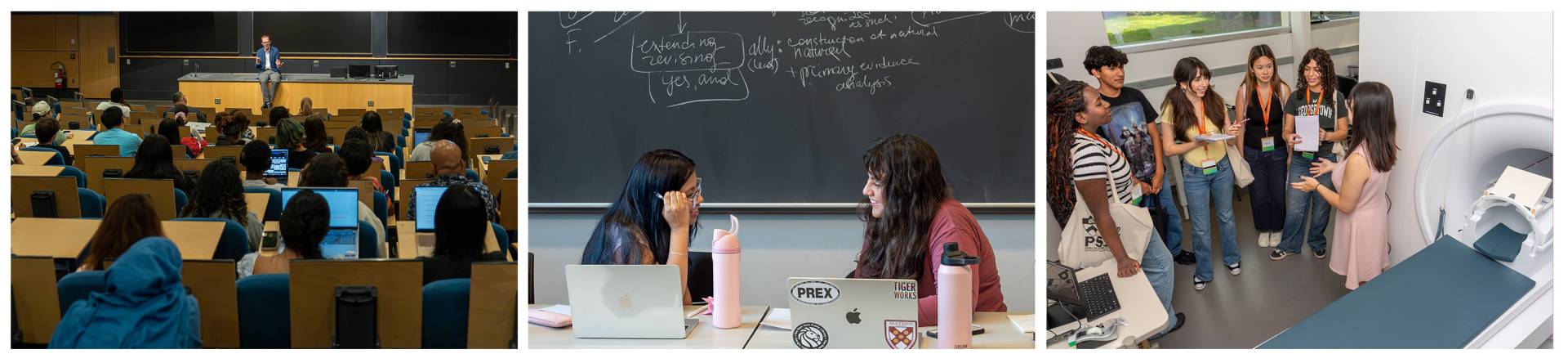
The variety of opportunities open to students in this summer's EBCAO programs included a colloquium on quantum computing led by Dean of the School of Engineering and Applied Science Andrew Houck (left), coursework through the Freshman Scholars Institute (center) and other programs, and a reporting assignment at the Princeton Neuroscience Institute (right) for students in the Princeton Summer Journalism Program, now in its 25th year.
He’d gone in wondering whether to study physics or engineering, and came out with his answer: In quantum science, he could do both. Houck has recently worked with colleagues at Princeton to design a new qubit that moves the field closer to building a practical quantum computer.
All FSI students take the humanities course “Ways of Knowing,” which prepares them for the discussion-based seminars at the heart of a Princeton education.
In one session, Marina Fedosik, a senior lecturer in the Princeton Writing Program, led students in a discussion of an excerpt from Gloria Anzaldúa’s work “Borderlands/La Frontera: The New Mestiza.” Students debated what Anzaldúa meant by her recurring description of a “shadow-beast.” Incoming first-year student Valentina Angon Rojas of Ewing, New Jersey, interpreted it as a manifestation of the author’s rebellion against “the social construct of her culture and traditions.”
FSI Residential students also take a quantitative class related to their academic interests. In “Foundations of Engineering,” incoming first-year student Leila Taylor of Richmond, Virginia, helped create an attachment to keep a drone in the air.
Taylor said FSI has both prepared her for the rigor of Princeton’s curriculum and introduced her to the University’s campuswide network of support. "As long as you're learning and doing your best, there are so many resources to help you," she said.
Aspiring Scholars and Professionals
This year, Aspiring Scholars and Professionals (ASAP) paired 11 undergraduates from local colleges and universities with Princeton faculty and staff mentors to introduce them to careers in higher education through professional development and research internships.
Paryn Wallace, the University’s associate director of Science Outreach, mentored Mariela Flores from Middlesex College, who wrote articles for the Science Outreach newsletter, helped develop a Top 100 STEM Careers guide for K-12 students and moderated a panel discussion with Princeton undergraduates majoring in STEM fields.
Flores said she is now considering a career focused on addressing gaps in STEM education, particularly for first-generation college students like herself. Wallace, a longtime ASAP mentor, said interns like Flores bring fresh perspectives to help the Office of Science Outreach refine its programs “and how we connect with students, schools and community partners.”
This summer marked five years of the program, with a total of 91 undergraduate interns from community, public and private colleges and universities in New Jersey, New York and Massachusetts across six cohorts.
Since its inception, ASAP has collaborated with the Princeton Prison Teaching Initiative (PTI) and this summer supported three former PTI students now pursuing bachelor’s degrees at Rutgers University’s Newark and Camden campuses, including two interns who helped redesign curricula around “The Iliad” and “The Odyssey” with Professor of Classics and Comparative Literature Joshua Billings and Jacob Neis, Ph.D. candidate in classics.
In addition to working directly with the mentors, ASAP interns participated in twice-weekly workshops on topics such as interpersonal communication, time management, conducting archival research and research interviewing methods. Each Friday, they participated in co-working sessions followed by community outings to places like the Princeton University Art Museum and Princeton Garden Theatre. After the summer, ASAP students and mentors have the option to continue working together remotely during the academic year.
Carolina Pinheiro, a senior sociology major at Rutgers University-Newark, said her internship with the Office of the Vice Provost for Institutional Equity and Diversity was an eye-opening experience. “I learned so much — like how generous financial aid is at schools like Princeton,” she said. Pinheiro said she’s excited to apply what she learned to her role as a college admission mentor at her alma mater, Science Park High School in Newark.
Union College's Zeferino, who plans to major in history at Williams, was one of three ASAP interns this year who had previously participated in the Transfer Scholars Initiative.
Working with Reed, he completed a study of Princeton alumni veterans from the Revolutionary War era, combing through 18th-century records housed in Special Collections at Princeton University Library.
“Many primary sources were handwritten in 18th-century script and could not be quickly read or searched,” Zeferino said. “My ASAP project helped me build the grit, patience and endurance that researching archival documents often requires.”
Lydia’s Scholars Program
Introduced last year as a new addition to EBCAO’s College Preparation Initiatives unit, the Lydia’s Scholars Program (LSP) brought 16 juniors from nearby Nottingham High School and Hamilton High School West to campus this summer for coursework taught by Princeton graduate students in classics, English and the University Center for Human Values.
The program is a partnership between EBCAO and the Teagle Foundation’s “Knowledge for Freedom” initiative, providing students with a snapshot of academic life at Princeton and beyond, and "a pipeline and one-on-one advice on their college admissions journey,” said Madison Stewart-Aryabaho, lead teaching assistant for the program.
This summer’s LSP scholars read works including Shakespeare's “Othello” and Toni Morrison's "Beloved,” identifying themes in the text and connecting it to work on display at the Princeton University Art Museum. Hannah Dilts, a student at Nottingham High School, said LSP "challenges you to look at things from different views."
In one discussion group, students read Derek Walcott’s poem “Omeros,” progressing from description to analysis to annotation. The class broke down the text line by line and drew parallels to Homer's "Odyssey," which they had read earlier in the week.
For their final project, students wrote an entry-level college essay. “It's teaching us valuable skills,” said Jeremy Solis of Hamilton High School West. “I feel like it's improved my view on college and my work ethic as well.”
Princeton University Preparatory Program
This summer, PUPP’s Summer Institute welcomed 70 rising sophomores, juniors and seniors from local high schools in Trenton, Ewing, Lawrence Township and Hamilton.
The longtime program connects Mercer County students from first-generation and lower-income backgrounds with pathways to higher education through high school and their transition to college.
During the school year, scholars participate in weekly after-school academic enrichment and cultural opportunities. In the summer, they are based on Princeton’s campus, taking classes in art, science, literature, mathematics and more to prepare them for the following academic year.
PUPP “accepted me with open arms,” said Allan Olivares, a sophomore at Nottingham High School.
At the end of the summer, PUPP held its annual research symposium. Students shared original research projects in the natural sciences and the social sciences, with topics ranging from a prototype for bioplastic water bottles to the effects of socioeconomic status on academic success.
Christy Jean, a junior from Nottingham High School, and Alex Jimenez, a junior at Trenton Central High School, both said they valued the deep dive into the methods and resources for scholarly research, which “gave us tips on how to do our paper and find the resources,” Jean said.
Princeton Summer Journalism Program
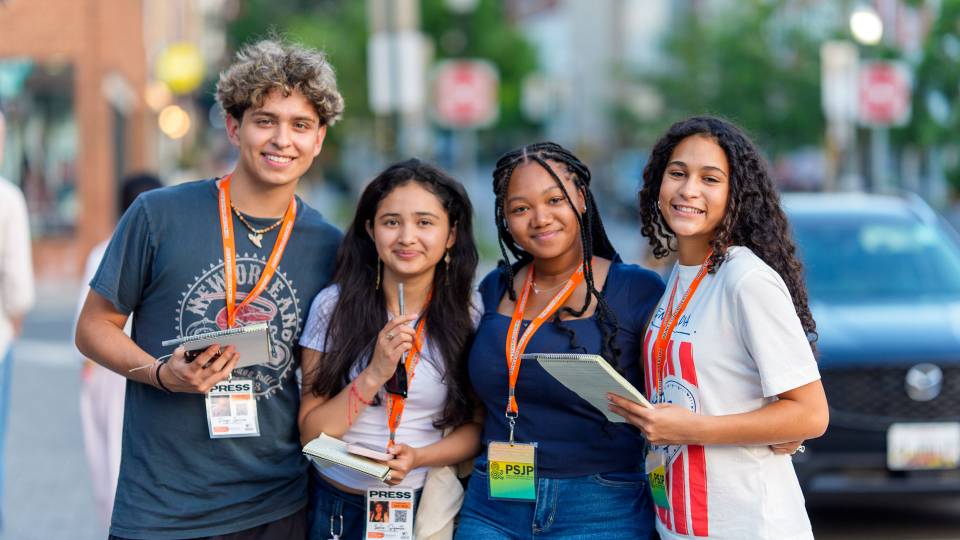
For 25 years, rising high school seniors from across the country have honed their writing, research and critical-thinking skills at the Princeton Summer Journalism Program, which has expanded over the years to support students as they apply to colleges and during their undergraduate studies.
This year’s program brought together 38 high school juniors from 19 states and Washington, D.C. After five weeks of online sessions, including a new college admissions class series, students convened at Princeton for 10 days to attend lectures and workshops with professional journalists and University faculty.
In one lecture, the decorated journalist Deborah Amos, a Ferris Professor of Journalism in Residence at Princeton, spoke about her course “International News: Migration Reporting” and her own experience in the field, along with broader issues including freedom of the press and the need for informed citizens to vary their media diet. “Don't count on social media to learn the news,” she told the PSJP students. “Vary your inputs.”
During a feature reporting assignment at the Princeton Neuroscience Institute, a group of students toured the Princeton Social Neuroscience Lab, run by Professor of Psychology Diana Tamir, and interviewed research specialist Amy Nguyen.
The lab uses hyperscanning, a neuroimaging method, to analyze conversations. “We're interested in the ways that people connect with each other socially, and we study that by looking at their brain activity and the types of language that they use,” Nguyen said.
Kaden Leyva from Santa Ana, California, said the visit reinforced his desire to conduct undergraduate research and pursue a pre-med track in college. “It was such a one-of-a-kind experience.”
At the end of their time on campus, the students published their work in the Princeton Summer Journal, reporting on topics ranging from single-issue voting to public transportation.
During PSJP and throughout the following school year, students are paired with mentors who can help them with college essays, scholarship opportunities, financial aid documentation and more.
“It's just really nice to be in a professional environment where I have all these adults around me who are looking out for my best interest, and I have all these colleagues around me who are challenging themselves,” said Mohamed Omer of Cary, North Carolina.
Angie Sepulveda of Los Angeles, California, said she particularly valued the variety of opportunities and speakers offered during the residential experience.
Tieisha Tift, who leads the program in collaboration with deputy director Megan Greenwell, noted that participants in last year's program were accepted to a range of institutions including Yale, Princeton, Harvard and Northwestern University. Past participants have gone on to graduate with degrees in law, political science, education, history, cognitive science and English, along with journalism.