|
About SLIPS
Turbulent drag reduction has been the center of much attention for several decades, but with the possible exceptions of non-Newtonian additives and riblets, all attempts so far have failed to deliver any noticeable effect under realistic flow conditions. Such conditions are highly turbulent, with Reynolds numbers several orders of magnitude higher than those experienced in laboratory studies of drag reduction. It has been proposed that one of the promising methods for drag reduction is that of superhydrophobic surfaces, allowing for entrapment of air, which reduces the effective shear of the surface. Unfortunately, these surfaces are typically plagued with problems, such as limited oleophobicity with high-contact-angle hysteresis, failure under pressure and upon physical damage, inability to self-heal, and high production costs.
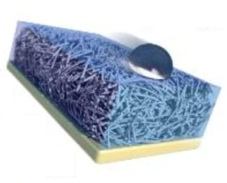
Here we follow a new direction where we explore a new surface technology developed by Aizenberg, Slippery Liquid-Infused Porous Surface (SLIPS), which exhibits negligible contact angle hysteresis when in contact with various polar and non-polar fluids, particularly low-surface-tension liquids and complex mixtures, low sliding angles for drops on the surface, rapid and repeatable self-healing, extreme pressure stability (at least ~675 atm), and optical transparency in the visible and IR. A natural next step for this conceptually new liquid-repellent material is to conduct fundamental studies of the response of SLIPS to flow, especially turbulent flows at high Reynolds numbers.
To achieve this goal, our team will focus on obtaining critical, detailed, basic understanding of SLIPS performance in flow and characterize its fundamental transport properties. This multifaceted, highly interactive, collaborative program will be conducted through six interrelated tasks:
- Materials Design, Manufacture and Characterization;
- Complex Fluids Theory and Simulation;
- Experiments on High Reynolds Number Turbulent Flow over SLIPS;
- Turbulent Conditions for Failure of SLIPS;
- Turbulent Heat Transfer over SLIPS, and
- Direct Numerical Simulation (DNS) of Turbulent Flow over SLIPS
This program is expected to lead to altogether new fundamental insights and potent strategies for developing advanced turbulence-resistant materials for DoD and commercial use.
|
|