~ Handbook: Folio-Quarto-Editions ~
Thirty-six plays appeared in the first collected edition,
put together in 1623  (seven years after his death) by fellow
actors in Shakespeare's acting
company. This book is now usually called the First
Folio: it is a large, impressive book, printed on sheets of
paper folded only once. Its title page calls it Mr
William Shakespeare's Comedies, Histories, and
Tragedies.
(seven years after his death) by fellow
actors in Shakespeare's acting
company. This book is now usually called the First
Folio: it is a large, impressive book, printed on sheets of
paper folded only once. Its title page calls it Mr
William Shakespeare's Comedies, Histories, and
Tragedies.
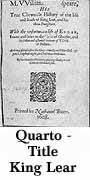
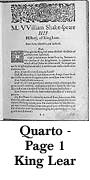
Eighteen of Shakespeare's 37 plays are extant in
single-play editions published during his lifetime. These
early editions are called quartos, because the printer
folded a single sheet of paper into quarters, producing
eight sides to print on; the result was a small, relatively
cheap book. We do not know how the printers obtained the
copy for these quartos. They vary greatly in quality; some
seem to be accurate, others wildly inaccurate. Of the plays
you read in Lit 131, there are quarto editions of A
Midsummer Night's Dream, 1 Henry IV, Henry
V, and King Lear.
Modern printed editions of the plays derive either from
the Folio text, or from quarto and Folio, where both exist.
Where there is both a quarto and a folio text, the modern
editor often has to choose between different readings of a
single word, line, even a whole scene. Sometimes an editor
cannot make sense out of a printed word and supplies his or
her best guess as to what Shakespeare wrote. Most modern
editors add stage directions which
do not appear in the original printed texts, and which do
not accurately reflect what an audience would have seen in
Shakespeare's theater: these
modern additions are placed in square brackets. The editor's
effort is to produce an accurate text; but notice, on the
basis of what you've just read, that these modern texts
involve a certain amount of educated guess-work; and where
there's both Q and F, it isn't always clear which, if
either, should be privileged. Can you spot the first major
difference between the Folio and Quarto Henry V?