 of the experimental-result average
  is to the
expected value E[R] is
through confidence intervals for the mean.
is to the
expected value E[R] is
through confidence intervals for the mean.
Another way to express how close the realization
of the experimental-result average is to the
expected value E[R] is
through confidence intervals for the mean.
Let  denote the probability that the outcome of
lies within a certain interval
centered at the true value:
denote the probability that the outcome of
lies within a certain interval
centered at the true value:
After the experiments have been performed, the value a can be replaced
by a fraction of , the realization of :
Assuming the sample mean
is normally distributed,
eqn. (10) can be written as:
which leads to:
with  - the cumulative standard normal distribution.
Data indicate that various soil properties are, with reasonable
accuracy,
normally distributed [9],
so that the assumption of
normality for their sample average is a fortiori justified.
- the cumulative standard normal distribution.
Data indicate that various soil properties are, with reasonable
accuracy,
normally distributed [9],
so that the assumption of
normality for their sample average is a fortiori justified.
The solution (12) is only valid if the standard deviation
 of the test results is known, which in general is not the
case.
By replacing by its estimate - the sample standard
deviation
of the test results is known, which in general is not the
case.
By replacing by its estimate - the sample standard
deviation  - the expression
 in eqn. (11) is approximated by
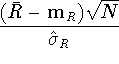 ,
which follows a Student's t distribution
with N-1 degrees of freedom
[5]
Denoting by
,
which follows a Student's t distribution
with N-1 degrees of freedom
[5]
Denoting by  the respective cumulative distribution and
taking advantage of its symmetry, the probability in
(10)
can be evaluated as:
the respective cumulative distribution and
taking advantage of its symmetry, the probability in
(10)
can be evaluated as:
It is important to observe that, if the bias is ignored or negligible,
the reliability of experimental results
very much depends on the number of tests performed:
for a certain series of experiments,
with given and for a given
interval size  , one can increase the level of confidence
(or decrease the expected error
, one can increase the level of confidence
(or decrease the expected error  ) as much as
needed, at the expense of additional tests.
) as much as
needed, at the expense of additional tests.




