 " of the experiment
with the probability
" of the experiment
with the probability  .
In other words,
is the likelihood that the true
value lies within the confidence interval of length 2b,
centered at the predicted value p:
.
In other words,
is the likelihood that the true
value lies within the confidence interval of length 2b,
centered at the predicted value p:
A second comparison index is proposed to account for the influence that
the quality of the experimental results has on the
reliability to be assessed to the
"class A" predictions.
The index is based on the measure of the half length "b" of
the confidence interval centered at the predicted value "p" which
contains the estimated true mean value " " of the experiment
with the probability .
In other words,
is the likelihood that the true
value lies within the confidence interval of length 2b,
centered at the predicted value p:
This "b" index can only be evaluated when more than one experimental result is available for comparisons with "class A" predictions. The methodology is briefly described in the followings.
Before a series of N experiments are performed, their results
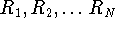 are random variables with expected values
  and standard deviations
  ,
, 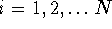 .
The following assumptions are made:
.
The following assumptions are made:
Under the above assumptions, the results  are identically distributed
random variables, i.e.
are identically distributed
random variables, i.e.  , for
all
, for
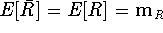
all  (assumption 1), the expected outcome equals the
true value,
(assumption 1), the expected outcome equals the
true value,  (assumption 2), and the average
outcome
(assumption 2), and the average
outcome 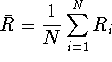 is a normally distributed random variable, even for small N
(assumption 3).
The mean and standard deviation of
is a normally distributed random variable, even for small N
(assumption 3).
The mean and standard deviation of  are
[12]:
are
[12]:
 and
and
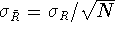 , respectively.
It follows that the random variable:
, respectively.
It follows that the random variable:
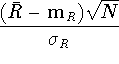 is standard normal.
Since the real standard deviation of the test results is not known,
it is replaced by its estimate - the sample standard
deviation
is standard normal.
Since the real standard deviation of the test results is not known,
it is replaced by its estimate - the sample standard
deviation  , evaluated after the experiments have been
performed.
The new random variable:
, evaluated after the experiments have been
performed.
The new random variable:
can be shown to follow a Student's t distribution with N - 1 degrees
of freedom [12].
Denoting by  the respective cumulative distribution, and
replacing in (5) using (6), one gets:
the respective cumulative distribution, and
replacing in (5) using (6), one gets:
with:
After the experiments have been performed and the results  -
realizations of - are known at every time instant t,
the random variable
in (8) is replaced by its realization
-
realizations of - are known at every time instant t,
the random variable
in (8) is replaced by its realization
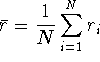 ,
and, given a value for ,
the equation (7) can be numerically solved for
,
and, given a value for ,
the equation (7) can be numerically solved for  .
.
The meaning of the size b of the confidence interval is illustrated
in the above figure.
Before the experiments are performed, the random variable has
the probability distribution function  , shown in
the figure.
If the standard deviation of the test results
, shown in
the figure.
If the standard deviation of the test results  is known,
is derived from the normal distribution, and it comes
from the Student's t distribution if is
approximated by the sample standard deviation .
After the experiments, is replaced by its realization
is known,
is derived from the normal distribution, and it comes
from the Student's t distribution if is
approximated by the sample standard deviation .
After the experiments, is replaced by its realization  ,
but the true value remains unknown.
Under the "random sampling" assumption, the uncertainty in locating
the true value relative to can be expressed
by the same probability distribution function.
Finally, given the predicted value p, the confidence interval
has a size 2b, corresponding to an area which equals the
likelihood (hatched area).
,
but the true value remains unknown.
Under the "random sampling" assumption, the uncertainty in locating
the true value relative to can be expressed
by the same probability distribution function.
Finally, given the predicted value p, the confidence interval
has a size 2b, corresponding to an area which equals the
likelihood (hatched area).
An overall measure of how close the predicted time history is to the
experimental measurements is obtained by averaging the value  ,
computed at every time instant t, over the analysis time interval
,
computed at every time instant t, over the analysis time interval
 .
Finally, to get a nondimensional index, the average value is normalized with
respect to the initial effective vertical stress
.
Finally, to get a nondimensional index, the average value is normalized with
respect to the initial effective vertical stress  :
:
The quantity  , evaluated for a certain value,
will be
refered to as "size of confidence interval".
, evaluated for a certain value,
will be
refered to as "size of confidence interval".




