When a material is to be used for a component, the allowed deformation of that component under the expected load is a design choice. For the tie of length, L, and lateral dimensions, t, subjected to a load, F, the permitted elongation is d.
The elongation is related
to the applied stress through Hooke's law so that:
(F / t2 )
= E (d/ L) , where E is Young's
modulus. Also, the mass of the tie is determined by its density and volume:
M = rLt2.
The material's performance
is measured by the force it can carry per unit mass while not extending
by more than the permitted design elongation.
For this case: (F/M)
= {d / L2 } (E / r).
The first term contains only the design qualities L and d, and
the second term the material parameters.
To select the best
material the quantity (E / r) should be maximized.
All materials having the same value of this quantity are equivalent under this
selection criterion.
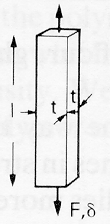
From: Ashby and Jones, "Engineering Materials 1," Pergamon (1986)
| Materials |
| Menu |
| Prev |
| Next |