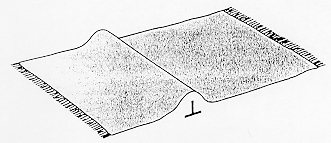
Dislocations are one-dimensional defects that occur in real crystalline solids and control their plastic deformation. The presence of dislocations permits planes to slip "one atomic row at a time" in a manner analagous to moving a rug over a floor by introducing a ruck on one edge, then pushing the ruck to the other edge by which time the carpet will have moved by the width of the ruck. This process may be repeated many times to
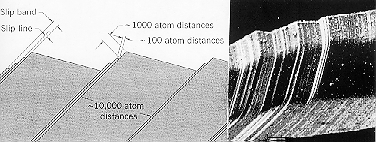
achieve the desired shear displacement between the rug and the floor. For a crystal, the size of the ruck is the distance between the atom planes, about 0.4 nm. The macroscopic shear is produced by the motion of many dislocations newly created by the applied stress. This process will tend to occur on planes for which the resolved shear stress is the largest. The diagram and photograph illustrate this for a Zinc single crystal
From: Guy, "Introduction
to Materials Science,"
McGraw Hill (1972)
| Materials |
| Menu |
| Prev |
| Next |