| |
Human
powered land transportation takes several forms and involves journeys of various
lengths. Pedestrians and Cyclists are the two common groupings. "Pedestrians"
can be expanded to include roller-blades and wheel-chairs, and "Cyclists"
would cover all types of bicycle, tricycle and velomobile. In the urban
setting of a European city such as Copenhagen, the average in-town journey is
of the order of 4.5 km and the journey to or from the suburbs is of the order
of 14 km. In these journeys, cars, busses or trains are the competing transportation
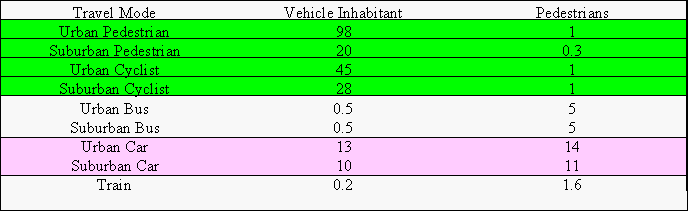
modes. The safety of these modes (in 1993) is shown in the following
table, where the number of deaths per billion kilometers is shown for
both the vehicle inhabitant and pedestrians struck by the vehicle. While vehicle
inhabitant rates are relatively high for both pedestrians and bicycles,
these modes are of little danger to other road users. Automobiles cause much
greater injury rates to others while reducing the vehicle inhabitant rate by
about 30%. Clearly, public transportation is the safest travel mode for the
passengers, but still carries a pedestrian hazard.
|