Two early-career researchers win Burroughs Wellcome Fund Career awards
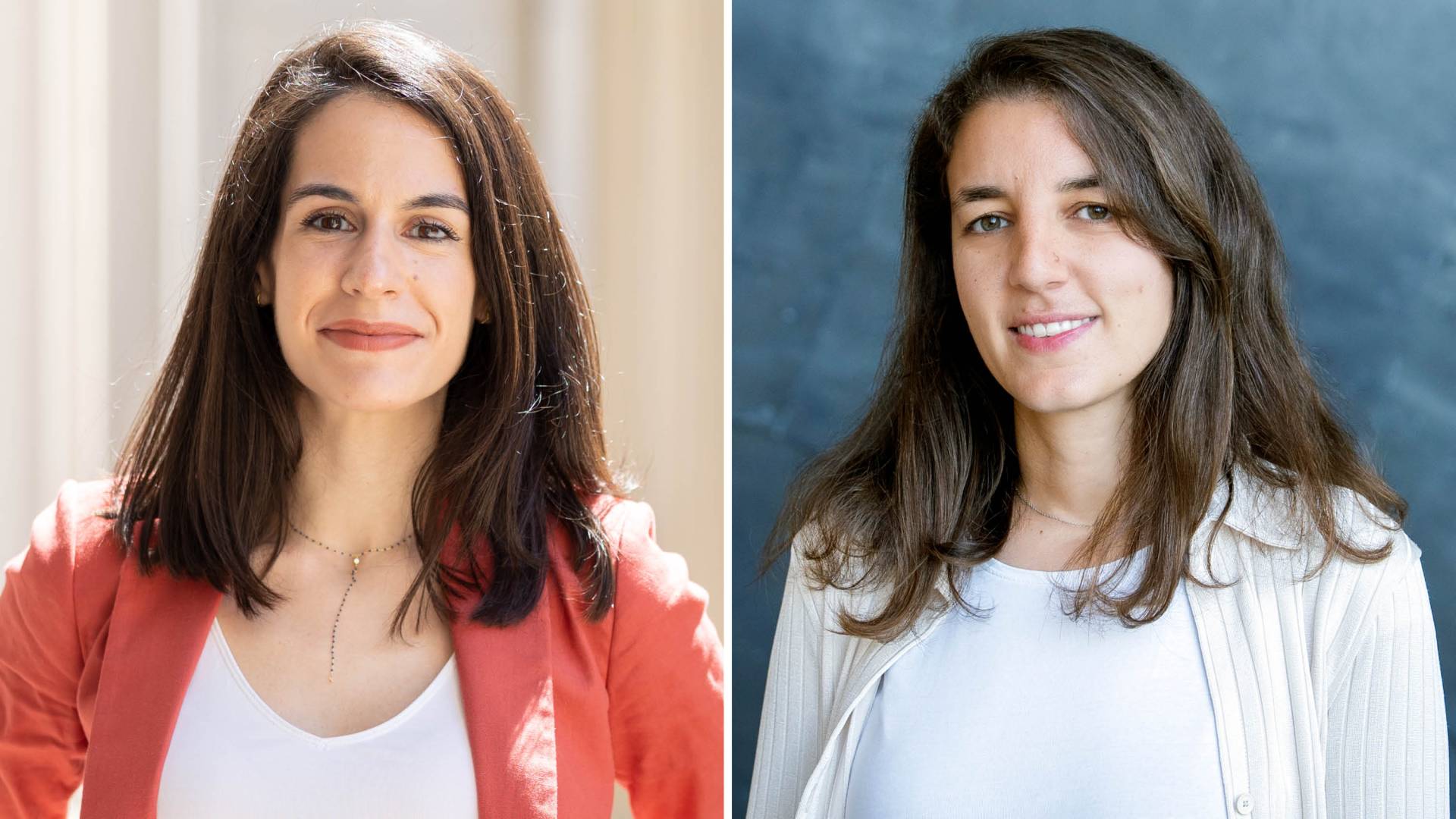
Juncal Arbelaiz (left) and Sarah Cherkaoui
Princeton postdoctoral researchers Juncal Arbelaiz and Sarah Cherkaoui have won prestigious Burroughs Wellcome Fund 2026 Career Awards at the Scientific Interface (CASI), which recognize early-career researchers “whose work bridges the physical, mathematical, computational, and engineering sciences with the biological sciences.”
“The questions at the frontiers of biology increasingly require scientists who can move comfortably across traditional disciplinary boundaries,” said Tammy Collins, program officer at the Burroughs Wellcome Fund, in the CASI award announcement. “These researchers bring extraordinary quantitative and technical expertise to biological problems, but just as importantly, they bring new ways of thinking about those problems.”
Arbelaiz, of the Princeton Neuroscience Institute, and Cherkaoui, of the Lewis-Sigler Institute for Integrative Genomics, are two of the 12 researchers in the 2026 CASI cohort. “The five-year awards are designed to help researchers trained in quantitative disciplines make the critical transition from postdoctoral work to independent careers in the biological sciences,” the award announcement said.
Juncal Arbelaiz: Understanding neural networks
Arbelaiz, a postdoctoral research associate at PNI, is using complex mathematical tools, including control theory, machine learning and mathematical modeling, to create algorithms that can analyze neural systems. The algorithms could potentially be used to identify in real time where and how to stimulate neurons. In the future, such an algorithm could be used to automatically adjust when there is a disruption, much like the cruise control in a car measures the car’s speed and adjusts the power to maintain a certain speed.
The research will focus on the nervous system of the roundworm, C. elegans, a transparent worm that has a neural network that scientists have mapped out in detail. The research could lead to new tools for understanding the relationship between neural systems and behavior and for learning how to potentially adapt that behavior.
“I'm extremely excited about Juncal's selection for the Burroughs Wellcome Fund Career Award,” said Jonathan Pillow, a professor at PNI. “Juncal has a background in control theory, and this award gives her an incredible opportunity to bring a powerful new set of tools to the problem of understanding how neural circuits give rise to complex behavior.”
Arbelaiz is a Schmidt Science Senior Fellow and a C.V. Starr Postdoctoral Fellow who has been at Princeton since 2022. She received seed funding for her research through a 2025 Schmidt Science Fellows Catalyst Grant, awarded jointly to Arbelaiz and her collaborator Harsha Gurnani, a faculty fellow at New York University’s Center for Data Science.
Arbelaiz earned her Ph.D. in applied mathematics at the Massachusetts Institute of Technology and her bachelor’s and master’s degrees in engineering from the University of Navarra's School of Engineering in San Sebastián, Spain. She received the National End-of-Studies Award for Engineering from the government of Spain and was named an MIT 2021 Rising Star in Electrical Engineering and Computer Science.
Sarah Cherkaoui: Exploring the link between lipids and cancer
Cherkaoui is a postdoctoral research fellow who focuses on cancer metabolism. She has worked in Joshua Rabinowitz’s laboratory in the Department of Chemistry since 2025 and is affiliated with the Ludwig Institute for Cancer Research, Princeton Branch.
Cherkaoui plans to develop new analytical and computational tools to study how diet can affect lipids in cell membranes and whether those lipids can affect the body’s defenses against cancer. She will examine specialized regions in the membranes called lipid rafts that can influence how well the immune system recognizes and attacks cancer. If successful, the research could lead to a strategy to use diet to help fight cancer and make existing cancer treatments more effective.
The research builds on Cherkaoui’s recent work. She was first author of a 2025 Nature paper that detailed experiments with mice testing a diet based on metabolism data. The study showed that a diet that eliminates certain amino acids can increase the effectiveness of the drug DFMO. The drug is used to treat high-risk neuroblastoma, which can be one of the most aggressive forms of childhood cancer.
“Sarah is a bold, creative scientist whose work bridges computation, large-scale biochemistry and cancer research,” said Rabinowitz, professor of chemistry and the Lewis-Sigler Institute for Integrative Genomics and director of the Ludwig Institute for Cancer Research, Princeton Branch. “Her prior work led to a highly promising dietary strategy that is entering clinical trials for childhood cancer. Now she is tackling a new question related to diet and cancer: Why does excess fat suppress anticancer immune response? To tackle this massively important question, Sarah has built collaborations with Princeton's Nobel Prize-winning chemist David MacMillan and several other members of the Ludwig Princeton Branch.”
Cherkaoui earned a bachelor’s and a master’s degree in bioinformatics from the University of Montreal and a Ph.D. in systems biology from the Swiss Federal Institute of Technology Zurich (ETH Zurich). She was previously a postdoctoral researcher at the University Children’s Hospital Zurich. She is currently funded by a postdoctoral fellowship from the Swiss National Science Foundation.