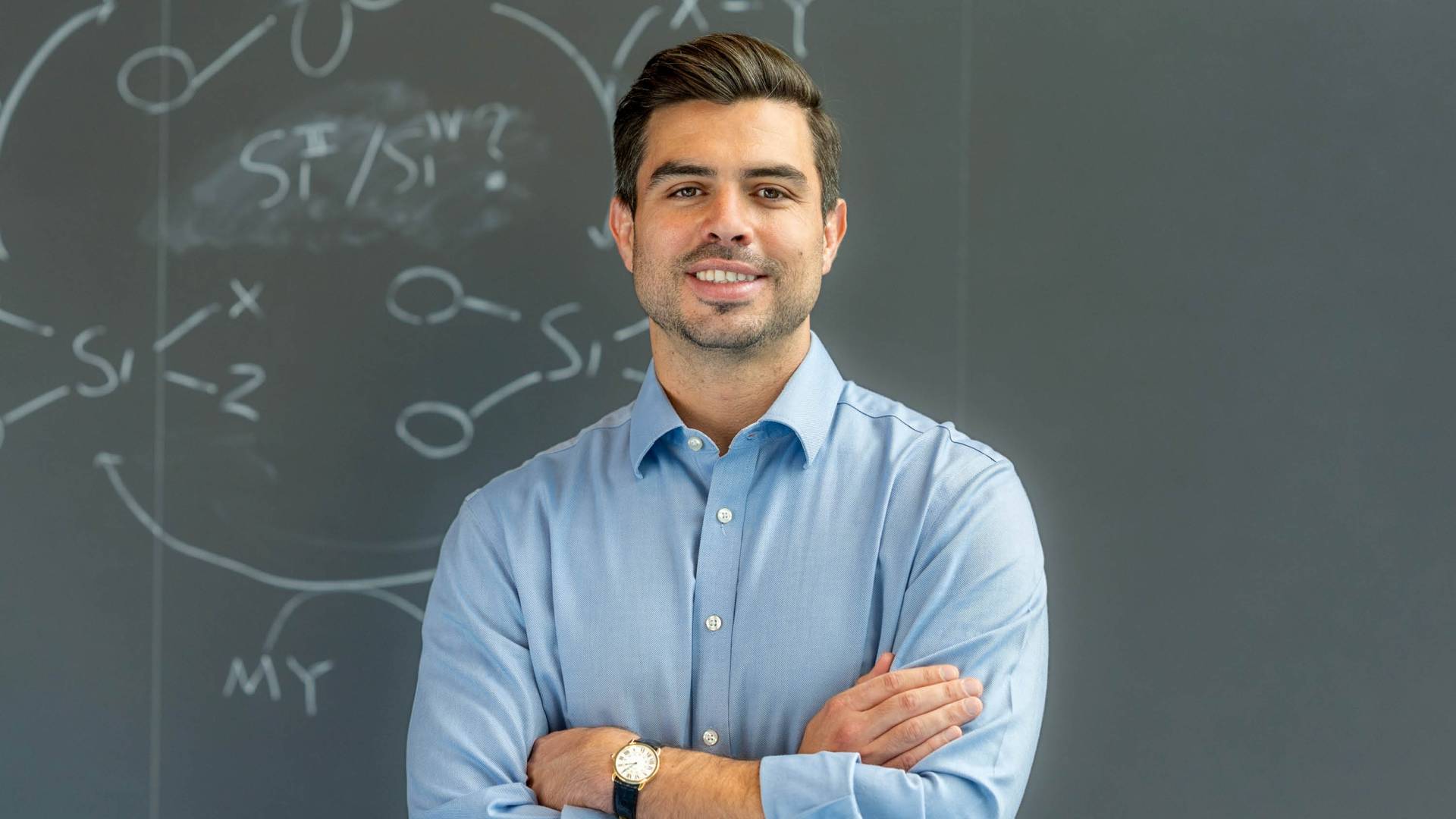
Jose Roque named a 2026 Packard Fellow
Jose Roque
Jose Roque, an assistant professor in the Department of Chemistry, has been awarded a 2026 Packard Fellowship for Science and Engineering by the David and Lucile Packard Foundation.
Roque is one of 20 early-career scientists, mathematicians and engineers in this year's cohort for the prestigious national award, which was announced this morning.
Other 2026 fellows affiliated with Princeton include Yonglong Xie, now at Rice University, who received his Ph.D. in physics here in 2019, and Henri Drake at the University of California-Irvine, who was a NOAA Climate and Global Change Postdoctoral Fellow at Princeton and NOAA’s Geophysical Fluid Dynamics Laboratory from 2021 to 2023 and a research specialist in physical oceanography at the University from 2015 to 2016.
Packard Fellowships are among the nation’s largest nongovernmental fellowships, designed to allow maximum flexibility in the use of funds. Each Packard Fellow receives $985,834 over five years to spend on research as they wish. The fellowships encourage “blue-sky thinking” that could one day foster discoveries to improve people’s lives and generate advancements through science.
“These scientists, engineers, and mathematicians are asking ambitious questions about our bodies, our planet, and the technologies shaping our future,” said Nancy Lindborg, president and CEO of the Packard Foundation.
Roque has been selected for his proposal “Metallomimetic Chemistry: Catalysis with Silicon.” His lab seeks to open the door to more affordable, sustainable catalysis through the use of silicon, bypassing the current reliance on transition metals.
Roque said he got the news about the Packard during a Zoom call arranged by his former postdoctoral mentor and current colleague, Chemistry Department Chair Paul Chirik.
“When I joined the call with Paul, the program manager for the foundation joined too. After a few introductions, she shared the news, and I was completely speechless,” said Roque. “For the first few seconds I genuinely thought I’d misheard her. Then, once it sank in, it took me another few minutes to form a coherent sentence.
“This award is an incredible honor and a huge source of motivation. It means so much to see the Packard Foundation supporting a mission that everyone in our lab feels strongly about,” he said. “Developing catalytic platforms based on silicon, the second-most-abundant element in Earth’s crust, is a huge scientific challenge. This fellowship gives us the opportunity to pursue that high-risk, high-reward research and bring some of our most ambitious ideas to life.
“Above all, this recognition reflects the creativity, dedication and hard work of the students and postdocs in my lab.”
The catalytic process drives most modern manufacturing, but many of these processes still rely on expensive, hard-to-mine transition metals, raising cost, sourcing, toxicity and environmental concerns. The Roque Group aims to harness the silicon found in sand to develop sustainable silicon-based catalysts and materials for applications ranging from the efficient synthesis of next-generation medicines and advanced materials to solar energy conversion and the breakdown of persistent pollutants. To realize this goal, the group is working to fundamentally alter silicon’s properties to achieve the reactivity required for these applications.
“The element in its +4 oxidation state is unreactive and so we need to come up with fundamental strategies in order to change its properties and develop catalysts based on this,” said Roque. “To do so, we draw principles from inorganic chemistry, photochemistry and organic chemistry to manipulate the environment around silicon using ligands that fundamentally change its properties in order to achieve the desired chemical transformation.”
Roque did his undergraduate work at Florida International University in Miami, where he studied reactions with singlet oxygen under adviser Kevin O’Shea. He earned his Ph.D. in chemistry at the University of California-Berkeley, where he was a National Science Foundation Graduate Research Fellow Honorable Mention, and a Reaxys Ph.D. Prize finalist. He also earned a Bristol Myers Squibb Graduate Fellowship in synthetic organic chemistry. In 2020, he took up his postdoctoral fellowship at Princeton Chemistry as a Presidential Postdoctoral scholar.
Roque joined the Department of Chemistry as an assistant professor in 2023.


