Event details
The Politics of the Middle Class: Aristotle and the American Founding
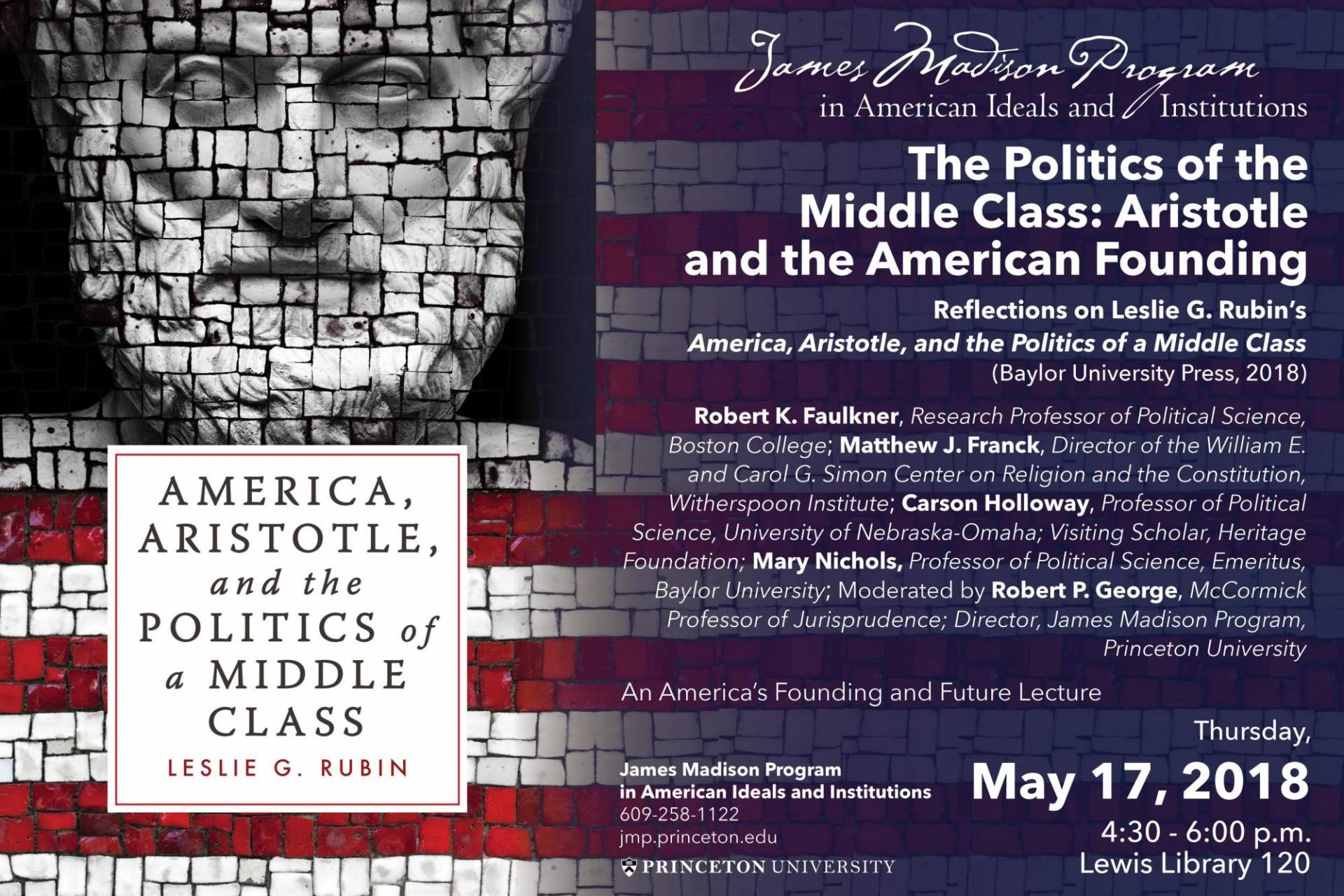
An America’s Founding and Future Lecture
Reflections on Leslie G. Rubin's America, Aristotle, and the Politics of a Middle Class (Baylor University Press, 2018)
The founders of the American regime prided themselves on having a “new science of politics” that would make republicanism a successful form of government for the first time in history. In a groundbreaking new book, political theorist Leslie G. Rubin argues that in certain critical respects the American founders rediscovered key insights of Aristotle about the role of a middle-class citizenry in stabilizing a durable republicanism. Rubin undertakes a fresh examination of Aristotle, reading him as offering the middle-class republic as his true best regime, and of American founders such as Adams and Franklin, in whose thought she finds echoes and evocations of Aristotelian themes. In an age of middle-class fragility, Rubin’s timely book prompts us to think anew about vital questions of American politics.
Robert K. Faulkner is Research Professor of Political Science at Boston College, where for 47 years he taught the history of political philosophy. He grew up outside of Rochester, New York, and taught for a number of years here at Princeton. Faulkner’s most recent book, The Case for Greatness: Honorable Ambition and Its Critics (2007), defends the classical philosophers’ admiration for outstanding virtue against doubters such as Hobbes, Kant, Nietzsche, Rawls, and Arendt. Faulkner is author also of Francis Bacon and the Project of Progress (1993), Richard Hooker and the Politics of a Christian England (1981), and The Jurisprudence of John Marshall (1968). His shorter writings address similar topics, not least Locke’s seminal liberalism. He co-edited John Marshall’s Life of George Washington (2000) and a prescient but much-ignored collection, America at Risk: Threats to Liberal Self-Government in an Age of Uncertainty (2009). Professor Faulkner received his B.A. from Dartmouth College, his M.A. from Oxford University, and his M.A. and Ph.D. from the University of Chicago.
Matthew J. Franck is the Director of the William E. and Carol G. Simon Center on Religion and the Constitution at the Witherspoon Institute. He is Professor Emeritus of Political Science at Radford University, in Radford, Virginia, where he taught constitutional law, American politics, and political philosophy, and was Chairman of the Department of Political Science from 1995 to 2010. He is also Visiting Lecturer in Politics at Princeton University. He was a J. William Fulbright Professor of American Studies at the Graduate School of International Studies, Yonsei University, Seoul, Korea, 1998, and a Visiting Fellow in the James Madison Program in American Ideals and Institutions at Princeton University, 2008-09. Franck earned his B.A. in political science from Virginia Wesleyan College and his M.A. and Ph.D. in political science from Northern Illinois University.
Carson Holloway is Professor of Political Science at the University of Nebraska, Omaha and Visiting Scholar in the Heritage Foundation’s B. Kenneth Simon Center for Principles and Politics. He is co-editor, with Bradford P. Wilson, of the two-volume work The Political Writings of Alexander Hamilton (Cambridge University Press, 2017). He is also the author of Hamilton versus Jefferson in the Washington Administration: Completing the Founding or Betraying the Founding? (Cambridge University Press, 2015). He has been a Visiting Fellow in Princeton University’s James Madison Program in American Ideals and Institutions and a Visiting Fellow in American Political Thought at the Heritage Foundation. His scholarly articles have appeared in the Review of Politics, Interpretation: A Journal of Political Philosophy, and Perspectives on Political Science, and he has written more popular articles for First Things, National Affairs, Public Discourse, National Review, and The Federalist. Professor Holloway received his B.A. from the University of Northern Iowa and his Ph.D. from Northern Illinois University.
Mary P. Nichols served as Professor of Political Science at Baylor University until her retirement in 2017. She has written numerous books and articles on the history of political thought and on politics, literature, and film. Her most recent books are on Greek political theory: Thucydides and the Pursuit of Freedom (Cornell, 2015) and Socrates on Friendship and Community: Reflections on Plato’s Symposium, Phaedrus, and Lysis (Cambridge, 2009). Her contributions to the study of film include work on classic and contemporary American westerns and on directors John Ford, Woody Allen, and Alfred Hitchcock. Professor Nichols received her Ph.D. in political science from the University of Chicago.
University programs and activities are open to all eligible participants without regard to identity or other protected characteristics. Sponsorship of an event does not constitute institutional endorsement of external speakers or views presented.
View physical accessibility information for campus buildings and find accessible routes using the Princeton Campus Map app.