Princeton University

Event details

Apr
10

The Christian Origins of Religious Freedom
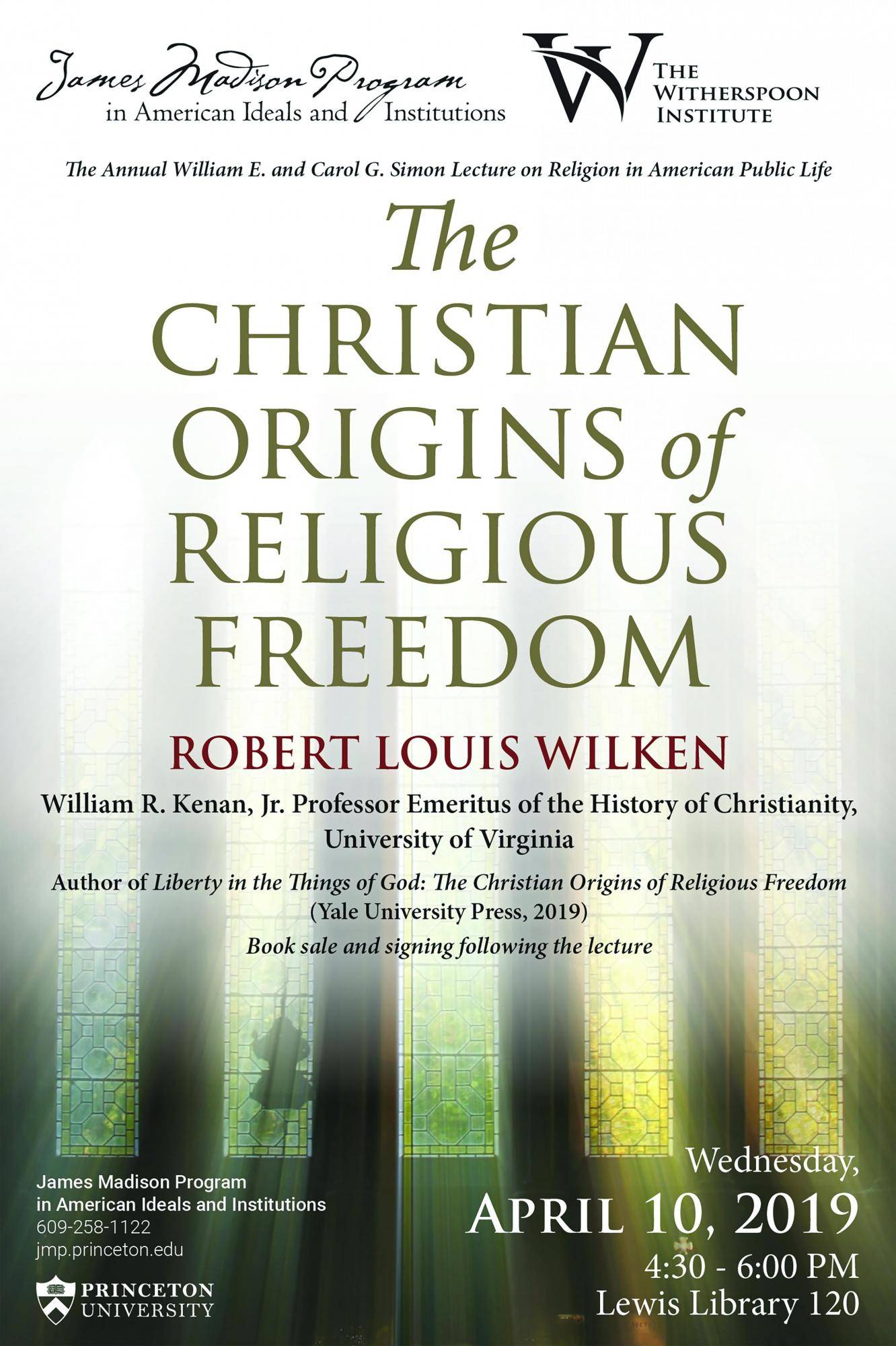
Wilken poster
Share on Facebook Share on Twitter Share on LinkedIn Email Print

The Annual William E. and Carol G. Simon Lecture on Religion in American Public Life

Robert Louis Wilken, William R. Kenan, Jr. Professor of the History of Christianity Emeritus, University of Virginia

Much writing on religious freedom focuses on the sixteenth and seventeenth centuries and on the Enlightenment. But the developments of those centuries are only intelligible when seen in a longer historical perspective. The ideas that undergird religious freedom have their origins centuries earlier in the writings of the church fathers and in medieval thinkers. They did not forge a doctrine of religious freedom, though the term “religious freedom” was first used by Tertullian in the third century, and for centuries their thinking was only a quiet murmur heard by the few. Nevertheless, writings defending the freedom and dignity of human beings from the early centuries were not forgotten and laid a foundation on which later generations could build. As the inheritance of the past was buffeted “by the rough torrent of occasion,” the Reformation of the sixteenth century, a doctrine of religious freedom as a natural right belonging to all human beings took shape. In the seventeenth century, its form can be seen in the writings of Roger Williams, John Owen, the English separatist, William Penn, John Locke, and in the eighteenth century in Philip Furneaux, whose Essay on Toleration was read by James Madison.

Event Details

University programs and activities are open to all eligible participants without regard to identity or other protected characteristics. Sponsorship of an event does not constitute institutional endorsement of external speakers or views presented.

View physical accessibility information for campus buildings and find accessible routes using the Princeton Campus Map app.

Date

April 10, 2019

Time

4:30 p.m.
Princeton University

Main navigation

Meet Princeton
In Service of Humanity
Facts & Figures
History
Honors & Awards
Contact Us
Visit Us
Our Faculty
Our Students
Our Alumni
Our Staff
Our Leadership
Academic Freedom and Free Expression
Strategic Planning Framework
Academics
Studying at Princeton
Library
Areas of Study
Humanities
Social Sciences
Engineering
Natural Sciences
Advising
Academic Calendar
Course Tools
Learning Abroad
Career Development
Continuing Education
Innovative Learning
Research
Engineering & Applied Science
Humanities
Natural Sciences
Social Sciences
Dean for Research Office
Interdisciplinary Approach
External Partnerships
Facilities & Labs
One Community
Lifelong Connections
Student Life
Arts & Culture
Athletics
Living in Princeton, N.J.
Housing & Dining
Activities & Organizations
Cultural & Affinity Groups
Health & Wellness
Religious Life
Serving the Public Good
Families
Admission & Aid
Affordable for All
About Financial Aid
Current Undergraduate Financial Aid
Undergraduate Admission
Graduate Admission
For International Students

The Princeton Campaign
.

The Impact of Audacious Bets

Athletics
.

Go Princeton Tigers

Utility menu

  • News
  • Events
  • Work at Princeton
  • Student Links
  • Alumni
  • Giving
  • Inside Princeton

Contact links

  • Contact Us
  • Accessibility Help
  • Directory

Visiting links

  • Plan a Visit
  • Maps & Shuttles
  • Varsity Athletics
  • Giving to Princeton

Academic links

  • Library
  • Academic Calendar
  • Student Links
  • Faculty & Staff Links

Footer social media

  • Facebook
  • Twitter
  • Instagram
  • Snapchat
  • LinkedIn
  • YouTube
  • Social Media Directory

Diversity and Non-discrimination 

Equal Opportunity and Non-discrimination at Princeton University: Princeton University believes that commitment to equal opportunity for all is favorable to the free and open exchange of ideas, and the University seeks to reach out as widely as possible in order to attract the most qualified individuals as students, faculty, and staff. In applying this policy, the University is committed to nondiscrimination on the basis of personal beliefs or characteristics such as political views, religion, national origin, ancestry, race, color, sex, sexual orientation, gender identity or expression, pregnancy and related conditions, age, marital or domestic partnership status, veteran status, disability and/or other characteristics protected by applicable law in any phase of its education or employment programs or activities. In addition, pursuant to Title IX of the Education Amendments of 1972 and supporting regulations, Princeton does not discriminate on the basis of sex in the education programs or activities that it operates; this extends to admission and employment. Inquiries about the application of Title IX and its supporting regulations may be directed to the University’s Sexual Misconduct/Title IX Coordinator or to the Assistant Secretary for Civil Rights, Office for Civil Rights, U.S. Department of Education. See Princeton’s full Equal Opportunity Policy and Nondiscrimination Statement.

Princeton University
Princeton, NJ 08544
Operator: (609) 258-3000
© 2026 The Trustees of Princeton University

Subfooter links

  • Copyright Infringement
  • Privacy Notice