Princeton University

Event details

Feb
9

Catching Ephemerality: One Decade of Digital Video Activism from Brazil

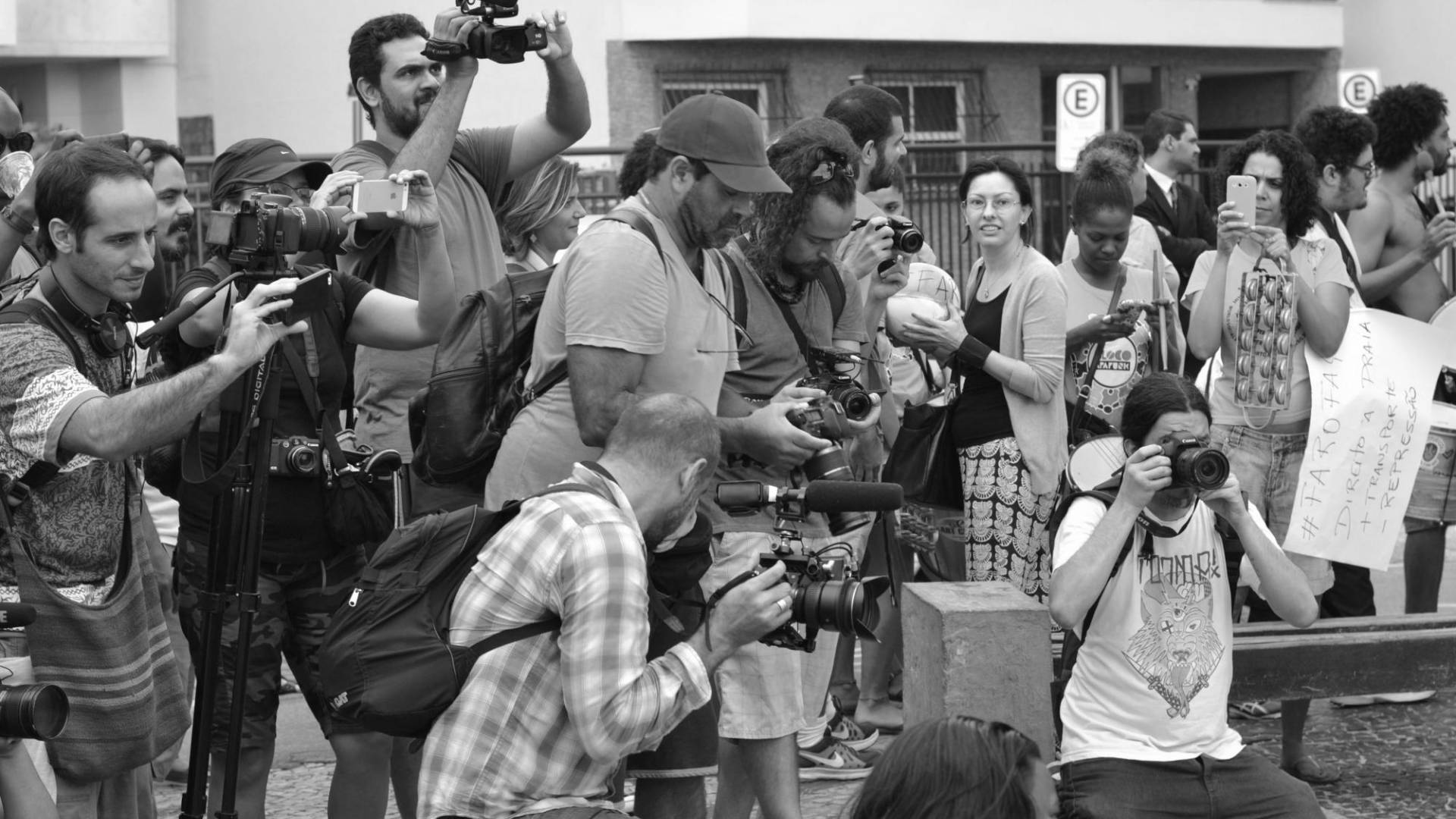
Photo by Jacob Geuder, Video Activists filming a street demonstration in Rio de Janeiro on October 4, 2015
Share on Facebook Share on Twitter Share on LinkedIn Email Print

The ubiquity of smartphones and social media in the early 2010s triggered an explosion of video production worldwide. Videos capturing police violence against protesters taking to the streets as well as smartphone recordings of police killing black teenagers in Rio de Janeiro’s favelas multiplied. The local appropriation of the globalized technologies for video making became the subject of Jacob Geuder's research on video activism, which he studied in Rio de Janeiro, Brazil and Cape Town, South Africa. In his central case, Brazil video activist collectives emerged rapidly during the 2013 protest wave of the Jornadas de Junho, making Rio one of the global hubs for video activism amongst cities such as Cairo, Hong Kong, and Istanbul. Almost ten years after the Jornadas de Junho protests swept over Rio de Janeiro, there are pressing questions that his current project of the Urban Video Archives aims to address in collaboration with academics and activists. Video activism has shifted how marginalized peoples and communities are seen in a media landscape that often renders them invisible. These tectonic shifts have been studied from various angles, including social movements and media studies. However, a number of key questions about the video activist movement remain unanswered: How have digital videos capturing protests and police violence transformed urban politics? How will the expansive growth of video activism and its audiovisual products be preserved for present and future use? How can academic research integrate inclusive, bottom-up digital media to understand the politics of (in)visibility?

ABOUT OUR GUEST SPEAKER:
JACOB GEUDER (Ph.D. University of Basel, Switzerland) works as urban sociologist with a focus on the right to the city, digital media, and social movements. In his PhD, “Visualizing Urban Struggles: Video Activism as Utopian Practice”, he examined video activism as a form of bottom-up city making in Cape Town and Rio de Janeiro. In his comparative, ethnographic study he analyzed the practices of recording videos of protests and police violence through participant observation, audiovisual analysis, and narrative interviews. The research shows how media activists appropriate global technologies in cities in the Global South. Currently, Jacob Geuder is building the Urban Video Archives as a digital platform to preserve, share and prepare grassroots video productions.

MODERATOR:
MARIAN THORPE, PLAS Postdoctoral Fellow


REGISTRATION

This lecture is offered in a hybrid format on Zoom and in-person for Princeton University ID holders only. Registration is required to attend.

Zoom Registration
In-Person Registration (PU ID holders only. Limited space available in 219 Burr Hall)

Masking is required for all in-person attendance in accordance with current University COVID-19 mitigation policies.
Event Details

University programs and activities are open to all eligible participants without regard to identity or other protected characteristics. Sponsorship of an event does not constitute institutional endorsement of external speakers or views presented.

View physical accessibility information for campus buildings and find accessible routes using the Princeton Campus Map app.

Date

February 9, 2022

Time

12:00 p.m.

Location

Hybrid (219 Burr Hall & Zoom)
Princeton University

Main navigation

Meet Princeton
In Service of Humanity
Facts & Figures
History
Honors & Awards
Contact Us
Visit Us
Our Faculty
Our Students
Our Alumni
Our Staff
Our Leadership
Academic Freedom and Free Expression
Strategic Planning Framework
Academics
Studying at Princeton
Library
Areas of Study
Humanities
Social Sciences
Engineering
Natural Sciences
Advising
Academic Calendar
Course Tools
Learning Abroad
Career Development
Continuing Education
Innovative Learning
Research
Engineering & Applied Science
Humanities
Natural Sciences
Social Sciences
Dean for Research Office
Interdisciplinary Approach
External Partnerships
Facilities & Labs
One Community
Lifelong Connections
Student Life
Arts & Culture
Athletics
Living in Princeton, N.J.
Housing & Dining
Activities & Organizations
Cultural & Affinity Groups
Health & Wellness
Religious Life
Serving the Public Good
Families
Admission & Aid
Affordable for All
About Financial Aid
Current Undergraduate Financial Aid
Undergraduate Admission
Graduate Admission
For International Students

The Princeton Campaign
.

The Impact of Audacious Bets

Athletics
.

Go Princeton Tigers

Utility menu

  • News
  • Events
  • Work at Princeton
  • Student Links
  • Alumni
  • Giving
  • Inside Princeton

Contact links

  • Contact Us
  • Accessibility Help
  • Directory

Visiting links

  • Plan a Visit
  • Maps & Shuttles
  • Varsity Athletics
  • Giving to Princeton

Academic links

  • Library
  • Academic Calendar
  • Student Links
  • Faculty & Staff Links

Footer social media

  • Facebook
  • Twitter
  • Instagram
  • Snapchat
  • LinkedIn
  • YouTube
  • Social Media Directory

Diversity and Non-discrimination 

Equal Opportunity and Non-discrimination at Princeton University: Princeton University believes that commitment to equal opportunity for all is favorable to the free and open exchange of ideas, and the University seeks to reach out as widely as possible in order to attract the most qualified individuals as students, faculty, and staff. In applying this policy, the University is committed to nondiscrimination on the basis of personal beliefs or characteristics such as political views, religion, national origin, ancestry, race, color, sex, sexual orientation, gender identity or expression, pregnancy and related conditions, age, marital or domestic partnership status, veteran status, disability and/or other characteristics protected by applicable law in any phase of its education or employment programs or activities. In addition, pursuant to Title IX of the Education Amendments of 1972 and supporting regulations, Princeton does not discriminate on the basis of sex in the education programs or activities that it operates; this extends to admission and employment. Inquiries about the application of Title IX and its supporting regulations may be directed to the University’s Sexual Misconduct/Title IX Coordinator or to the Assistant Secretary for Civil Rights, Office for Civil Rights, U.S. Department of Education. See Princeton’s full Equal Opportunity Policy and Nondiscrimination Statement.

Princeton University
Princeton, NJ 08544
Operator: (609) 258-3000
© 2026 The Trustees of Princeton University

Subfooter links

  • Copyright Infringement
  • Privacy Notice